BackinFocus: Iterative Design and Validation of a Smart Jacket for Robust Posture Sensing
DOI: https://doi.org/10.1145/3772363.3799182
CHI EA '26: Extended Abstracts of the 2026 CHI Conference on Human Factors in Computing Systems, Barcelona, Spain, April 2026
Prolonged static sitting contributes to musculoskeletal discomfort, yet creating wearable aids that are both accurate and usable in daily life remains a challenge. We present BackinFocus, a smart textile jacket that monitors upper-body posture using six inertial measurement units. This paper details the iterative design of the hardware and machine learning pipeline, positioning it as an intermediate step toward viable, long-term posture support. Across two hardware versions, we demonstrate how a shift to a distributed architecture reduces sensor dropout under physical stress by over 80% and improves a system-usability scale inspired score from 65.3 to 74.6. On a newly recorded, comprehensive dataset from 33 participants, our multilayer perceptron and long short-term memory models classify ten distinct seated postures with over 94% accuracy. Using our findings, we provide actionable learnings for human computer interaction projects creating posture-aware smart clothing.
ACM Reference Format:
Viktor Emil Kalvoda, Josef Pribbernow, Nikolas Rieger, and Thomas Mathias Wolf. 2026. BackinFocus: Iterative Design and Validation of a Smart Jacket for Robust Posture Sensing. In Extended Abstracts of the 2026 CHI Conference on Human Factors in Computing Systems (CHI EA '26), April 13--17, 2026, Barcelona, Spain. ACM, New York, NY, USA 5 Pages. https://doi.org/10.1145/3772363.3799182
1 Introduction
Maintaining healthy posture is a central concern in today's medical landscape and work environment. Lower back pain (LBP), often caused by poor seated posture, is a leading cause of work absence worldwide [11]. Ergonomics research emphasizes that posture should be dynamic, with frequent variation being more beneficial than maintaining a single alignment. We introduce BackinFocus, a smart jacket using inertial measurement units (IMUs) to collect physical data such as acceleration or relative spatial positions, combined with machine learning (ML) to classify postures and provide haptic feedback encouraging dynamic movement.
Camera- or chair-based sensing can permit highly accurate posture identification, but these solutions are location-bound. As an alternative, smart clothing offers mobility and integrates seamlessly into daily routines. However, wearables involve trade-offs between accuracy, comfort, and usability. For ML based approaches, physiological and behavioral differences challenge model generalizability, which we aim to address by utilizing fine-tuning and data augmentation techniques. The BackinFocus system pairs the jacket with a mobile application for posture tracking and haptic feedback. We ask two research questions: can machine learning be used to accurately classify diverse sitting postures across different users based on recorded data, and how can iterative hardware design improve the reliability and wearability of a smart textile for continuous posture monitoring?
2 Related Work
2.1 Human Activity Recognition and Smart Clothing
Human Activity Recognition (HAR) infers activities from sensor data for applications in fitness, rehabilitation, and smart environments [3, 16]. Vision-based methods using cameras or depth sensors [7] face privacy, portability, and computational challenges, while sensor-based approaches offer continuous, unobtrusive monitoring. IMUs are most prevalent due to their compactness and low cost [4, 21].
Research has advanced from smartphone and smartwatch IMUs [26] towards textile-integrated sensors with improved comfort and multi-sensor integration [17, 30]. Notable work includes the Loose Inertial Poser for real-time posture estimation using 4 jacket-mounted IMUs [32], and clothing-mounted IMU systems achieving higher accuracy than rigid-attached sensors [24]. Challenges remain in sensor calibration, durability, and sensor accuracy during daily wear.
Bibliometric analysis of 2014-2023 suggests that there is few research on wearable health devices from the perspective of user experience and usability [12]. A prior review on HAR for sitting posture specifically [15] highlights that sensing modalities involve trade-offs in privacy, comfort, and usability, tailored to environments, while feedback effects are mostly studied short-term with limited UX consideration.
2.2 Deep Learning for Wearable Human Activity Recognition
While early HAR relied on handcrafted features [2, 29], deep learning transformed the field through automatic feature extraction, progressing from MLPs [19] to CNNs for spatial dependencies [8, 31], LSTMs for temporal modeling [22], and hybrid CNN-LSTM architectures [9, 20]. Transfer learning addresses cross-user generalization challenges [6] through fine-tuning pretrained models [1, 23] and domain adaptation [10, 18]. Data augmentation offers solutions to limited training data [13], a common constraint when collecting large-scale HAR datasets with specialized hardware.
3 System Design
3.1 Hardware & Software
The system comprises six Bosch BNO055 IMUs, an ESP32-C3 microcontroller, and two DC vibration motors powered by a 3.7 V LiPo battery. The IMU sensors are positioned at the sacrum, iliac crests, shoulder blades, and C4 vertebra to monitor spinal and shoulder posture, based on an evaluation of [25]. A mobile application connects via BLE to stream sensor data and perform on-device posture classification using local ML models, tracking sustained static postures and activating vibrotactile feedback when posture isn't changed in a given time frame.
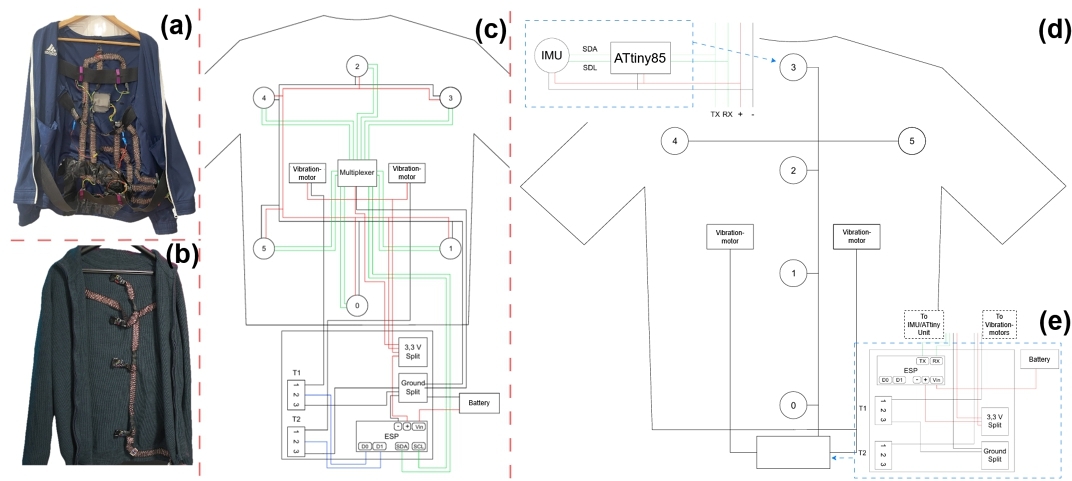
3.1.1 Iteration 1. The initial prototype used a central I2C multiplexer communicating with all IMUs via long, sewn-in conductive bands from Amohr, with elastic straps ensuring sensor-body contact, as visualized in the top and left of Figure 1. This design proved fragile, as physical stress caused intermittent bus faults, leading to simultaneous dropouts from all sensors. The straps were consistently reported as uncomfortable.
3.1.2 Iteration 2. For iteration 2 adopted a distributed architecture where each IMU is paired with a local ATtiny85 microcontroller on a 3D-printed mount, as can be seen in the bottom and right of Figure 1. The ATtiny reads its IMU over a short I2C connection and transmits data to the ESP32-C3 via UART. This decouples sensors, preventing single points of failure. Elastic straps were removed and modules were sewn directly into the lining with conductors routed along seams, improving both comfort and visual unobtrusiveness.
3.2 Data Collection
Each IMU provides quaternions and raw acceleration, gyroscope, magnetometer, linear acceleration, gravity in all three dimensions (x, y, z), with a frequency of 5Hz. The decision for 5Hz was driven by the quasi-static nature of office-based postural shifts and the desire to reduce transmission overhead. Subject height in cm, back length, and back width are recorded. Participants complete a 5-second initialization, then perform ten postures for 15 seconds each on a low-backrest chair, with slight movement encouraged to approximate real-world conditions. We collected data from 33 healthy volunteers (70% male, 30% female, aged 20–24), each completing at two runs; six recorded four additional runs for fine-tuning experiments. Participants where recorded at different locations on the same campus.
4 Posture Classification
4.1 Postures
We classify ten seated postures. Seven are adopted from [28]: Straight Up, Slightly Backwards, Slump, Leaned Right/Left, and Rotated Right/Left. We add Completely Backwards, Completely Forward, and Slightly Forward to increase sagittal plane granularity relevant for desk work.
4.2 Data Augmentation
We address data scarcity using jittering as described in [13]. Jittering adds Gaussian noise $\epsilon \sim \mathcal {N}(0, \sigma ^2)$ to each timestep, with separate σ values per feature type. For quaternions, we compose small random rotations to preserve normalization. Parameters were optimized via leave-one-subject-out (LOSO) training on 33 subjects.
4.3 Machine Learning Model
We trained a two-layer Multi-Layer Perceptron (MLP) and a two-layer Long Short-Term Memory (LSTM) network to classify the ten postures. HAR models often degrade on unseen users due to inter-user variability. To mitigate that problem, we use transfer learning adapting LOSO-pretrained models with limited data.
5 Results
5.1 Evaluation - System Design
We quantified reliability using mean loss rate (MLR, proportion of missing frames), mean time between failures (MTBF, in frames), and mean time to recovery (MTTR, in frames), comparing the jacket at rest versus when worn by a user. A sampling rate of 5 Hz was used for these tests, which is sufficient for quasi-static posture recognition, as postural shifts in office work occur on the order of seconds, not milliseconds [14, 27].
| Iteration | MLR ($\widehat{\lambda }$) | MTTR [Frames] | MTBF [Frames] |
|---|---|---|---|
| Iteration 1 | 0.18 | 125.63 | 713.50 |
| Iteration 2 | 0.03 | 1.03 | 34.26 |
Participants wore each prototype for 20 minutes while performing office tasks, then completed a questionnaire adapted from the System Usability Scale (SUS) [5]. To suit the wearable context, we modified the standard SUS questions to focus on comfort, donning, and unobtrusiveness. Because of these changes, we report a SUS-inspired score, using the standard SUS calculation to generate a 0–100 score for internal comparison, without claiming direct comparability to other SUS studies. The SUS-inspired score (M, SD) increased from the first iteration (65.3, 21.4) to the second iteration (74.6, 10.6) resulting in a more consistent and positive rating.
5.2 Evaluation - Posture Classification
Under LOSO evaluation, the MLP achieved a mean accuracy of 94.7% and a mean F1 score of 94.2% with a five-feature set (quaternions, Euler angles, accelerometer, gyroscope, and magnetometer). The LSTM was similarly strong, achieving a mean accuracy of 93.7% and an F1 score of 93.3%. A significant finding from our feature-set analysis was the performance of compact models. A MLP using only Euler angles and accelerometer data achieved a highly competitive 94.3% accuracy.
The six fine-tuning subjects already achieved strong LOSO baselines, leaving limited room for improvement. With single-quaternion features, target-domain fine-tuning yielded no meaningful gains despite requiring labeled user data. In contrast, source-domain fine-tuning using canonical correlation analysis to identify runs similar to the target user produced small but statistically significant improvements (p = 0.042). A simple physiological proxy (body height) achieved comparable gains without additional data collection, minimizing user effort. These results suggest that pre-calibration via matching users to similar profiles in an existing dataset is feasible, though performance gains remain modest.
Jittering with optimized parameters (σg=2.0, σq=0.15) improved mean model 1 accuracy by 1.28% (92.02% to 93.30%) while reducing variance by 0.71% (4.02% to 3.32%). For outlier subjects, gains reached up to 27% (subject 22: 64.51% → 92.27%). Given jittering's computational simplicity and consistent improvements, it is a useful augmentation strategy for our use case.
6 Discussion
Our iterative development of BackinFocus, coupled with rigorous evaluation, provides promising classification results and design leanings for HCI projects and points towards crucial future research directions.
We showed that machine learning models, combined with reliable IMU sensor data, are capable of classifying diverse seated postures accurately (> $94\%$ accuracy), with fine-tuning and data augmentation enabling further improvements without problematic overhead. The most significant finding is that even small feature sets can be sufficient. This demonstrates that robust, high-accuracy posture classification is achievable with a minimal feature set, suggesting a viable path toward on-device inference on resource-constrained wearable microcontrollers.
During development of our wearable we found that mechanical stress and strain are primary failure modes, not merely edge cases. Future designs should prioritize robustness from the outset, as our findings indicate that our distributed bus architecture, where sensitive communication is localized to short, rigid links, improved data quality thanks to 80% reduction in data loss.
Additionally, removing obtrusive fixation straps improved comfort but reduced vibrotactile efficacy due to diminished body coupling. Solutions include higher-power actuators, alternative modalities (thermal, electrotactile), or positioning feedback at naturally tight-fitting locations (wrists, collars). These trade-offs necessitate empirical validation.
Limitations and Future Work: This work successfully produced a robust hardware platform and validated its posture classification capabilities. However, it is a foundational step, not a solution to induce permanent behavioral change. Our evaluation was conducted in a short-term lab setting. The clear next step is a longitudinal, in-the-wild deployment to study how users adapt to the device. This could also grant insights on the efficacy of different feedback mechanisms.
Our models were trained in a single lab. Future studies must test generalization under varied conditions, potentially requiring online adaptation or a robust domain adaptation strategy.
7 Conclusion
We presented the iterative design and validation of BackinFocus, a smart jacket for posture sensing. By analyzing hardware robustness and wearability as primary research outcomes, we engineered a platform that is both reliable for continuous data collection (over 80% reduction in data loss under physical stress) and usable in short-term task-based contexts. Our LOSO validation demonstrated that this platform provides high-quality data for $> 94\%$ accurate, person-independent classification of ten distinct postures, with even compact feature sets proving highly effective. This work contributes a validated hardware platform, a high-performing classification pipeline, and a set of concrete design lessons to guide the next generation of robust and effective posture-aware smart clothing toward real-world deployment and long-term user benefit.
Acknowledgments
We would like to thank Holly McKee, Dr. Orhan Konak, Prof. Dr. Bert Arnrich, the Connected Healthcare Chair, Holger Rhinow & the HPI Maker Universe, who continuously assisted us. Also part of the project team were Husin Alfil, Gian Ehses, Tyron Franzke, Simon Immelmann, Nicolas Löser, Iuri Silva Santos, Tebbe Ubben and Nils Urban. ChatGPT was used to assist in the creation of software and the polishing of this paper.
References
- Hamza Amrani, Daniela Micucci, and Paolo Napoletano. 2021. Personalized Models in Human Activity Recognition using Deep Learning. In 2020 25th International Conference on Pattern Recognition (ICPR). 9682–9688. https://doi.org/10.1109/ICPR48806.2021.9412140 ISSN: 1051-4651.
- Ferhat Attal, Samer Mohammed, Mariam Dedabrishvili, Faicel Chamroukhi, Latifa Oukhellou, and Yacine Amirat. 2015. Physical human activity recognition using wearable sensors. Sensors 15, 12 (2015), 31314–31338.
- Akin Avci, Stephan Bosch, Mihai Marin-Perianu, Raluca Marin-Perianu, and Paul Havinga. 2010. Activity Recognition Using Inertial Sensing for Healthcare, Wellbeing and Sports Applications: A Survey. In 23th International Conference on Architecture of Computing Systems 2010. 1–10. https://ieeexplore.ieee.org/document/5759000
- Ahmed Ayman, Omneya Attalah, and Heba Shaban. 2020. Smart System for Recognizing Daily Human Activities Based on Wrist IMU Sensors. In 2019 International Conference on Advances in the Emerging Computing Technologies (AECT). 1–6. https://doi.org/10.1109/AECT47998.2020.9194154
- John Brooke. 1996. SUS: A “Quick and Dirty” Usability Scale. In Usability Evaluation in Industry, P. W. Jordan, B. Thomas, B. A. Weerdmeester, and I. L. McClelland (Eds.). Taylor & Francis, London, 189–194.
- Youngjae Chang, Akhil Mathur, Anton Isopoussu, Junehwa Song, and Fahim Kawsar. 2020. A Systematic Study of Unsupervised Domain Adaptation for Robust Human-Activity Recognition. Proc. ACM Interact. Mob. Wearable Ubiquitous Technol. 4, 1 (2020), 39:1–39:30. https://doi.org/10.1145/3380985
- Ong Chin Ann and Bee Lau. 2015. Human activity recognition: A review. https://doi.org/10.1109/ICCSCE.2014.7072750 Journal Abbreviation: Proceedings - 4th IEEE International Conference on Control System, Computing and Engineering, ICCSCE 2014 Pages: 393 Publication Title: Proceedings - 4th IEEE International Conference on Control System, Computing and Engineering, ICCSCE 2014.
- Federico Cruciani, Anastasios Vafeiadis, Chris Nugent, Ian Cleland, Paul McCullagh, Konstantinos Votis, Dimitrios Giakoumis, Dimitrios Tzovaras, Liming Chen, and Raouf Hamzaoui. 2020. Feature learning for Human Activity Recognition using Convolutional Neural Networks: A case study for Inertial Measurement Unit and audio data. CCF Transactions on Pervasive Computing and Interaction 2 (Jan. 2020). https://doi.org/10.1007/s42486-020-00026-2
- Adarsh Dubey and Joseph Zacharias. 2024. IMU Data Based HAR Using Hybrid Model of CNN & Stacked LSTM. In 2024 International Conference on Advancements in Power, Communication and Intelligent Systems (APCI). 1–6. https://doi.org/10.1109/APCI61480.2024.10616429
- Zhongzheng Fu, Xinrun He, Enkai Wang, Jun Huo, Jian Huang, and Dongrui Wu. 2021. Personalized Human Activity Recognition Based on Integrated Wearable Sensor and Transfer Learning. Sensors 21, 3 (Jan. 2021), 885. https://doi.org/10.3390/s21030885 Publisher: Multidisciplinary Digital Publishing Institute.
- D. Hoy, P. Brooks, F. Blyth, and R. Buchbinder. 2010. The Epidemiology of low back pain. Best Practice & Research Clinical Rheumatology 24, 6 (Dec. 2010), 769–781. https://doi.org/10.1016/j.berh.2010.10.002
- Longxue Hu, Yongkang Chen, Enguo Cao, and Weifeng Hu. 2025. User Experience & Usability of Wearable Health Device: A Bibliometric Analysis of 2014–2023. International Journal of Human–Computer Interaction 41, 8 (2025), 5100–5119. arXiv:https://doi.org/10.1080/10447318.2024.2357905 https://doi.org/10.1080/10447318.2024.2357905
- Brian Kenji Iwana and Seiichi Uchida. 2021. An empirical survey of data augmentation for time series classification with neural networks. PLOS ONE 16, 7 (July 2021), e0254841. https://doi.org/10.1371/journal.pone.0254841
- Christian Krauter, Katrin Angerbauer, Aimée Sousa Calepso, Alexander Achberger, Sven Mayer, and Michael Sedlmair. 2024. Sitting Posture Recognition and Feedback: A Literature Review. In Proceedings of the 2024 CHI Conference on Human Factors in Computing Systems (CHI ’24). Association for Computing Machinery, New York, NY, USA, 1–20. https://doi.org/10.1145/3613904.3642657
- Christian Krauter, Katrin Angerbauer, Aimée Sousa Calepso, Alexander Achberger, Sven Mayer, and Michael Sedlmair. 2024. Sitting Posture Recognition and Feedback: A Literature Review. In Proceedings of the 2024 CHI Conference on Human Factors in Computing Systems (Honolulu, HI, USA) (CHI ’24). Association for Computing Machinery, New York, NY, USA, Article 943, 20 pages. https://doi.org/10.1145/3613904.3642657
- Oscar D. Lara and Miguel A. Labrador. 2013. A Survey on Human Activity Recognition using Wearable Sensors. IEEE Communications Surveys & Tutorials 15, 3 (2013), 1192–1209. https://doi.org/10.1109/SURV.2012.110112.00192
- Uwe Maurer, Asim Smailagic, Daniel P. Siewiorek, and Michael Deisher. 2006. Activity Recognition and Monitoring Using Multiple Sensors on Different Body Positions. In Proceedings of the International Workshop on Wearable and Implantable Body Sensor Networks(BSN ’06). IEEE Computer Society, USA, 113–116. https://doi.org/10.1109/BSN.2006.6
- Ala Mhalla and Jean-Marie Favreau. 2024. Domain adaptation framework for personalized human activity recognition models. 83, 25 (2024), 66775–66797. https://doi.org/10.1007/s11042-024-18267-z
- Edmond Mitchell, David Monaghan, and Noel E. O'Connor. 2013. Classification of Sporting Activities Using Smartphone Accelerometers. Sensors 13, 4 (April 2013), 5317–5337. https://doi.org/10.3390/s130405317 Number: 4 Publisher: Multidisciplinary Digital Publishing Institute.
- Francisco Javier Ordóñez and Daniel Roggen. 2016. Deep Convolutional and LSTM Recurrent Neural Networks for Multimodal Wearable Activity Recognition. Sensors 16, 1 (Jan. 2016), 115. https://doi.org/10.3390/s16010115 Number: 1 Publisher: Multidisciplinary Digital Publishing Institute.
- Enrica Papi, Woon Senn Koh, and Alison H. McGregor. 2017. Wearable technology for spine movement assessment: A systematic review. Journal of Biomechanics 64 (Nov. 2017), 186–197. https://doi.org/10.1016/j.jbiomech.2017.09.037
- Mattia Pesenti, Giovanni Invernizzi, Julie Mazzella, Marco Bocciolone, Alessandra Pedrocchi, and Marta Gandolla. 2023. IMU-based human activity recognition and payload classification for low-back exoskeletons. Scientific Reports 13, 1 (Jan. 2023), 1184. https://doi.org/10.1038/s41598-023-28195-x Publisher: Nature Publishing Group.
- Seyed Ali Rokni, Marjan Nourollahi, and Hassan Ghasemzadeh. 2018. Personalized Human Activity Recognition Using Convolutional Neural Networks. https://doi.org/10.48550/arXiv.1801.08252 arXiv:1801.08252 [cs].
- Tianchen Shen, Irene Di Giulio, and Matthew Howard. 2023. A Probabilistic Model of Human Activity Recognition with Loose Clothing. Sensors (Basel, Switzerland) 23, 10 (May 2023), 4669. https://doi.org/10.3390/s23104669
- Lauren Simpson, Monish M. Maharaj, and Ralph J. Mobbs. 2019. The Role of Wearables in Spinal Posture Analysis: A Systematic Review. BMC Musculoskeletal Disorders 20 (2019), 55.
- Marcin Straczkiewicz, Peter James, and Jukka-Pekka Onnela. 2021. A systematic review of smartphone-based human activity recognition methods for health research. NPJ Digital Medicine 4 (Oct. 2021), 148. https://doi.org/10.1038/s41746-021-00514-4
- Hao-Yuan Tang, Shih-Hua Tan, Ting-Yu Su, Chang-Jung Chiang, and Hsiang-Ho Chen. 2021. Upper Body Posture Recognition Using Inertial Sensors and Recurrent Neural Networks. Applied Sciences 11, 24 (2021), 12101. https://doi.org/10.3390/app112412101
- Hao-Yuan Tang, Shih-Hua Tan, Ting-Yu Su, Chang-Jung Chiang, and Hsiang-Ho Chen. 2021. Upper Body Posture Recognition Using Inertial Sensors and Recurrent Neural Networks. Applied Sciences 11, 24 (Jan. 2021), 12101. https://doi.org/10.3390/app112412101 Number: 24 Publisher: Multidisciplinary Digital Publishing Institute.
- Yu-Hsuan Tseng and Chih-Yu Wen. 2023. Hybrid Learning Models for IMU-Based HAR with Feature Analysis and Data Correction. Sensors 23, 18 (Jan. 2023), 7802. https://doi.org/10.3390/s23187802 Publisher: Multidisciplinary Digital Publishing Institute.
- Feng Yu, Ziyi Chen, Minghua Jiang, Zhangyuan Tian, Peng Tao, and Xinrong Hu. 2022. Smart Clothing System With Multiple Sensors Based on Digital Twin Technology. IEEE Internet of Things Journal PP (Jan. 2022), 1–1. https://doi.org/10.1109/JIOT.2022.3224947
- Shibo Zhang, Yaxuan Li, Shen Zhang, Farzad Shahabi, Stephen Xia, Yu Deng, and Nabil Alshurafa. 2022. Deep Learning in Human Activity Recognition with Wearable Sensors: A Review on Advances. Sensors 22, 4 (Jan. 2022), 1476. https://doi.org/10.3390/s22041476 Publisher: Multidisciplinary Digital Publishing Institute.
- Chengxu Zuo, Yiming Wang, Lishuang Zhan, Shihui Guo, Xinyu Yi, Feng Xu, and Yipeng Qin. 2024. Loose Inertial Poser: Motion Capture with IMU-attached Loose-Wear Jacket. In 2024 IEEE/CVF Conference on Computer Vision and Pattern Recognition (CVPR). IEEE, Seattle, WA, USA, 2209–2219. https://doi.org/10.1109/CVPR52733.2024.00215
Footnote
⁎All authors contributed equally to this research.
1trained on gravity and quaternions

This work is licensed under a Creative Commons Attribution 4.0 International License.
CHI EA '26, Barcelona, Spain
© 2026 Copyright held by the owner/author(s).
ACM ISBN 979-8-4007-2281-3/26/04.
DOI: https://doi.org/10.1145/3772363.3799182