Strengthening Cyberinfrastructure Networks: Institutional Representation and Social Network Analysis of “Midwest Research Computing and Data Consortium”
DOI: https://doi.org/10.1145/3708035.3736037
PEARC '25: Practice and Experience in Advanced Research Computing, Columbus, OH, USA, July 2025
The Midwest Research Computing with Data Consortium (MWRCD), funded by the National Science Foundation since 2022, aims to enhance high-performance computing and cyberinfrastructure through inter-institutional collaboration. This study explores institutional representation and collaboration patterns within MWRCD to optimize engagement and sustainability. Using data from the 2024 and 2025 MWRCD Annual Meetings, we analyzed two aspects: (1) institutional categorization based on Carnegie Classification, public/private status, and (2) social network analysis to identify central institutions and collaboration gaps. Findings show that research-intensive (R1) universities, like Indiana University and the University of Michigan, act as key hubs, while institutions, such as Case Western Reserve University and the Ohio Supercomputer Center, connect isolated institutions. Smaller institutions remain on the network's periphery, indicating opportunities for greater connection. The findings provide a data-driven framework to strengthen research computing ecosystems and ensure broad access to CI resources. Recommendations are included.
ACM Reference Format:
Esen Gokpinar Shelton, Laura Pettit, and Winona Snapp-Childs. 2025. Strengthening Cyberinfrastructure Networks: Institutional Representation and Social Network Analysis of “Midwest Research Computing and Data Consortium”. In Practice and Experience in Advanced Research Computing (PEARC '25), July 20--24, 2025, Columbus, OH, USA. ACM, New York, NY, USA 3 Pages. https://doi.org/10.1145/3708035.3736037
1 Introduction
The Midwest Research Computing with Data Consortium (MWRCD) is an NSF-funded initiative designed to enhance research computing, high-performance computing (HPC), and cyberinfrastructure (CI) through inter-institutional collaboration [1]. While the Midwest group has been in existence since 2017, it has undergone a significant review since 2022, following the NSF funding. This review has led to a shift in focus, embracing a new model that prioritizes collaboration and resource-sharing to support large-scale research initiatives and foster innovation in computational research [2]. This model is applied both to the MWRCD organization and its individual participants, ensuring the network operates as a collaborative, inclusive ecosystem [3]. However, to optimize the activities and maximize the impact of MWRCD, it is essential to regularly examine the composition of institutional participation and the structure of professional relationships within the network [4]. Therefore, this study aims to: (1) Analyze "Institutional Representation" to understand engagement patterns.; and (2) Conduct a "Social Network Analysis" (SNA), mapping collaborative ties between institutions to identify central actors, structural gaps, and opportunities for strengthening partnerships.
By applying such analyses, the study provides an empirical foundation for understanding the collaborative landscape within MWRCD and offers actionable insights for enhancing institutional engagement and sustainable interconnectivity. The work contributes to broader discussions on fostering effective research computing ecosystems.
2 Methodology
The study analyzed data from the 2024 and 2025 MWRCD Annual Meetings, where professionals from 20+ institutions participated. Two primary data sources were used:
- Annual Meeting Registration Data: Institutional participation was assessed, categorizing institutions by Carnegie Classification, public/private status, and geographic distribution. This approach allowed us to understand engagement patterns based on institution type and location.
- Social Network Analysis (SNA): Attendees identified their institutional affiliations and reported collaborations within the network using an SNA tool called Net.Create [5]. To capture the nature of relationships, reported collaborations were classified as: (a) Strong Ties (Past 48 Months): Advisor-advisee relationships, co-authorships, joint research projects, co-editing; (b) Medium Ties (Past 24 Months): Event participation, committee membership; (c) Weak Ties: Interest in future collaborations. The categorization was based on social network theory and aligns with NSF's focus on fostering dynamic ecosystems that encourage resource-sharing and innovation.
3 Findings
3.1 Institutional Representation in MWRCD (2024-2025)
MWRCD's institutional membership reflects an evolving ecosystem of research organizations, including major R1 universities, national laboratories, nonprofit cyberinfrastructure providers, and academic institutions. Across both 2024 and 2025, participation has expanded and deepened, underscoring MWRCD's role as a regional convening platform.
In 2024, MWRCD welcomed 83 attendees from 23 institutions, reflecting a broad and diverse network. Research universities, both public and private, made up the majority of participants, highlighting higher education's central role in advancing research computing. Public R1 institutions such as the University of Michigan, Indiana University, and the University of Wisconsin–Madison contributed significantly, supported by strong federal research funding and advanced computational infrastructure. Private R1s like the University of Notre Dame and Northwestern University brought specialized research strengths, further enriching the network. A small number of other academic institutions, including Saint Louis University, extended MWRCD's reach beyond major research centers. Nonprofits like NJ Edge, Inc. and the Ohio Supercomputer Center played a vital role in providing resources and coordination, reinforcing MWRCD's collaborative foundation across sectors.
In 2025, institutional engagement not only sustained its breadth, with 96 attendees from the same number of institutions, but also saw deeper concentration around a few key contributors. R1 institutions continued to dominate, accounting for nearly 90 percent of attendees. Public R1s led participation (60 percent), with private R1s making up the remaining 40 percent, highlighting higher education's continued leadership in research computing. Notably, five institutions accounted for nearly 72 percent of total attendance: Case Western Reserve (31 attendees), Indiana University (17), University of Michigan (9), Ohio Supercomputer Center (7), and Purdue University (6). These organizations emerged as regional collaboration hubs, reinforcing their leadership roles. While participation from master's-level and regional campuses remained modest, their ongoing involvement signals growing interest and opportunity for future engagement. Non-university HPC centers, including OSC and the Minnesota Supercomputing Institute, contributed a total of 8 attendees, reflecting the importance of cross-sector collaboration. This trajectory, 51 attendees from 13 institutions in 2023, rising to 83 from 23 in 2024 and 96 from 23 in 2025, demonstrates steady growth in both size and cohesion.
3.2 Social Network Analysis (SNA) (2024)
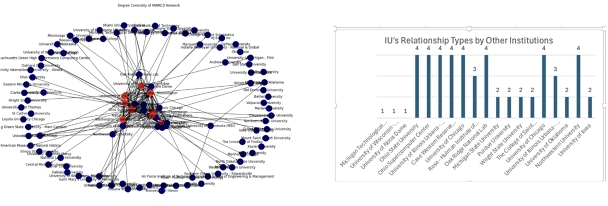
3.2.1 Degree Centrality. Degree Centrality measures institutional engagement based on the number of direct connections. Indiana University, the Ohio Supercomputer Center, and Michigan State University emerged as key hubs, with the highest number of connections (Figure 1). Additionally, Figure 1 further illustrates these relationships, in this case for IU, showing the type of connections with each institution (1: Strong, 2: Medium, 3: Weak, 4: Undefined).
3.2.2 Between Centrality. This metric highlights institutions that act as connectors, facilitating communication and interaction between otherwise loosely linked parts of the network. In MWRCD, institutions such as Indiana University, Case Western Reserve University, and the Ohio Supercomputer Center show high Betweenness Centrality, positioning them as important bridges across different sub-networks. For example, the data suggests that Case Western Reserve University may help connect institutions like the University of Minnesota and the Ohio Supercomputer Center, two nodes that appear less directly connected. By occupying positions on the shortest paths between others, these institutions can play a key role in supporting cross-institutional collaboration and ensuring that information and resources move more effectively throughout the network.
3.2.3 Clustering Coefficient. This measure assesses the tendency of institutions to form tightly-knit groups based on shared collaborations. The analysis revealed that institutions engaged in joint research projects, such as those receiving NSF funding for cyberinfrastructure development, were more likely to cluster together. Notably, R1 institutions formed dense sub-networks, collaborating frequently with national laboratories and nonprofit organizations. However, smaller institutions were positioned at the periphery, indicating opportunities to enhance their integration into the network.
3.2.4 Modularity and Community Detection. Modularity measures the strength of the division within a network into distinct communities. Community detection algorithms (e.g., the Girvan-Newman and Louvain algorithms) help identify these densely connected groups. Five distinct communities emerged, each consisting of 8 to 15 institutions. One example is a community anchored by Purdue University, which is closely connected to 13 other interconnected institutions, forming a dense sub-network. Each community shows similar internal cohesion, suggesting possible shared characteristics, such as common research domains, funding sources, geographic proximity, or histories of collaboration. Further investigation is needed to understand these patterns (See the poster for a visual of the communities).
4 Recommendations and Next Steps
Building on these insights, we've identified several key actions to strengthen and broaden the MWRCD community:
1. Actively Engage Peripheral Institutions: Institutions like IU, the Ohio Supercomputer Center, and Michigan State University continue to serve as central hubs. However, newer and smaller institutions remain on the periphery. To better integrate them, we plan to host targeted events, launch initiatives that pair emerging participants with established members, and provide resources to help them navigate the research computing ecosystem more effectively.
2. Leverage High Betweenness Centrality Institutions for Broader Collaboration: Institutions like Indiana University, Case Western Reserve University, and Ohio Supercomputer Center play a critical role in bridging disconnected parts of the network. These hubs can be leveraged to expand MWRCD's reach, ensuring more cross-institutional collaboration.
3. Strengthen Internal Communities: The analysis identified a large, active community within MWRCD, consisting of 53 institutions. Although only 23 institutions attended the 2024 event, MWRCD should focus on expanding engagement by ensuring more institutions within this community actively participate in future activities.
4. Bridge the Gap Between R1 Institutions and Smaller Partners: The network shows a division between large R1 institutions and smaller organizations. We are committed to closing this gap by elevating the voices of underrepresented institutions, supporting more equitable collaborations, and creating opportunities for nonprofits and smaller partners to play visible and meaningful roles in shared projects.
5 Broader Impacts
The study maps key nodes, collaboration gaps, and peripheral institutions, offering a data-driven framework for inclusive research communities. As HTC networks grow, such approach is needed to foster stronger collaborations, ensuring all institutions contribute and benefit.
Acknowledgments
This material is based upon work supported by the National Science Foundation under Grant No. 2227627. Opinions, findings, and conclusions are the authors’ and do not necessarily reflect NSF views.
References
- Midwest Research Computing and Data Consortium. (n.d.). Retrieved from https://midwestresearchcomputing.org/
- Woodley L, Pratt K (2020) The CSCCE Community Participation Model – A framework to describe member engagement and information flow in STEM communities. https://doi.org/10.5281/ZENODO.3997802
- Broadening participation in computing. ICICLE: Intelligent CI with Computational Learning in the Environment (2022). Retrieved from https://icicle.osu.edu/education-and-outreach/broadening-participation-computing
- Ely, T. L., Edwards, K., Hogg Graham, R., and Varda, D. (2020). Using Social Network Analysis to Understand the Perceived Role and Influence of Foundations. The Foundation Review, 12(1). https://doi.org/10.9707/1944-5660.1505
- Net.create: Retrieved from: https://netcreate.org/
Footnote
National Science Foundation 2227627
Permission to make digital or hard copies of part or all of this work for personal or classroom use is granted without fee provided that copies are not made or distributed for profit or commercial advantage and that copies bear this notice and the full citation on the first page. Copyrights for third-party components of this work must be honored. For all other uses, contact the owner/author(s).
PEARC '25, Columbus, OH, USA
© 2025 Copyright held by the owner/author(s).
ACM ISBN 979-8-4007-1398-9/25/07.
DOI: https://doi.org/10.1145/3708035.3736037