A New Beginning of Rational Design in the Age of Large Language Models of Synthetic Biology
DOI: https://doi.org/10.1145/3809986.3810000
BIC 2026: 2026 6th International Conference on Bioinformatics and Intelligent Computing, Dongguan, China, March 2026
Synthetic biology aims to design predictable functional modules by integrating high-dimensional multi-omics data with large-scale computational models. However, the inherent complexity of biological regulation and cellular stochasticity continue to challenge traditional engineering principles. This review systematically examines the evolution of biological sequence modeling, tracing the trajectory from early convolutional neural networks (CNNs) to contemporary genome-scale foundation models and sub-quadratic architectures. Moving from isolated component optimization to system-level synthesis, we evaluate current progress in generative genetic design and analyze the persistent representation gap arising from unaccounted systemic variables and the non-linear dynamics of cellular environments. Furthermore, we discuss the role of mechanistic interpretability in transitioning from statistical correlation to engineering causality, alongside the emergence of autonomous, closed-loop laboratories. Finally, we address technical safety and sequence authentication, providing a perspective on the realization of programmable biological systems grounded in biological logic.
ACM Reference Format:
Luwei Li, Zimo Wang, Xiangjian He and Chunbo Lou. 2026. A New Beginning of Rational Design in the Age of Large Language Models of Synthetic Biology. In 2026 6th International Conference on Bioinformatics and Intelligent Computing BIC 2026), March 13-15, 2026, Dongguan, China. ACM, New York, NY, USA, 12 Pages. https://doi.org/10.1145/3809986.3810000
1 Introduction
Synthetic biology is fundamentally an engineering discipline that seeks to translate the logic of life into predictable and orthogonal functional modules, following the engineering principle of "understanding by building". Historically, the extraction of biological truth and the elucidation of mechanism historically relied on the intuition and meticulous experimentation of researchers. However, the paradigm of biological discovery is being transformed by high-throughput sequencing and systematic data mining. While the famous CRISPR sequence was first sequenced in 1987 via traditional methods, it was recent large-scale comparative genomics that identified IscB and TnpB as the ancestors of Cas9 and Cas12[1,2]. A prominent example is the discovery of OMEGA (obligate mobile element-guided activity) systems[3,4]. These transposon-encoded, RNA-guided endonucleases represent an extensive functional repertoire within mobile genetic elements. Beyond functional characterization, the modularity of such biological components facilitates advanced engineering, as demonstrated by the development of the DIRECTED platform[5]. By decoupling viral fusogens from targeting moieties, researchers have created modular envelopes for cell-type-specific delivery of genetic cargoes, including Cas9-RNPs, thereby bridging the gap between evolutionary discovery and precision therapeutic application. Beyond systematic sequence analysis, the advancements in Natural Language Processing (NLP) provides a complementary path for functional discovery by utilizing automated information extraction to convert unstructured biomedical literature into structured biological knowledge bases. At the foundational level, pre-trained neural representation models such as BioBERT[6] have significantly improved the accuracy of biological entity recognition and relation extraction. Built upon these capabilities, automated frameworks like DeepDive have enabled the large-scale extraction of gene-disease associations and molecular interactions, which now support the curation pipelines of major biological databases, including STRING, BRENDA and IntAct[7–10]. More recently, this paradigm has evolved from passive knowledge retrieval to active part mining. A notable implementation is the SYMPLEX platform[11], which integrates Large Language Models (LLMs) with weakly supervised learning. By synthesizing evidence-linked functional data from massive corpora, SYMPLEX facilitated the discovery of diverse mRNA capping enzymes with superior activity compared to existing commercial standards. Similarly, the Sidero-Mining pipeline leverages LLMs to automate the extraction of biosynthetic gene clusters (BGCs) from over 10,000 publications[12]. By systematically cataloging 738 unique siderophore BGCs and their substrate specificities, this framework significantly expands the available repertoire of functional modules for metabolic engineering and natural product discovery. This transition from text mining to functional gene mining underscores the power of AI in expanding the genetic part catalog for synthetic biology.
While LLM paradigms enabled the utilization of unannotated sequencing data, their practical engineering utility remained inconsistent. Recent benchmarking studies, such as BEND and comprehensive evaluations in 2025, indicate that early Genomic Foundation Models (GFMs) often struggled to outperform specialized shallow architectures in tasks like gene expression prediction[13,14]. However, newer architectures are addressing these limitations by integrating biological symmetries and long-range dependencies. For instance, Caduceus implements bi-directional blocks to capture long-range DNA interactions while maintaining reverse complementarity equivariance[15]. Simultaneously, models like Evo-2 and HybriDNA have expanded context windows to 1 Mbp, enabling the generation of entire functional genomic systems[16,17]. These advancements mark a shift from simple sequence representation to high-resolution functional design.
The primary challenge has evolved from data scarcity to a deficiency in system-level mechanistic modeling. Current GFMs excel at identifying statistical patterns but often fail to account for the non-linear dynamics of cellular environments. Specifically, these models lack integration of cellular trade-offs and transcriptional/translational resource competition, which govern the actual performance of synthetic circuits[18,19]. Without incorporating these mechanistic constraints, AI-driven designs remain prone to failure under unknown genetic perturbations. Therefore, achieving programmable biological systems requires a transition from statistical pattern matching toward models that integrate causal interpretability and the global coupling of cellular resources, a direction recently formalized in the pursuit of AI-powered virtual cells[20].
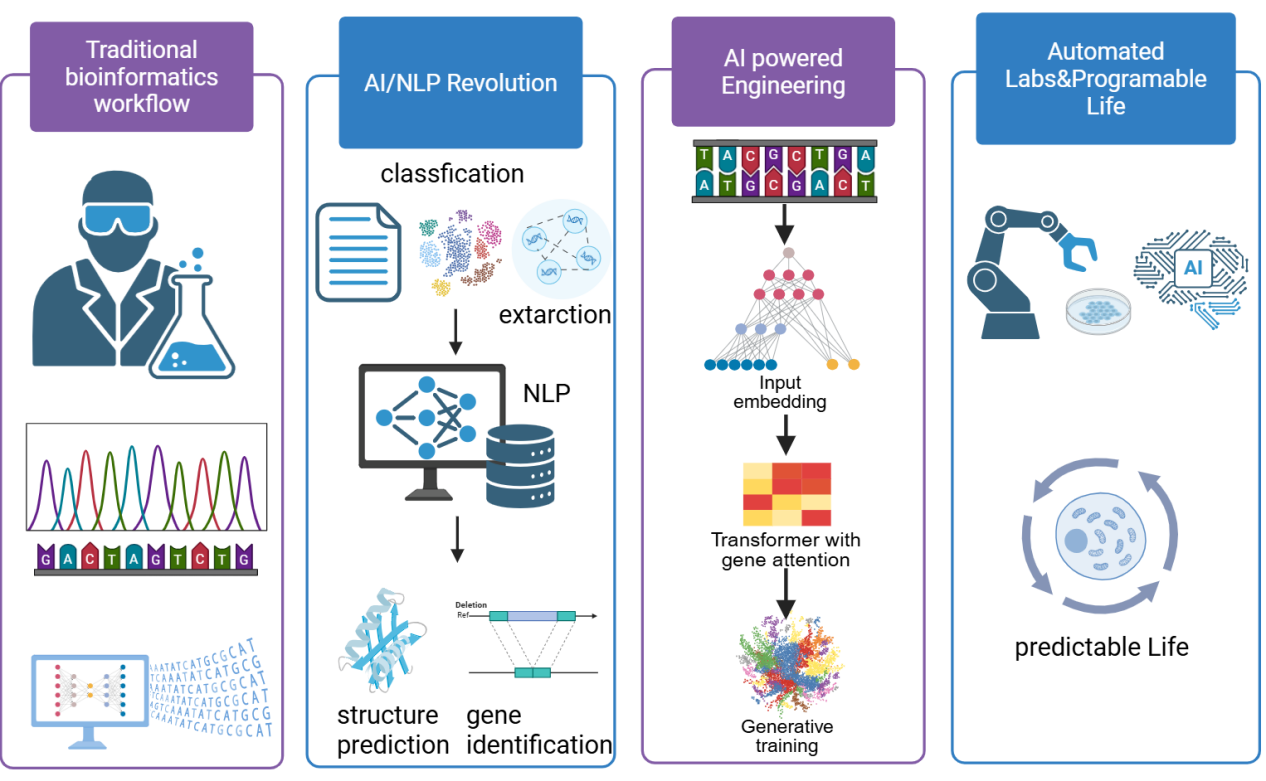
This review examines the evolution of sequence modeling through this lens of engineering efficiency and system-level integration(Figure 1). We first trace the trajectory from local feature extractors to genome-scale models. We then analyze the mismatch between component-level design and the unpredictable behavior of multi-gene circuits. Finally, we discuss strategies for model distillation and mechanistic interpretability, offering a roadmap toward the realization of programmable biological systems that are grounded in biological logic rather than mere statistical pattern matching.
2 The evolution of sequence modeling: from local feature extractors to genome-scale foundation models
Modeling biological sequences requires capturing the underlying syntax that governs cellular functions. Early bioinformatics addressed this by employing statistical frameworks to identify discrete functional elements. Tools such as MEME and MaxEntScan utilized probabilistic models to predict discrete motifs and splice sites[21,22]. However, as the field moved toward large-scale genomic analysis, the focus shifted from these localized statistical methods to deep learning architectures capable of extracting complex, hierarchical features (Figure 2). Deep learning transitioned biological modeling toward automated feature extraction and end-to-end optimization. DeepSEA established this approach by employing a multi-task Convolutional Neural Network (CNN) to predict transcription factor binding and chromatin states directly from raw DNA sequences[23]. This framework was further scaled by Basset, which utilized deeper CNN architectures to learn functional activities across 164 cell types[24]. To address the inherent inability of CNNs to capture distal interactions, DanQ introduced a hybrid architecture coupling a CNN with a Bidirectional Long Short-Term Memory (BLSTM) network, enabling the model to learn long-range dependencies between motifs[25]. Despite these structural improvements, this generation of models remains fundamentally constrained by their inductive biases. The reliance on convolutional layers imposes a strong assumption of spatial locality, forcing the model to prioritize local patterns while struggling to integrate information across the broader regulatory grammar of the genome. While the addition of recurrent units in models like DanQ was intended to bridge these gaps, the sequential nature of RNNs introduces significant computational bottlenecks, as the hidden state must be computed step-by-step, preventing efficient parallelization. Furthermore, standard recurrent architectures often suffer from information decay over extended sequences, making them less effective for capturing distal regulatory interactions compared to contemporary attention-based or selective state-space models. These inherent biases and structural limitations eventually necessitated a transition toward attention-based architectures, which replace rigid locality assumptions with a global receptive field.
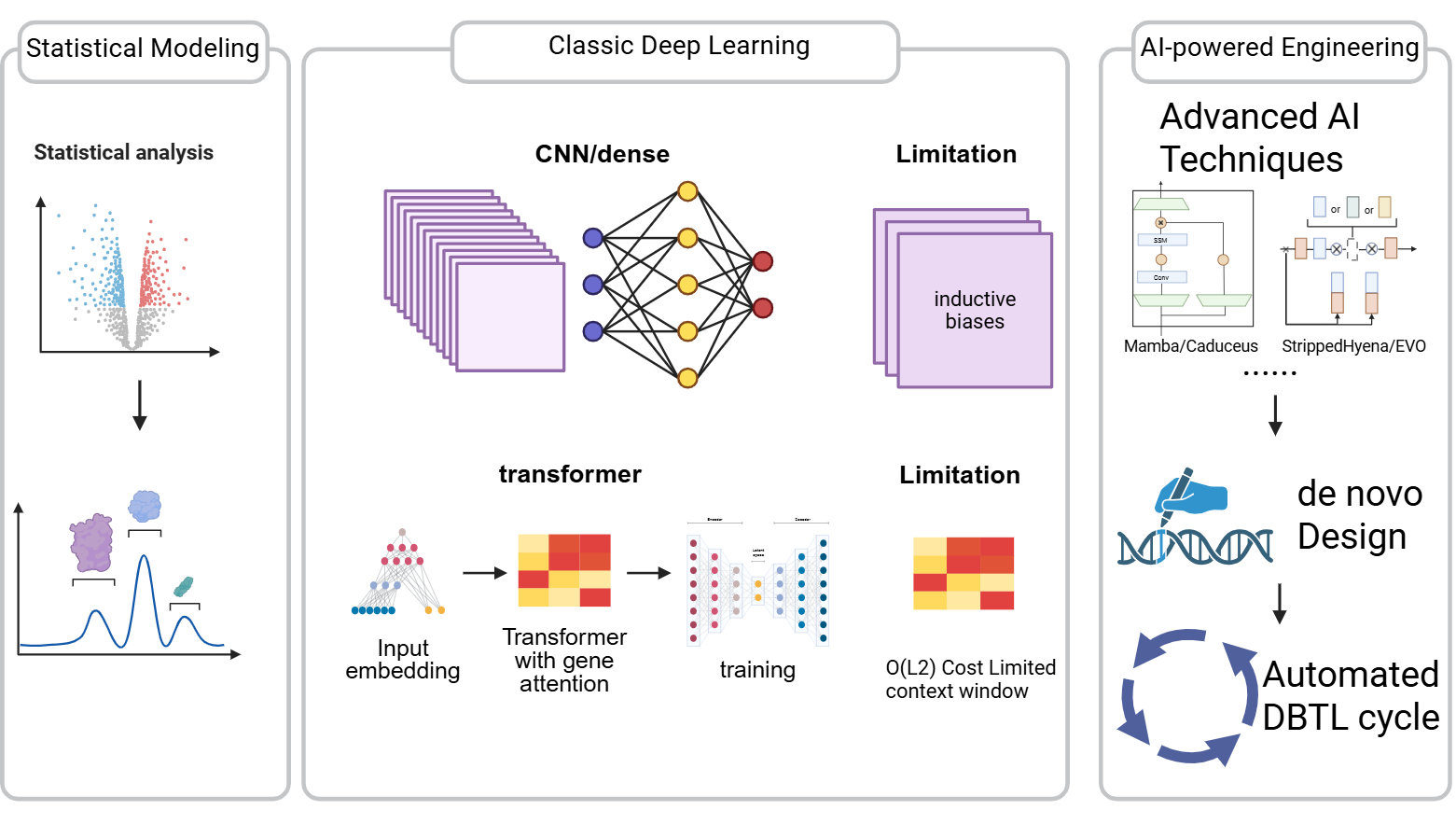
To address the limitations of convolutional and recurrent architectures in capturing global genomic context, the Transformer framework has become the dominant paradigm in biological sequence modeling. Unlike CNNs, which are restricted by a fixed receptive field, Transformers utilize self-attention mechanisms to compute pairwise interactions between all positions in a sequence. A pivotal advancement in this transition was Enformer, which integrated Transformer blocks with dilated convolutions to expand the receptive field to 100 kb[26]. This design significantly improved the prediction of gene expression by recognizing long-range enhancer-promoter interactions. In comparative evaluations, Enformer consistently outperformed earlier convolutional and hybrid architectures on tasks such as gene expression prediction, chromatin accessibility, and transcription factor binding, particularly for distal regulatory effects. Simultaneously, the adoption of Transformers facilitated the utilization of vast unannotated sequencing datasets through self-supervised learning. In this domain, DNABERT pioneered the application of masked language modeling to DNA k-mer tokens, demonstrating that pre-trained Transformers can capture fundamental genomic syntax—such as promoters and splice sites—from the human reference genome alone[27]. This paradigm was further scaled by the Nucleotide Transformer (NT), which integrated information from 3,202 human genomes and 850 diverse species[28]. By increasing parameter capacity and taxonomic diversity, these models provide robust, context-specific representations that significantly improve performance in low-data regimes and variant effect prediction. Despite these advantages, the standard self-attention mechanism remains fundamentally limited by its quadratic computational complexity, O(L2), with respect to sequence length. This quadratic bottleneck makes it computationally prohibitive to model long-form biological sequences at the scale of whole chromosomes.
To overcome the O(L2) complexity bottleneck, several sub-quadratic architectures have been adapted for biological sequence modeling, aiming to achieve linear scaling without sacrificing the ability to capture long-range dependencies. A pivotal development is the Hyena hierarchy, which replaces standard self-attention with a combination of long-filter convolutions and element-wise gating[29]. This signal-processing-inspired approach enables modeling at single-nucleotide resolution with context lengths extending up to 1 million tokens. The Evo foundation model leverages the StripedHyena architecture to capture complex genomic grammars[16,30]. By scaling this architecture to 7 billion parameters, Evo demonstrates the capability to predict gene essentiality and perform zero-shot design of functional biological systems, such as toxin-antitoxin pairs, across diverse taxonomic groups[30]. In parallel, the Mamba architecture introduces a selective scanning mechanism within the State Space Model (SSM) framework, allowing the model to perform content-aware information compression in linear time[31]. Within the biological domain, Caduceus extends this framework by incorporating inductive biases specific to DNA, namely bi-directionality and reverse complementarity (RC) equivariance[15]. By ensuring that the model's representations remain invariant under RC transformations, Caduceus achieves superior performance in variant effect prediction, outperforming significantly larger models that lack these biological symmetries. These advancements, represented by the divergent yet complementary paths of gated convolutions and selective SSMs, signal a transition toward architectures specifically optimized for the structural and computational demands of chromosomal-scale data.
Beyond the pursuit of computational efficiency, recent research has increasingly prioritized the integration of structural and evolutionary priors to refine sequence-based representations. While sequence-only Transformers are effective, they often neglect the topological complexities of biological interactions. GraphormerDTI addresses this by employing a Graph Transformer to model molecular structures, utilizing node spatial encoding to capture structural inductive biases essential for drug-target interaction prediction[32]. Furthermore, to handle the inherent noise in biological data and leverage evolutionary information, the SHS-DFESN-MMC framework incorporates sequence homology scores into a deep fuzzy echo-state network, demonstrating improved robustness in identifying therapeutic peptides compared to standard deep learning architectures[33]. These advancements collectively signal a transition from general-purpose sequence modeling toward architectures that are increasingly informed by the underlying biological and physical constraints.
The scaling of long-context architectures has catalyzed a transition from modeling isolated components to the generative synthesis of entire functional systems. This shift represents a milestone where AI models enable the design of complex, multi-gene interactions necessary for autonomous biological entities. A pivotal advancement is semantic design, where models leverage genomic context to autocomplete functionally linked sequences. Using the Evo foundation model, researchers generated de novo anti-CRISPR proteins and toxin-antitoxin systems that maintained high experimental activity despite having minimal sequence similarity to natural templates[34]. Expanding to engineering-specific contexts, PlasmidGPT achieved the end-to-end design of functional E. coli plasmid backbones by internalizing the structural grammar of origins and selection markers, with all designs validated in vivo[35]. The frontier of this generative capability is the synthesis of viable, whole-genome bacteriophages. By reconciling dense architectures of overlapping ORFs and DNA packaging constraints, Evo produced synthetic ΦX174 genomes that demonstrated fitness and lysis kinetics comparable to, or exceeding, wild-type strains[36]. These advancements signify that modern GFMs have evolved from predictive tools into primary architects, capable of designing complex living systems from the ground up.
The ultimate validation of these generative architectures lies in the establishment of "closed-loop" frameworks, integrating the Design-Build-Test-Learn (DBTL) cycle. By coupling sequence generation with automated synthesis and high-throughput screening, researchers can now provide empirical feedback to refine model parameters. The successful in vivo validation of synthetic plasmids and functional phage genomes demonstrates that modern models can effectively navigate the sequence space to identify viable biological configurations. However, moving beyond the automated identification of functional sequences requires addressing the fundamental gap between statistical prediction and mechanistic realization. The limits of pure sequence-to-function mapping are increasingly evident in large-scale cellular modeling, a tension epitomized by the recent debate over the Virtual Cell Challenge[37].
3 From sequence to systems: bridging the gap in cross-scale biological design
Deep learning models have achieved high-fidelity mapping between sequences and single biological functions at the component level, effectively decoupling genetic sequences from their local functional outputs. Recent generative frameworks enable the precise de novo design of modular parts: DNA-Diffusion utilizes denoising diffusion models to generate synthetic regulatory elements with cell-type-specific activity, while GEMORNA employs Transformer-based architectures to optimize full-length mRNA by coordinating CDS and UTR features for enhanced stability[38,39]. Beyond regulatory sequences, Protein Language Models (PLMs) have redefined the scale of functional sequence space exploration. The ESM series illustrates the transition from representation learning to multimodal generation: while ESM-2 (15B parameters) internalized evolutionary information to enable atomic-resolution structure prediction across metagenomic scales, the frontier ESM3 model operates as a multimodal generative engine capable of reasoning across sequence, structure, and function[40,41]. ESM3 demonstrated the ability to simulate 500 million years of evolution by generating a functional fluorescent protein with only 58% sequence identity to known counterparts. Similarly, the ProGen family focuses on controllable and scalable protein synthesis[42–44]. ProGen initially demonstrated that LLMs could generate functional proteins across diverse families using control tags, a capability later expanded by ProGen3, which utilized sparse mixture-of-experts architectures to scale up to 46B parameters. ProGen3 showed that increased model capacity directly translates to a higher success rate in generating viable proteins from distant evolutionary clusters, moving beyond simple sequence imitation toward the internalization of biochemical logic. Holistic structural models like AlphaFold-3 or RoseTTAFold-All-Atom have expanded the design space to complex biomolecular interactions involving ligands and nucleic acids[45,46]. However, a fundamental gap persists between the successful design of isolated parts and the predictable construction of functional systems (Figure 3). When these optimized components are integrated into multi-gene circuits or metabolic pathways, the global behavior of the system is rarely a linear summation of its parts. The CLASSIC platform, which enables the ultra-high-throughput mapping of over 105 genetic circuit configurations, revealed that even within relatively short 6-9 kb constructs, incidental molecular coupling and non-intuitive design rules lead to emergent behaviors that deviate from standard engineering expectations[47]. These challenges are further amplified in heterologous pathways where complex epistasis creates a rugged evolutionary landscape. For instance, despite the use of ML models like ProEnsemble to balance metabolic flux by optimizing individual gene transcriptions, the unpredictable interactions between pathway enzymes often render traditional directed evolution impractical[48]. To address this representation gap, several recent efforts have begun to incorporate higher-order context or mechanistic priors into the modeling of circuits and pathways.Sequence-to-function frameworks such as GEMSTAT and mechanistically constrained neural ODE models attempt to integrate biophysical rate laws or regulatory logic into learning pipelines, while multi-scale platforms combining kinetic modeling with machine learning have shown promise in metabolic pathway optimization. However, these approaches remain limited in scalability and generalization, particularly for large combinatorial design spaces.These findings suggest that the primary bottleneck is a representation gap: while current models are proficient pattern recognizers at the component level, they struggle to capture the mechanistic causality and non-linear dependencies that govern system-level performance. Consequently, circuit and pathway design remains largely empirical, underscoring the urgent need for hybrid modeling approaches that integrate physical constraints with statistical learning to navigate these high-order biological interactions.
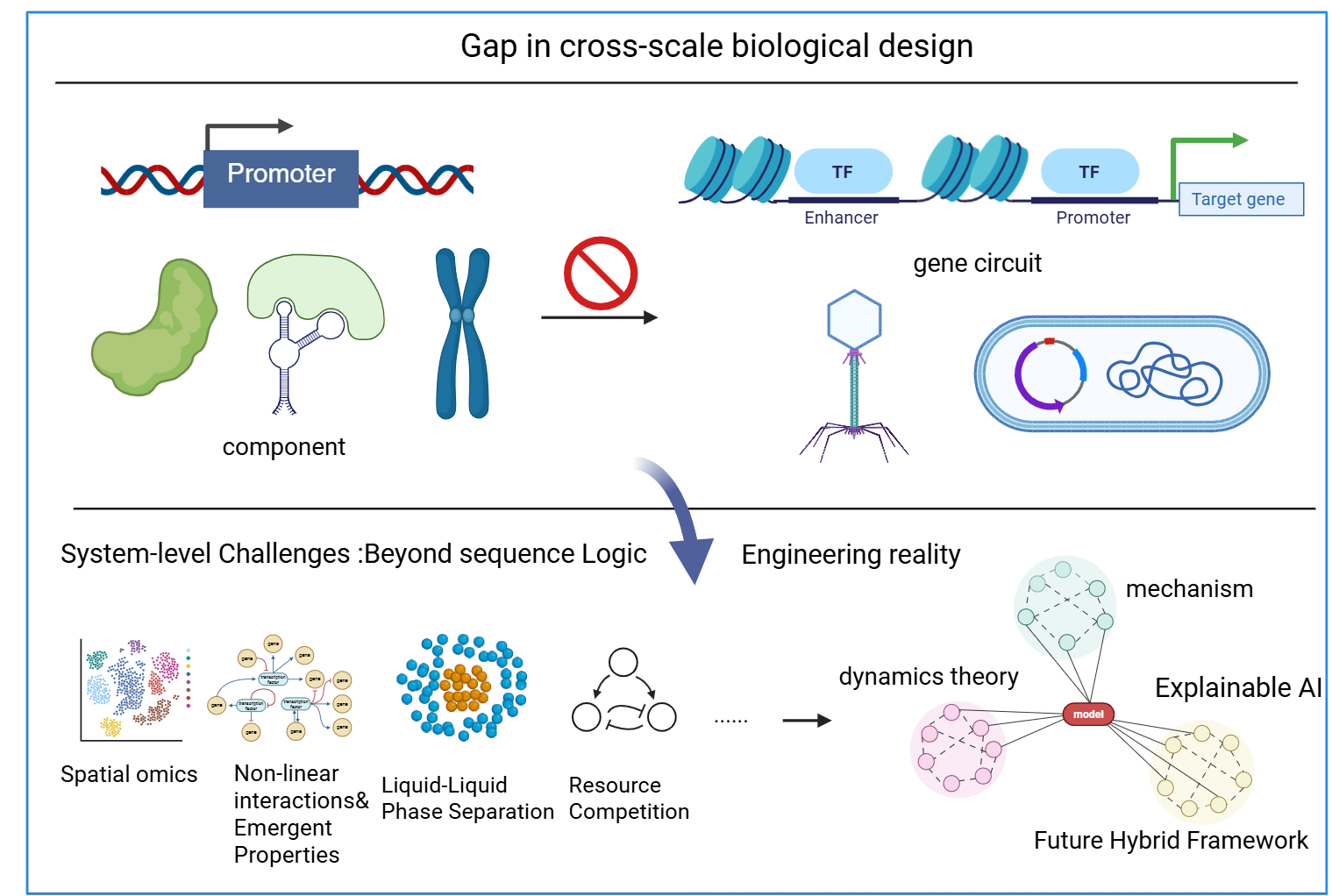
To mitigate the discrepancies in cross-scale integration, computer vision (CV) and spatial omics provide a critical phenotypic feedback loop. Unlike sequence-based predictions, image-based machine learning strategies utilizing live-cell bright-field imaging enable real-time recognition of cellular states and dynamic correction of differentiation trajectories[49]. This suggests that the representation gap mentioned earlier is not merely a lack of sequence data, but a failure to capture the morphological latent space where systemic stress and metabolic load first manifest. The expansion from single-cell observation to multicellular assembly further necessitates a spatial dimension of feedback. When synthetic circuits are embedded into complex tissues or organoids, their performance is no longer governed solely by intracellular logic but by their coordinates within the tissue architecture. Deep learning frameworks for spatial transcriptomics, such as DeepST and Bering, provide a robust diagnostic lens to evaluate this spatial robustness[50,51]. By identifying distinct spatial domains and segmenting cells within their native microenvironments, these tools allow researchers to pinpoint where local genetic logic fails to translate into global pattern formation. However, the realization of such a visually-guided paradigm requires more than just analytical algorithms. It demands a physical infrastructure capable of reflexive action. Error-correcting platforms like Puddle represent the necessary bridge between digital logic and physical execution[52]. By coupling CV-derived insights with adaptive microfluidic control, researchers can implement a closed-loop engineering cycle where the system automatically compensates for the stochasticity of living matter. This synergy between computer vision, spatial analysis, and automated hardware facilitates a transition in synthetic biology from open-loop empirical optimization toward a robust, self-correcting engineering framework.
While image-based feedback provides a reactive solution to integration failures, the ultimate goal remains the proactive encoding of these complex dependencies directly into genomic foundations. This is where large-scale generative models like Evo-2 demonstrate the power of scaling laws in synthesizing viable genomic structures, the predictive reliability of these systems remains challenged by the high-dimensional complexity of cellular environments[16]. Current data-centric approaches focus heavily on integrating diverse datasets to identify stable biological markers. For instance, the work of Mitić et al. (2025) underscores the utility of correlation-based feature selection in reconciling single-cell transcriptomics data from multiple, heterogeneous sources[53]. However, such methodologies, while effective for distilling descriptive signatures, inherently prioritize statistical associations over the generative regulatory logic. This reliance on correlation often fails to account for the hidden biophysical constraints that govern actual system performance. One such critical but often overlooked dimension is biological phase separation[54]. The formation of membrane-less organelles through liquid-liquid phase separation (LLPS) provides a spatial organizing principle that operates independently of primary sequence motifs. Without explicit biophysical priors for these non-homogeneous interactions, AI models risk designing components that, while functional in isolation, may fail due to unpredictable aggregation or spatial sequestration in vivo. Furthermore, the operational stability of synthetic circuits is fundamentally bounded by the cellular economy. Mechanistic studies have demonstrated that the expression of heterologous modules inevitably competes for a finite pool of shared ribosomes and metabolic precursors[18,19]. This zero-sum resource competition creates a global coupling between the synthetic circuit and host growth kinetics, a phenomenon known as metabolic load. Consequently, the next frontier in virtual cell modeling lies in developing hybrid architectures that can bridge the gap between the high-dimensional statistical correlations identified by models like those in Mitić et al. and the hard physical and metabolic constraints of a living chassis. For instance, frameworks like Dynamo have demonstrated that by reconstructing continuous transcriptomic vector fields, it is possible to derive mechanistic insights directly from single-cell snapshots[55]. This approach effectively moves beyond descriptive clustering toward a predictive dynamical systems perspective, providing a quantitative template for incorporating kinetic priors into future generative models.
In summary, the transition from component-level optimization to system-level design marks a maturation of biological AI, yet it also exposes a representation gap. The predictive success of long-context models in genome synthesis indicates a capability to model structural grammar, but the persistent unpredictability of host-circuit interactions and spatial organization suggests that statistical correlation remains an insufficient surrogate for mechanistic causality. Bridging this gap requires moving beyond 'black-box' scaling. To this end, the following chapter examines the emerging field of mechanistic interpretability, exploring how we might deconstruct the internal representations of these models to extract the fundamental biochemical rules they have implicitly learned.
4 Explainable artificial intelligence: beyond the black box
The integration of deep learning into synthetic biology is limited by the "black box" nature of neural networks. Although these models achieve high predictive accuracy, the lack of mechanistic clarity prevents a transition from statistical correlation to engineering-grade causality. Current Explainable AI (XAI) frameworks are evolving from simple feature attribution toward the extraction of human-readable biological concepts. Early efforts in biological modeling primarily utilized post-hoc attribution methods. Gradient-based saliency maps and attention mechanisms have been widely adopted to identify critical features, ranging from regulatory motifs in genomic sequences to morphological markers in live-cell imaging[24,49,56–60]. Furthermore, perturbation-based approaches utilize techniques like ablation studies or in-silico mutagenesis to quantify the causal impact of specific sequence variations. However, while these methods identify "where" a model focuses its computation, they often fail to reveal the internal logic or the high-level biological hierarchies synthesized within the hidden layers.
A fundamental challenge in interpreting large-scale PLMs is "superposition", where individual neurons simultaneously encode multiple, unrelated biological concepts to maximize representational capacity[61]. This phenomenon renders traditional post-hoc attribution noisy and biologically ambiguous. Recent advancements in Sparse Autoencoders (SAEs), as demonstrated by the InterPLM framework, provide a systematic solution by decomposing dense latent representations into thousands of sparse, monosemantic features[61]. By mapping hidden activations to precise semantics like catalytic sites or binding interfaces, SAEs prove that PLMs learn a coherent internal logic. This structural clarity is further amplified by model scaling; as demonstrated in ProGen3, increasing parameters to the 46B scale does not obscure functional logic but instead unlocks a deeper, more granular understanding of protein fitness across diverse families[44]. To move beyond mere observation, the Concept Bottleneck Model (CBM) architecture offers a modular approach that constrains model predictions to these human-interpretable concepts, allowing for targeted interventions[62]. Furthermore, as demonstrated in recent genomic studies on transcription initiation, modern explainable modeling can distill complex neural computations into position-specific mechanical rules[63].
We argue that these developments are actively reinforcing a fundamental shift in the field: interpretability is no longer merely a post-hoc diagnostic tool but is rapidly evolving into a proactive design principle. By deconstructing deep learning into discrete, verifiable biological laws, we are transitioning from statistical correlation to engineering-grade causality. Ultimately, this strengthening trend suggests a future where interpretation serves as the indispensable blueprint for biological design.
5 The emerging future: coexistence, automation, and ethics
Recent large-scale benchmarking indicates that while GFMs capture global features effectively, their performance on specific downstream tasks, such as gene expression prediction, remains inconsistent[14]. This gap suggests that foundation models are best utilized as centralized feature extractors within a hierarchical framework, providing high-quality zero-shot embeddings as a robust starting point. This gap, coupled with the high-performance computing (HPC) requirements of billion-parameter models, dictates that the integration of AI into synthetic biology is primarily governed by computational economics. Standard laboratory settings often lack the infrastructure for heavy fine-tuning, suggesting that a tiered ecosystem will persist as a strategic necessity. In this framework, foundation models serve as centralized feature extractors providing high-quality zero-shot embeddings. However, to transition toward resource-constrained benchtop applications, the field must adopt architecture-aware distillation. The De-LightSAM framework exemplifies this through a modality-decoupled architecture, which maintains generalization while reducing parameter counts[64]. In genomics, the Puffin framework further demonstrates that such distillation can be enhanced via XAI[63]. Specifically, specialized small models possess inherent advantages in capturing local biological motifs and maintaining robustness on low-N experimental datasets, where billion-parameter models often suffer from overfitting. Consequently, the future of the field lies in a hybrid paradigm: foundation models provide the scaffold of biological grammar via zero-shot embeddings, while task-specific light-weight architectures handle the high-precision refinement required at the laboratory benchtop.
However, the practical utility of this hierarchical computational paradigm is ultimately bounded by the execution throughput of physical experimentation. The massive volume of design candidates generated by high-capacity models creates an execution bottleneck that traditional manual workflows cannot bridge. This discrepancy necessitates a transition toward the self-correcting, autonomous "self-driving" laboratories (SDLs)[65]. As established in earlier sections, these systems integrate real-time phenotypic feedback with adaptive hardware to mitigate biological stochasticity[49,52,66]. Beyond reactive error correction, the frontier of this field is moving toward fully autonomous discovery through active learning (AL)[67]. By iteratively selecting the most informative candidates, AL frameworks effectively address the "curse of dimensionality" in genetic engineering, minimizing experimental effort while simultaneously enhancing model accuracy in high-dimensional design spaces. Furthermore, for these AI-driven laboratories to achieve true scalability, the field must prioritize the conversion of unstructured experimental protocols into standardized, machine-executable digital formats, such as SBOL, which has evolved to the third version[68]. The emergence of agentic bioinformatics provides a theoretical blueprint for systems capable of perceiving biological environments and executing complex DBTL cycles with minimal human intervention[69]. Such an integrated pipeline enables a global, cloud-based infrastructure where AI agents independently manage both the computational design and the physical realization of biological systems. However, the realization of such an integrated, cloud-based infrastructure remains contingent on overcoming significant socio-economic and technical barriers, such as the lack of universal interoperability between heterogeneous laboratory hardware. Despite these immediate constraints, the trajectory toward decentralized, autonomous discovery represents a strategic horizon for the field. As these infrastructures mature and the barriers to entry gradually lower, they will likely transition from isolated pilot projects to a standardized backbone for programmable biology, necessitating a proactive re-evaluation of our current biosafety and oversight frameworks.
The transition toward autonomous biological engineering necessitates a rigorous re-examination of technical safety beyond traditional ethical discourse. A primary concern involves the unintended functional consequences of AI-generated sequences. While foundation models excel at capturing statistical regularities, they are susceptible to "biological hallucinations" where generated candidates exhibit deleterious cross-reactivity. To address this, current research in neural network robustness analysis offers validated frameworks for verifying model stability against input perturbations, exemplified by domain-theoretic approaches[70]. Furthermore, as the field adopts generative models, it must account for adversarial-like vulnerabilities, where subtle feature learning biases can lead to unintended biological failures[71]. Ensuring the predictability of these systems requires advanced uncertainty quantification, such as inductive conformal regression, which provides theoretical guarantees on functional prediction intervals to mitigate out-of-distribution risks[72]. Complementing these design-side safeguards, the implementation of cryptographic DNA watermarking and digital signature techniques represents an emerging standard for sequence authentication[73]. These methods enable synthetic biological entities to be "self-documenting," ensuring traceable authorship and the detection of unauthorized modifications in a decentralized bioeconomy.
6 Conclusion
As a conclusion, synthetic biology is shifting from empirical optimization to rational, model-driven design. While genome-scale foundation models have enabled the generative synthesis of functional genomic systems, a representation gap persists between statistical pattern matching and the mechanistic causality of cellular environments. The unpredictability of host-circuit interactions and metabolic resource competition indicates that model scaling alone cannot achieve engineering-grade precision. To bridge this gap, future developments must integrate computational power with biophysical constraints. This includes utilizing sparse autoencoders to extract verifiable biological laws from black-box models , and deploying hierarchical ecosystems where foundation models provide global scaffolds for task-specific refinement. Furthermore, the convergence of AI agents and closed-loop automation will facilitate autonomous discovery , provided that rigorous technical safety and sequence authentication protocols are in place. Ultimately, grounding generative AI in system-level logic and physical priors will define the next era of programmable biological systems.
Reference
- Ishino, Y., Shinagawa, H., Makino, K., Amemura, M. & Nakata, A. Nucleotide sequence of the iap gene, responsible for alkaline phosphatase isozyme conversion in Escherichia coli, and identification of the gene product. Journal of Bacteriology 169, 5429–5433 (1987).
- Park, S.-J., Lee, G. E., Cho, S. M. & Choi, E.-H. Recent applications, future perspectives, and limitations of the CRISPR-Cas system. Mol. Ther. Nucleic Acids 36, 102634 (2025).
- Gao, L. et al. Diverse enzymatic activities mediate antiviral immunity in prokaryotes. Science 369, 1077–1084 (2020).
- Altae-Tran, H. et al. The widespread IS200/IS605 transposon family encodes diverse programmable RNA-guided endonucleases. Science 374, 57–65 (2021).
- Strebinger, D. et al. Cell type-specific delivery by modular envelope design. Nature Communications 14, 5141 (2023).
- Lee, J. et al. BioBERT: a pre-trained biomedical language representation model for biomedical text mining. Bioinformatics 36, 1234–1240 (2020).
- Mallory, E. K., Zhang, C., Ré, C. & Altman, R. B. Large-scale extraction of gene interactions from full-text literature using DeepDive. Bioinformatics 32, 106–113 (2016).
- Szklarczyk, D. et al. The STRING database in 2023: protein–protein association networks and functional enrichment analyses for any sequenced genome of interest. Nucleic Acids Res 51, D638–D646 (2023).
- Hauenstein, J. et al. BRENDA in 2026: a Global Core Biodata Resource for functional enzyme and metabolic data within the DSMZ Digital Diversity. Nucleic Acids Res gkaf1113 (2025) doi:10.1093/nar/gkaf1113.
- Orchard, S. et al. The MIntAct project—IntAct as a common curation platform for 11 molecular interaction databases. Nucleic Acids Res 42, D358–D363 (2014).
- Wang, T. et al. Discovery of Diverse and High-quality mRNA Capping Enzymes through a Language Model-enabled Platform.
- Shao, J. et al. Sidero-Mining: Systematic Extraction of Siderophore Biosynthetic Information Using Large Language Models. 2025.03.09.642270 Preprint at https://doi.org/10.1101/2025.03.09.642270 (2025).
- Marin, F. I. et al. BEND: Benchmarking DNA Language Models on biologically meaningful tasks. Preprint at https://doi.org/10.48550/arXiv.2311.12570 (2024).
- Feng, H. et al. Benchmarking DNA foundation models for genomic and genetic tasks. Nat Commun 16, 10780 (2025).
- Schiff, Y. et al. Caduceus: Bi-Directional Equivariant Long-Range DNA Sequence Modeling. Preprint at https://doi.org/10.48550/arXiv.2403.03234 (2024).
- Brixi, G. et al. Genome modeling and design across all domains of life with evo 2. 2025.02.18.638918 Preprint at https://doi.org/10.1101/2025.02.18.638918 (2025).
- Ma, M. et al. HybriDNA: A Hybrid Transformer-Mamba2 Long-Range DNA Language Model. Preprint at https://doi.org/10.48550/arXiv.2502.10807 (2025).
- Weiße, A. Y., Oyarzún, D. A., Danos, V. & Swain, P. S. Mechanistic links between cellular trade-offs, gene expression, and growth. Proceedings of the National Academy of Sciences 112, E1038–E1047 (2015).
- Gyorgy, A. et al. Isocost Lines Describe the Cellular Economy of Genetic Circuits. Biophysical Journal 109, 639–646 (2015).
- Bunne, C. et al. How to build the virtual cell with artificial intelligence: priorities and opportunities. Cell 187, 7045–7063 (2024).
- Bailey, T. L., Johnson, J., Grant, C. E. & Noble, W. S. The MEME Suite. Nucleic Acids Res 43, W39–W49 (2015).
- Yeo, G. & Burge, C. B. Maximum entropy modeling of short sequence motifs with applications to RNA splicing signals. J. Comput. Biol. 11, 377–394 (2004).
- Zhou, J. & Troyanskaya, O. G. Predicting effects of noncoding variants with deep learning–based sequence model. Nat Methods 12, 931–934 (2015).
- Kelley, D. R., Snoek, J. & Rinn, J. L. Basset: learning the regulatory code of the accessible genome with deep convolutional neural networks. Genome Res. 26, 990–999 (2016).
- Quang, D. & Xie, X. DanQ: a hybrid convolutional and recurrent deep neural network for quantifying the function of DNA sequences. Nucleic Acids Res 44, e107 (2016).
- Avsec, Ž. et al. Effective gene expression prediction from sequence by integrating long-range interactions. Nat Methods 18, 1196–1203 (2021).
- Ji, Y., Zhou, Z., Liu, H. & Davuluri, R. V. DNABERT: pre-trained Bidirectional Encoder Representations from Transformers model for DNA-language in genome. Bioinformatics 37, 2112–2120 (2021).
- Dalla-Torre, H. et al. Nucleotide Transformer: building and evaluating robust foundation models for human genomics. Nat Methods 22, 287–297 (2025).
- Nguyen, E. et al. HyenaDNA: Long-Range Genomic Sequence Modeling at Single Nucleotide Resolution. Preprint at https://doi.org/10.48550/arXiv.2306.15794 (2023).
- Nguyen, E. et al. Sequence modeling and design from molecular to genome scale with Evo. Preprint at https://doi.org/10.1101/2024.02.27.582234 (2024).
- Gu, A. & Dao, T. Mamba: Linear-Time Sequence Modeling with Selective State Spaces. Preprint at https://doi.org/10.48550/arXiv.2312.00752 (2024).
- Gao, M. et al. GraphormerDTI: A graph transformer-based approach for drug-target interaction prediction. Computers in Biology and Medicine 173, 108339 (2024).
- Guo, X. et al. Sequence homology score-based deep fuzzy network for identifying therapeutic peptides. Neural Networks 178, 106458 (2024).
- Merchant, A. T., King, S. H., Nguyen, E. & Hie, B. L. Semantic design of functional de novo genes from a genomic language model. Nature 1–10 (2025) doi:10.1038/s41586-025-09749-7.
- Cunningham, A. G., Dekker, L., Shcherbakova, A. & Barnes, C. P. Generative design and construction of functional plasmids with a DNA language model. 2025.12.06.692736 Preprint at https://doi.org/10.64898/2025.12.06.692736 (2025).
- King, S. H. et al. Generative design of novel bacteriophages with genome language models. 2025.09.12.675911 Preprint at https://doi.org/10.1101/2025.09.12.675911 (2025).
- Roohani, Y. H. et al. Virtual Cell Challenge: Toward a Turing test for the virtual cell. Cell 188, 3370–3374 (2025).
- DaSilva, L. F. et al. Designing synthetic regulatory elements using the generative AI framework DNA-Diffusion. Nat Genet 1–15 (2025) doi:10.1038/s41588-025-02441-6.
- Zhang, H. et al. Deep generative models design mRNA sequences with enhanced translational capacity and stability. Science 390, eadr8470 (2025).
- Lin, Z. et al. Evolutionary-scale prediction of atomic-level protein structure with a language model. Science 379, 1123–1130 (2023).
- Hayes, T. et al. Simulating 500 million years of evolution with a language model. Science 387, 850–858 (2025).
- Madani, A. et al. Large language models generate functional protein sequences across diverse families. Nat Biotechnol 41, 1099–1106 (2023).
- Nijkamp, E., Ruffolo, J. A., Weinstein, E. N., Naik, N. & Madani, A. ProGen2: Exploring the boundaries of protein language models. cels 14, 968-978.e3 (2023).
- Bhatnagar, A. et al. Scaling Unlocks Broader Generation and Deeper Functional Understanding of Proteins. 2025.04.15.649055 Preprint at https://doi.org/10.1101/2025.04.15.649055 (2025).
- Abramson, J. et al. Accurate structure prediction of biomolecular interactions with AlphaFold 3. Nature 630, 493–500 (2024).
- Krishna, R. et al. Generalized biomolecular modeling and design with RoseTTAFold All-Atom. Science 384, eadl2528 (2024).
- Rai, K. et al. Ultra-high-throughput mapping of genetic design space. Nature 1–10 (2026) doi:10.1038/s41586-025-09933-9.
- Deng, H. et al. Pathway Evolution Through a Bottlenecking-Debottlenecking Strategy and Machine Learning-Aided Flux Balancing. Advanced Science 11, 2306935 (2024).
- Yang, X. et al. A live-cell image-based machine learning strategy for reducing variability in PSC differentiation systems. Cell Discovery 9, 53 (2023).
- Xu, C. et al. DeepST: identifying spatial domains in spatial transcriptomics by deep learning. Nucleic Acids Res 50, e131 (2022).
- Jin, K. et al. Bering: joint cell segmentation and annotation for spatial transcriptomics with transferred graph embeddings. 2023.09.19.558548 Preprint at https://doi.org/10.1101/2023.09.19.558548 (2023).
- Willsey, M. et al. Puddle: A Dynamic, Error-Correcting, Full-Stack Microfluidics Platform. in Proceedings of the Twenty-Fourth International Conference on Architectural Support for Programming Languages and Operating Systems 183–197 (Association for Computing Machinery, New York, NY, USA, 2019). doi:10.1145/3297858.3304027.
- Mitić, N. S. et al. Correlation-based feature selection of single cell transcriptomics data from multiple sources. J Big Data 12, 4 (2025).
- Yoshizawa, T., Nozawa, R.-S., Jia, T. Z., Saio, T. & Mori, E. Biological phase separation: cell biology meets biophysics. Biophys Rev 12, 519–539 (2020).
- Qiu, X. et al. Mapping transcriptomic vector fields of single cells. Cell 185, 690-711.e45 (2022).
- Kazmierczak, R., Berthier, E., Frehse, G. & Franchi, G. Explainability for vision foundation models: a survey. Preprint at https://arxiv.org/abs/2501.12203v1 (2025).
- Shrikumar, A., Greenside, P. & Kundaje, A. Learning Important Features Through Propagating Activation Differences. Preprint at https://doi.org/10.48550/arXiv.1704.02685 (2019).
- Mumuni, F. & Mumuni, A. Explainable artificial intelligence (XAI): from inherent explainability to large language models. Preprint at https://arxiv.org/abs/2501.09967v1 (2025).
- Wang, Z. et al. Surformer: An interpretable pattern-perceptive survival transformer for cancer survival prediction from histopathology whole slide images. Computer Methods and Programs in Biomedicine 241, 107733 (2023).
- Li, X. et al. A hybrid medical text classification framework: Integrating attentive rule construction and neural network. Neurocomputing 443, 345–355 (2021).
- Simon, E. & Zou, J. InterPLM: discovering interpretable features in protein language models via sparse autoencoders. Nat Methods 22, 2107–2117 (2025).
- Koh, P. W. et al. Concept Bottleneck Models. Preprint at https://doi.org/10.48550/arXiv.2007.04612 (2020).
- Dudnyk, K., Shi, C. & Zhou, J. Sequence basis of transcription initiation in human genome. 2023.06.27.546584 Preprint at https://doi.org/10.1101/2023.06.27.546584 (2023).
- Xu, Q. et al. De-LightSAM: Modality-Decoupled Lightweight SAM for Generalizable Medical Segmentation. Preprint at https://doi.org/10.48550/arXiv.2407.14153 (2024).
- Tobias, A. V. & Wahab, A. Autonomous ‘self-driving’ laboratories: a review of technology and policy implications. R Soc Open Sci. 12, 250646 (2025).
- Zhou, S., Chen, B., Fu, E. S. & Yan, H. Computer vision meets microfluidics: a label-free method for high-throughput cell analysis. Microsyst. Nanoeng. 9, 116 (2023).
- Du, Q., Wang, H., Jiang, B. & Wang, X. Advancing genetic engineering with active learning: theory, implementations and potential opportunities. Brief Bioinform 26, bbaf286 (2025).
- McLaughlin, J. A. et al. The Synthetic Biology Open Language (SBOL) Version 3: Simplified Data Exchange for Bioengineering. Front. Bioeng. Biotechnol. 8, (2020).
- Zhou, J., Jiang, J., Han, Z., Wang, Z. & Gao, X. Streamline automated biomedical discoveries with agentic bioinformatics. Brief Bioinform 26, bbaf505 (2025).
- Zhou, C., Shaikh, R. A., Li, Y. & Farjudian, A. A domain-theoretic framework for robustness analysis of neural networks. Math. Struct. Comp. Sci. 33, 68–105 (2023).
- Xie, W., Niu, Z., Lin, Q., Song, S. & Shen, L. Generative Imperceptible Attack With Feature Learning Bias Reduction and Multi-Scale Variance Regularization. IEEE Transactions on Information Forensics and Security 19, 7924–7938 (2024).
- Lei, H. & Bellotti, A. Reliable prediction intervals with directly optimized inductive conformal regression for deep learning. Neural Networks 168, 194–205 (2023).
- Berezin, C.-T., Peccoud, S., Kar, D. M. & Peccoud, J. Cryptographic approaches to authenticating synthetic DNA sequences. Trends in Biotechnology 42, 1002–1016 (2024).
Footnote
∗Corresponding author

This work is licensed under a Creative Commons Attribution 4.0 International License.
BIC 2026, Dongguan, China
© 2026 Copyright held by the owner/author(s).
ACM ISBN 979-8-4007-2194-6/2026/03
DOI: https://doi.org/10.1145/3809986.3810000