VR as a Creative Medium for Immersive Storytelling: An Autobiographic Design Exploration
DOI: https://doi.org/10.1145/3803784.3816833
C&C '26: Creativity and Cognition, London, United Kingdom, July 2026
This project explores virtual reality (VR) as a creative medium for expressing personal memories through space, movement, and interaction, while evoking shared experiences. Using autobiographic and research through design approaches, three VR scenes were developed through iterative prototyping and first-person inquiry to investigate immersive storytelling. Guided by the framework of immersion, presence, and interactivity, the project examines how design decisions shape immersive experience in VR through the alignment of perception, embodied movement, and responsive interaction. The work demonstrates how personal memory can function as a generative resource for experiential storytelling rather than representational narration. It also reflects on the potential and limitations of autobiographic design as a method of creative inquiry in VR and identifies future directions for engaging collective and cultural memory through audience participation.
ACM Reference Format:
Bozhi Peng, Heekyoung Jung, Ming Tang and Yoshiko Burke. 2026. VR as a Creative Medium for Immersive Storytelling: An Autobiographic Design Exploration. In Creativity and Cognition C&C '26), July 13-16, 2026, London, United Kingdom. ACM, New York, NY, USA, 12 Pages. https://doi.org/10.1145/3803784.3816833
1 Introduction
Technology has continually introduced new media for recording, sharing, and reliving memories, from paper and photography to mobile applications and extended reality. Whether serving ritualistic or functional purposes, practices of capturing and curating memories reflect a fundamental aspect of what it means to be human. While memory is often understood as a foundation of personal identity and reflection, it is inseparable from cultural values and shared symbolic assets that inspire artistic and creative expression. This project explores Virtual Reality (VR) as a medium for storytelling at the intersection of personal and collective memory [5, 11], where memories are creatively expressed, shared, reinterpreted, and transformed into spatial narrative experiences.
1.1 Collective Memory and Cultural Heritage
Carl Jung's concept of collective unconscious, originally introduced in 1916, describes a shared layer of the psyche shaped by inherited, universal experiences accumulated over human evolution [13]. These experiences surface as archetypes—recurring symbolic patterns found in myths, religions, art, and dreams—constituting a form of shared psychological heritage. Relatedly, sociologist Maurice Halbwachs’ notion of collective memory (1925) frames memory as a socially constructed phenomenon, shaped through communication and interaction within specific groups [10]. Rather than serving as an objective record of the past, collective memory reflects shared histories, values, and identities.
These forms of shared remembering construct broader understanding of cultural heritage, which encompasses traditions, physical artifacts, culture practices, and natural landscapes inherited from the past, valued in the present, and sustained into the future [2, 3]. Traditionally, cultural heritage has been closely tied to geographic locations and communities, manifesting in both tangible forms (i.e., monuments, sites) or intangible forms (i.e., languages, beliefs). Today, however, the Internet increasingly serves as a space where cultural assets are produced, circulated, transformed and sometimes lost, giving rise to forms of heritage that emerge and persist within virtual environments.
This shift toward digitally mediated heritage inspires and informs our design exploration. Contemporary projects such as Close Isn't Home by Digital Artist Residency [7] illustrate how digital artists use virtual space to recreate culturally specific objects, foregrounding non-Western design aesthetics and the value of cultural specificity in digital media. For diaspora communities in particular, identity is often sustained through meaningful objects and shared practices. Participatory digital creation—for example, supported through extended reality and stop-motion animation—offers a tactile, narrative-driven means of evoking memory, enabling collaborative storytelling that bridges cultural distance and reinforces collective identity [8].
1.2 Immersive Storytelling in Virtual Reality
Based on the conceptual grounding above, this project explores VR as a medium for immersive reminiscence and storytelling that interweaves personal memory with collective and cultural forms of remembering. VR affords engagement with memory not only at a cognitive level but also through embodied, spatial, and sociocultural experience [6, 9, 24]. By enabling audience to move through reconstructed environments, interact with symbolic objects, and inhabit atmosphere shaped by sound and light, VR supports somatic forms of reminiscence that situate memory within lived and felt space.
These affordances allow the integration of subtle, ambient elements that evoke personal recollection and emotional responses while resonating with culturally shared symbols and narratives. As both creators and viewers, participants can embed and encounter memories that are individually meaningful yet collectively legible, aligning immersive reminiscence with broader processes of cultural remembrance and heritage-making. Prior work highlights this potential: research in VR and AI demonstrates support for spatial memory, immersive storytelling, and personal reflection [23]; the Re-Live Project reconstructs walkable 3D environments from personal media to facilitate emotional connection with the past [17]. Additionally, VR has been shown to be effective for spatial memory assessment [20] and for fostering empathy through sensorially and emotionally rich environments that simulate experiences of cognitive conditions such as dementia [21] and self-other merging to put the self in another person's perception with disabilities [1].
Situated within this body of work, our project explores VR to express and curate personal memories through culturally resonant objects embedded in immersive space. Rather than pursuing archival fidelity, we frame immersive reminiscence as a creative, situated practice that embraces the fuzziness of memory and the ambiguity of emotion, inviting audiences to reinterpret personal and collective memories through interaction, shared symbolism, and embodied experience.
1.3 Autobiographic Research Through Design
This project primarily adopts an autobiographical design approach, leveraging designers’ lived experience and sustained engagement in the creative process [19]. It further extends embodied aesthetics in immersive art perspectives that position self-experience as central to adaptive perceptual processes in immersive environments [22]. Following related VR explorations [5], the first author's personal memories informed the design and curation of culturally and personally meaningful VR environments and objects. Serving as both creator and first-hand tester, the first author translated memories into spatial composition, lighting, sound, and interactive elements that could be experienced by others.
Through repeated cycles of sketching, design, testing, reflection, and refinement, the VR scenes were used to explore visual atmosphere, spatial structure, and interaction mechanics for immersive storytelling. The co-authors collaborated as advisors and critics, contributing conceptual and technical expertise in interaction design, architecture, and visual narrative design. Prototypes were reviewed from early storyboard sketches to higher-fidelity iterations, with ongoing feedback to refine the scenes and inform broader approaches to immersive storytelling in VR. These iterative processes generated practice-based insights into how perception, embodied movement, and responsive interaction can be orchestrated to create immersive and narratively engaging VR experiences.
2 Design Exploration
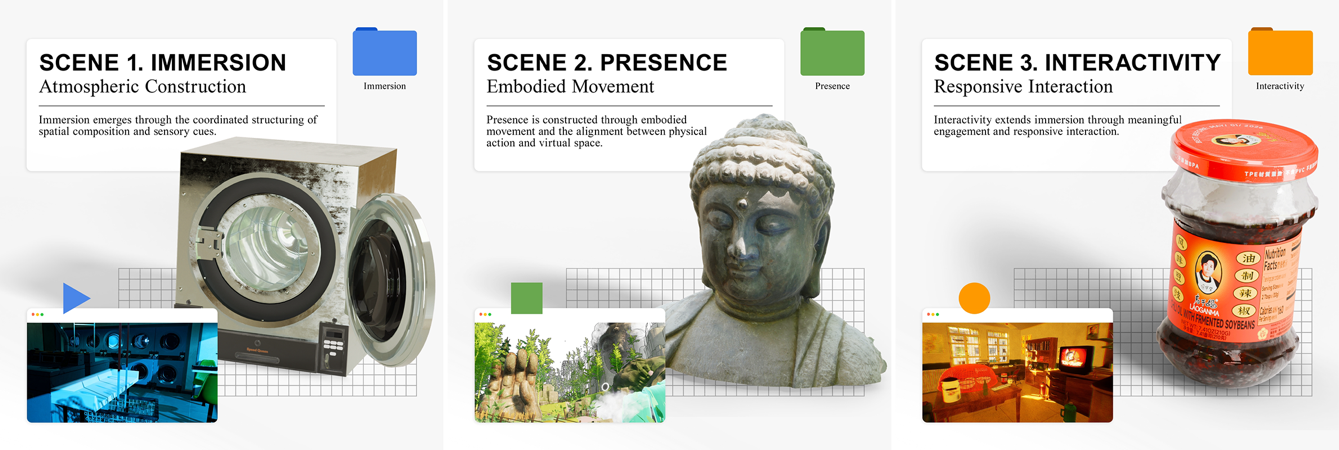
This section presents three VR scenes developed through iterative prototyping, highlighting their design narratives and technical considerations for immersive storytelling (written from the designer's first-person perspective). Each scene was created using a VR setting that combines a head-mounted display with a physical locomotion interface, supporting sensory immersion, embodied movement, and a stable first-person perspective. Testing was conducted across multiple Meta Quest devices (Quest 2, Quest 3, Quest 3S, and Quest Pro) to assess performance under different hardware conditions. Six-degrees-of-freedom (6DoF) tracking enabled real-time synchronization between bodily movement and visual feedback, helping maintain spatial coherence and presence. All scenes were implemented in Unreal Engine 5 (v5.3.2) using real-time rendering throughout the design process (Figure 1). The Immersion—Presence—Interactivity Framework [16] was adopted as a lens for organizing narrative design, observation and reflection throughout the design exploration.
2.1 Scene 1: Immersion Through Atmosphere
In Scene 1, the primary design focus is immersion, which is not driven by explicit interaction or task-oriented goals, but emerges gradually through the accumulation of multi-sensory cues. Visual, auditory, and environmental elements are composed to surround users over time, encouraging slow attunement to the space rather than immediate action. The scene recreates a laundromat in VR, a widely recognizable environment (Figure 2). As a space that exists between the public and the private, the laundromat is both familiar and subtly detached, remaining emotionally neutral and open-ended. Its ordinariness lowers the threshold for entry, inviting users to project their own experiences onto it. Rather than relying on explicit narrative structures or interaction cues, immersion in this scene is shaped through the emotional qualities embedded in spatial scale, lighting, sound, and material detail. As users encounter these familiar elements, personal memories and emotional associations are naturally activated, fostering immersion without additional guidance.
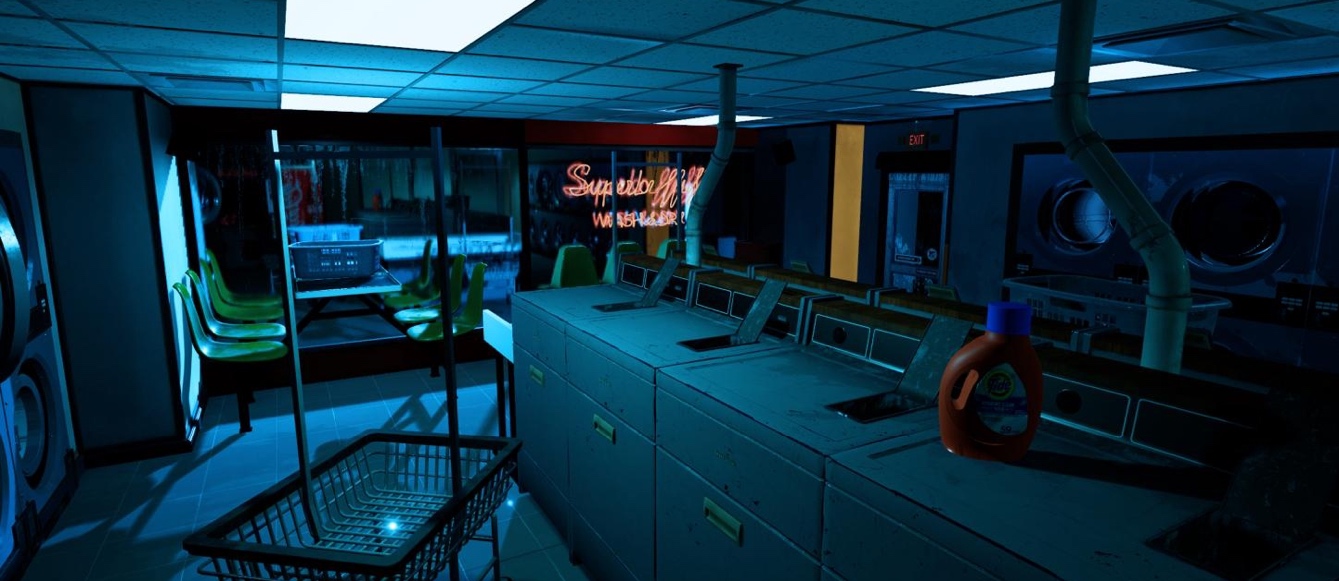
The creative motivation for this scene comes from my personal experience as an international student, where feelings of loneliness and isolation became persistent emotional states. This experience resonates with Pablo Picasso's Blue Period [4], where somber blue tones and subdued compositions convey melancholy, solitude, and detachment—expressions closely tied to his personal hardships and translated into the affective language in his artwork. Similarly, my intention in this scene is to translate my emotional state into a spatial atmosphere that can be perceived and felt by others through immersive media. The goal is not to depict a specific event, but to construct an emotional field that users can sense and inhabit.
Interaction in this scene focused on immersion is intentionally minimal. The laundromat, as a spatial container associated with waiting, repetition, and solitude, provides an ideal setting for reminiscence. While basic movement and presence remain possible, viewers are not required to manipulate objects or perform actions. Instead, they are invited to dwell within the environment and attend to subtle sensory cues through immersive visual experience: faint humidity in the air, familiar melodies intermittently playing from the speakers, and the nocturnal ambience created by moonlight and rain against large windows (Figure 2). These cues accumulate gradually and foreground atmosphere over action, fostering emotional immersion through duration rather than intensity.
The VR headset functions as the main carrier of immersion. Through sensory isolation, it blocks external distraction and stabilizes the first-person perspective, reducing perceptual conflict. At the same time, six-degrees-of freedom (6DoF) tracking synchronizes subtle head movements with real-time visual feedback, ensuring continuity and spatial coherence. It invites audience to move from sensing to interpreting and from presence to meaning-making, scaffolding the experiential trajectory of reminiscence and positioning immersion as a prerequisite for creative and cognitive engagement.
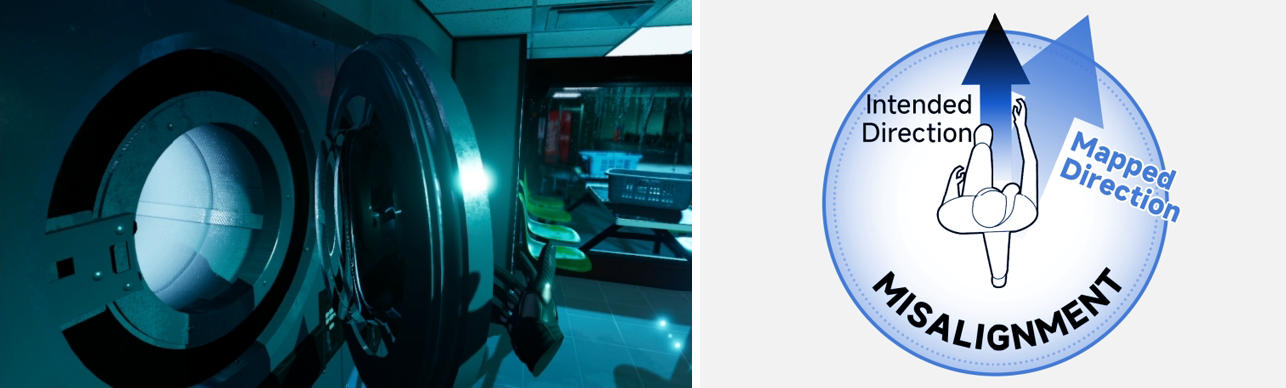
Notably, the design process revealed technical limitations and their direct impact on user experience (Figure 3): (a) unresponsive functional signifiers (e.g., the washing machine) shift user attention from perceptual dwelling to frustrated action-seeking; (b) directional drift between physical treadmill movement and virtual tracking disrupts sensorimotor consistency; (c) high environmental rendering complexity causes frame-rate instability and latency.
2.2 Scene 2: Embodied Presence through Movement
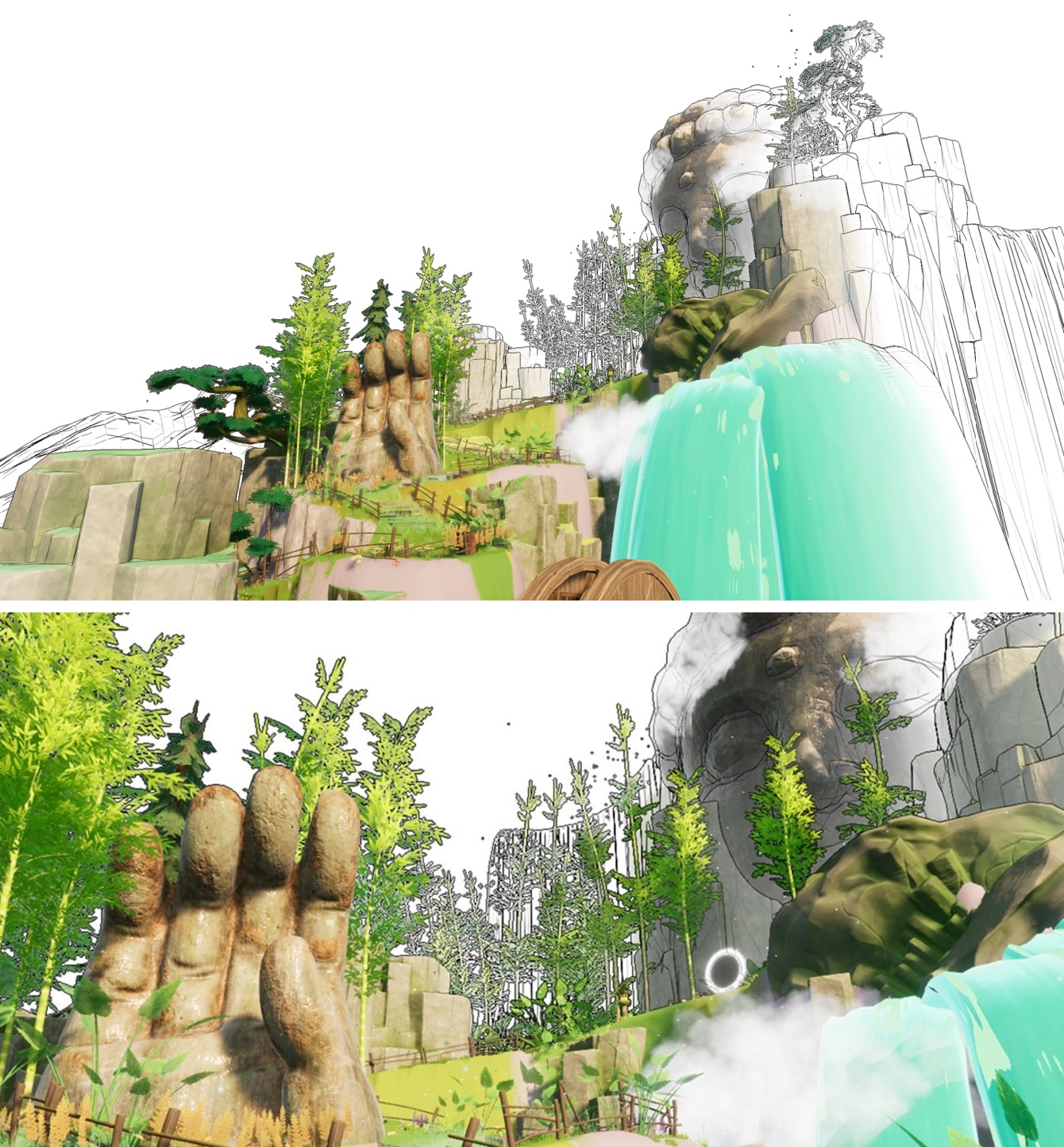
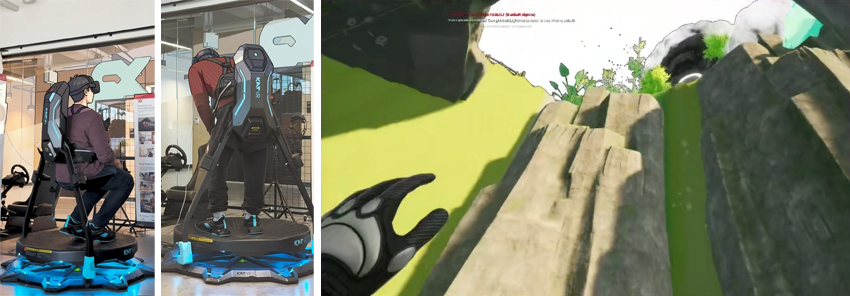
Scene 2 focuses on presence, spatial awareness, and bodily involvement by foregrounding the user's physical participation as central to the experience. Upon entering this scene, users are placed within an open plain oriented toward a distant mountain top. A bell sound emanating from the summit serves as a persistent auditory landmark, guiding users’ directional spatial awareness (Figure 4). Real walking on a Physical-Locomotion VR Treadmill is mapped in real time to movement within the virtual environment, creating a tight coupling between bodily action and spatial translation. This alignment reinforces a sense of presence, allowing users to experience the environment not merely as visual observers, but as embodied agents moving through space.
As users walk and gradually approach the destination, the scene leverages the reciprocal relationship between presence and emotional engagement. Bodily effort, spatial progression, and perceptual change work together to intensify emotional involvement. In turn, heightened emotional engagement reinforces the perception of spatial realism, forming an experiential loop that deepens presence over time (Lin et al., 2025) [16]. In contrast to emotional stillness in the previous scene, this one introduces duration, effort, and progression as key experiential dimensions.
The creative motivation for this scene comes from my personal background and engagement with spiritual and ritual aesthetics. Although not practicing a particular religion, I have sustained an interest in spirituality from cultural and artistic perspectives. Growing up in an artistic family, I was surrounded by objects with historical and religious significance, valued not for doctrinal belief but for their aesthetic, symbolic, and cultural meanings. This environment shaped my nuanced understanding of emotional states such as reverence, ritual, and divinity, independent of a singular religious framework.
These influences inform the experiential structure of Scene 2, which is designed to evoke a process toward an aesthetic journey. Meaning accumulates through bodily effort and spatial ascent, culminating in a moment of perceived revelation at the mountaintop. Early in the experience, only nearby materials and details are rendered clearly, while distant regions appear in a low-information, sketch-like state. As users physically walk upward, the environment gradually becomes fully rendered and saturated with color (Figure 4). This visual transformation functions as intuitive feedback for sustained bodily effort, symbolizing completion and reinforcing the emotional resonance of arrival. Within the overall structure of the project, Scene 2 bridges the transition from passive immersion to active agency, situating presence as a necessary step between sensing and acting in immersive reminiscence.
Physical and systemic constraints affect embodied presence and spatial continuity (Figure 5): (a) accumulated physical load from hardware weight and treadmill locomotion redirects attention from environmental engagement to bodily fatigue; (b) disproportionate movement mapping between physical steps and virtual displacement forces excessive physical effort; (c) teleportation-induced spatial discontinuities cause collision misalignment, leading to unintended geometry penetration.
2.3 Scene 3: Interactivity
Scene 3 explores interactivity as a way of advancing immersive experience from perception and presence toward action, feedback, and a sense of agency within this immersive narrative. I selected this scene as a site for reminiscence because it draws directly from my childhood memories of domestic space, which I associate with emotional safety, familiarity, and stability. Born in China in the late twentieth century, my recollections of home are shaped by warm, yellow-toned lighting, and sunlight filtering through windows, evoking a quiet atmosphere punctuated by everyday sounds—school bells from outside and cooking noises from the kitchen (Figure 6). These memories are often indistinct and fragmented, yet they carry a strong emotional charge. Rather than attempting a precise reconstruction of the past, Scene 3 represents an experiential state between reality and memory, capturing the fuzziness and nostalgia of lived pastness.
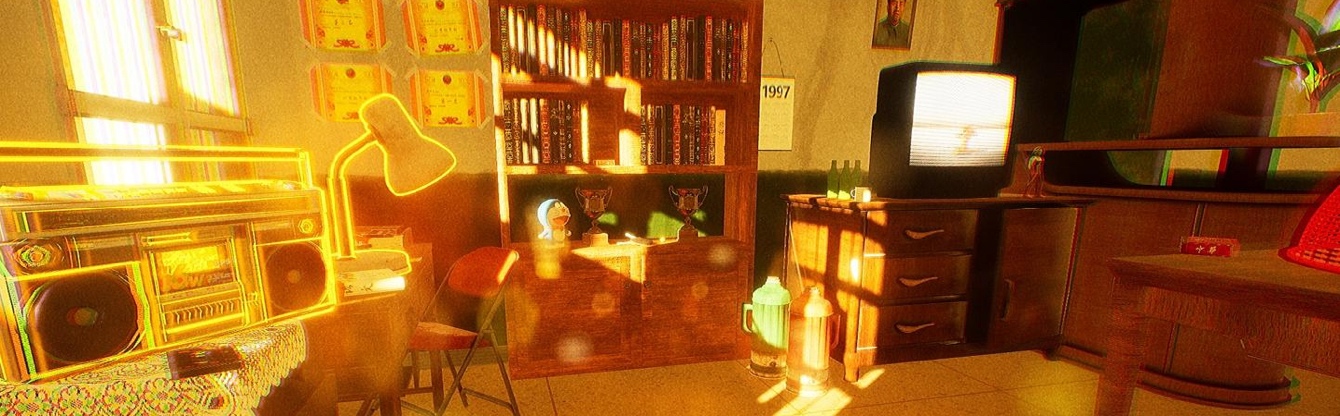
To communicate this emotional state, I chose the domestic interior as the narrative setting and reconstructed it through three-dimensional modeling and VR technology. Central to this scene is the use of interactivity to transform viewers from passive observers into active participants. By touching, manipulating, and exploring objects, users form a direct, embodied connection with the remembered environment, producing an illusion of being physically present within it.
Although Scene 3 comes from my personal memories, I intentionally selected objects that were widely common in China during the 1990s—such as radios, televisions, and Mao Zedong portraits—rather than highly individualized items. These culturally recognizable objects balance personal reminiscence with collective memory, making the scene more legible and emotionally accessible to a broader audience while preserving its autobiographic core.
Interactivity in Scene 3 is carefully structured to support gradual discovery sustained immersion. Approximately two thirds of the scene assets are interactive. A half of them show complex interactivity that trigger visual or audio feedback, accompanied by explicit cues as outlined in Figure 6. These objects enable users to influence the environment in meaningful ways, such as turning on table lamps, radios, or television animations. Immediate visual and auditory feedback reinforces the illusion of agency, allowing users to feel that their actions genuinely affect the world. Another half the assets are objects with simple interactivity that can be grabbed and examined but do not generate additional feedback. These objects support slower, tactile exploration and invite contemplation without overwhelming users with too much interactive responses. The remaining third of the scene consists of static elements—such as walls, floors, and cabinets—that provide spatial grounding and coherence. This hierarchical distribution of interaction allows to intuitively learn which objects are meaningful through exploration rather than instruction.
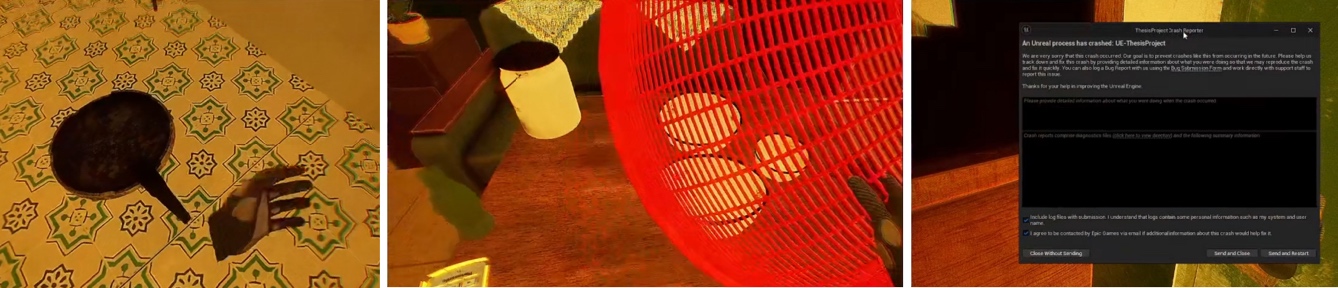
Technical issues were identified through prototyping. Systemic anomalies and their immediate perceptual impacts during prototyping (Figure 7): (a) high virtual eye-level setup mismatches environmental scale, impeding natural interaction reachability for floor-level objects; (b) ineffective spatial boundaries allow unintended entry into restricted geometry, causing collision mismatches; and (c) perceptible loading delays and system crashes during scene transitions trigger extreme temporal discontinuities.
3 Discussion & Critical Reflection
In this creative inquiry, immersion, presence, and interactivity serve as an interconnected structure that organizes immersive storytelling through design decisions and the unfolding of experience [16]. These elements operate as a layered structure in which immersion establishes a perceptual foundation, presence emerges through embodied alignment, and interactivity introduces action and feedback to enable engagement. In this series of design explorations, Scene 1 focuses on establishing immersion through spatial atmosphere, Scene 2 strengthens presence through embodied movement, and Scene 3 introduces interactivity through structured action and feedback. This staged approach allows the experience to gradually unfold across perceptual, embodied, and interactive levels. As the design process progressed, a series of tensions gradually surfaced at the intersections between system performance, embodied movement, interaction logic, and narrative flow. The following examines these tensions identified to discuss design implications for immersive storytelling in VR environments while critically reflecting on autobiographic design as a method of inquiry.
Immersive experience depends less on visual complexity than on perceptual stability. Rather than prioritizing sensory abundance alone, VR environments require consistent rendering, smooth temporal flow, and coherent visual composition. Presence emerges through embodied alignment between physical movement and virtual spatial response, making stable sensorimotor consistency essential for sustaining a continuous sense of “being there.” Similarly, interactivity depends on credible affordances supported by reliable relationships between action and feedback. Interaction functions as a system of expectations in which suggested actions must remain clear, responsive, and consistent.
Although immersion, presence, and interactivity were explored through different scenes, they were not intended as separate dimensions; rather the design inquiry reinforced that spatial and temporal continuity underpin all three dimensions of immersive storytelling. Spatial credibility is established through controlled movement and alignment between locomotion systems and environmental organization, while temporal continuity sustains narrative engagement through uninterrupted experiential flow. Maintaining these conditions requires not only technical stability but also the integration of transitions within the narrative structure itself. Future inquiry may extend these findings by examining additional dimensions of immersive storytelling, including more nuanced understandings of embodiment [14], the balance between directed viewing and viewer agency in narrative encounters [15], and the role of social interactions in VR experience [12].
This project adopted autobiographical design and first-person technical experimentation. As a proof-of-concept inquiry, it offers an initial framework toward immersive storytelling as a creative practice in VR rather than a comprehensive evaluation, with the absence of audience testing limiting claims regarding reception or broader applicability. Autobiographical design proved valuable as a mode of critical inquiry: personal memory functioned not as a reconstruction of specific events but as a generative resource for shaping atmosphere, embodied movement, and interaction, shifting storytelling from representational narration toward experiential construction. Individually rooted experiences were expressed through recognizable spaces, culturally resonant objects, and archetypal atmospheres that positioned personal memory within broader cultural and collective contexts. In this sense, autobiographical content served as a bridge between intimate experience and potentially shared forms of remembering. However, because such environments are shaped through first-person interpretation, whether these experiences resonate beyond their original context remains an open question. Future research should therefore examine how autobiographically grounded VR experiences are interpreted and made socially and culturally meaningful through audience engagement and empirical evaluation.
4 Conclusion
This project explored VR as a creative medium for immersive storytelling through autobiographical and iterative design inquiry. As an early-stage investigation, it contributes situated design insights into how spatial design, embodiment, and interaction shape immersive experiences grounded in memory and cultural meaning. Rather than offering generalizable audience findings, this work provides informative guidance for designers exploring VR storytelling, highlighting practical considerations for maintaining immersion, presence, and narrative coherence. Future research may extend these insights through broader audience engagement and more diverse storytelling contexts.
References
- S.J. Ahn, A.M.T. Le, and J. Bailenson. 2013. The Effect of Embodied Experiences on Self-Other Merging, Attitude, and Helping Behavior. Media Psychology 16, 1 (2013), 7–38. https://doi.org/10.1080/15213269.2012.755877
- V. Apaydin (Ed.). 2020. Critical perspectives on cultural memory and heritage: Construction, transformation and destruction. UCL Press. https://doi.org/10.14324/111.9781787354845
- D. Barthel-Bouchier. 2025. Cultural heritage: tangible and intangible markers of collective memory. In Routledge International Handbook of Memory Studies, A.L. Tota and T. Hagen (Eds.). Routledge, 221–232. https://doi.org/10.4324/9780203762844
- H.P. Blum. 2013. Picasso's Prolonged Adolescence, Blue Period, and Blind Figures. The Psychoanalytic Review 100, 2 (2013), 267–287. https://doi.org/10.1521/prev.2013.100.2.267
- J. Cao, Q. He, Z. Wang, R. LC, and X. Tong. 2023. DreamVR: Curating an interactive exhibition in social VR through an autobiographical design study. In Proceedings of the CHI Conference on Human Factors in Computing Systems (CHI '23). ACM, 1–18. https://doi.org/10.1145/3544548.3581362
- M. Ceuterick and C. Ingraham. 2021. Immersive storytelling and affective ethnography in virtual reality. Review of Communication 21, 1 (2021), 9–22. https://doi.org/10.1080/15358593.2021.1881610
- Digital Artist Residency. Close Isn't Home. Retrieved April 11, 2025 from https://www.digitalartistresidency.org/artists/closeisnthome/
- N. Eivazy, Jan P.L. Peeters, and S. Claes. 2023. Connecting Through Objects: Sharing Memories Through Participatory Stop-Motion Animation with Personal Objects of the Armenian Diaspora. In Proceedings of the 11th International Conference on Communities and Technologies (C&T '23). ACM, 48–53. https://doi.org/10.1145/3593743.3593756
- C. Fencott. 2001. Virtual storytelling as narrative potential: Towards an ecology of narrative. In Virtual storytelling: Using virtual reality technologies for storytelling (Lecture Notes in Computer Science, Vol. 2197), O. Balet, G. Subsol, and P. Torguet (Eds.). Springer, 90–99. https://doi.org/10.1007/3-540-45420-9_11
- M. Halbwachs. 1925. Les cadres sociaux de la mémoire. Félix Alcan, Paris.
- L. Heux. 2023. Collective memory and autobiographical memory: Perspectives from the humanities and cognitive sciences. WIREs Cognitive Science 14, 5 (2023), e1665. https://doi.org/10.1002/wcs.1635
- S. Hudson, S. Matson-Barkat, N. Pallamin, and G. Jegou. 2019. With or without you? Interaction and immersion in a virtual reality experience. Journal of Business Research 100 (2019), 459–468. https://doi.org/10.1016/j.jbusres.2018.10.062
- C.G. Jung. 1959. The Archetypes and the Collective Unconscious (Collected Works of C.G. Jung, Volume 9, Part 1). Princeton University Press.
- K. Kilteni, R. Groten, and M. Slater. 2012. The Sense of Embodiment in Virtual Reality. Presence: Teleoperators and Virtual Environments 21, 4 (2012), 373–387. https://doi.org/10.1162/PRES_a_00124
- Y.E. Kim and M.J. Khajavi. 2024. Exploring the viewer's role in narrative-based animated virtual reality experiences: Strategies for role activation and immersive storytelling. Animation: An Interdisciplinary Journal 19, 2-3 (2024), 101–128. https://doi.org/10.1177/17468477241281635
- C. Lin, G. Xia, F. Nickpour, and Y. Chen. 2025. A review of emotional design in extended reality for the preservation of cultural heritage. npj Heritage Science 13, 1 (2025), 86. https://doi.org/10.1038/s40494-025-01625-x
- MIT Media Lab. Re·Live Project. Retrieved April 10, 2025 from https://www.media.mit.edu/projects/re-live/overview/
- J.H. Murray. 2017. Hamlet on the Holodeck: The Future of Narrative in Cyberspace (updated edition). MIT Press.
- C. Neustaedter and P. Sengers. 2012. Autobiographical design in HCI research: Designing and learning through use-it-yourself. In Proceedings of the Designing Interactive Systems Conference (DIS ’12). ACM, 514–523. https://doi.org/10.1145/2317956.2318034
- M. Tang, M. Nikolaenko, E. Boerwinkle, S. Obafisoye, A. Kumar, M. Rezayat, S. Lehmann, and T. Lorenz. 2024. Evaluation of the effectiveness of traditional training vs. immersive training. In Extended Reality (XR Salento 2024) (Lecture Notes in Computer Science, Vol. 15030), L.T. De Paolis, P. Arpaia, and M. Sacco (Eds.). Springer, 71–82. https://doi.org/10.1007/978-3-031-71713-0_7
- M. Tang, J. Nored, M. Anthony, J. Eschmann, J. Williams, and L. Dunseath. 2024. VR-based empathy experience for nonprofessional caregiver training. In Extended Reality (XR Salento 2024) (Lecture Notes in Computer Science, Vol. 15028), L.T. De Paolis, P. Arpaia, and M. Sacco (Eds.). Springer, 325–336. https://doi.org/10.1007/978-3-031-71704-8_28
- B. Trentini. 2015. Immersion as an embodied cognition shift: Aesthetic experience and spatial situated cognition. Cognitive Processing 16, 1 (2015), 413–416. https://doi.org/10.1007/s10339-015-0684-y
- XRMemory Workshop. IEEE VR 2025. Retrieved April 10, 2025 from https://sites.google.com/view/spatial-memory-vr-2025/main
- H. Yao, L. Zhao, B. Chen, K. Li, H. Liang, and L. Yu. 2025. 3DStoryline: Immersive visual storytelling. Journal of Visualization 28 (2025), 681–697. https://doi.org/10.1007/s12650-025-01058-5
Appendix
This project incorporated the following third-party 3D assets, licensed under Creative Commons and obtained from free libraries on the Fab platform, in prototyping VR scenes. Detailed attributions are provided below.
- Asset 1: Old Television from 90's - 3D model created by Zgon (2020, December 16). Sketchfab. Retrieved from: https://sketchfab.com/3d-models/old-television-from-90s-5642074408e94782a7f2ee545e846b45
- Asset 2: Ultraman Seven - 3D model created by Craft Tama (2021, March 14). Sketchfab. Retrieved from: https://sketchfab.com/3d-models/ultraman-seven-ebfaf719cdc14d78be0f2cbc7bf735a0
- Asset 3: Doraemon 3D created by arc98tect. (2024). Sketchfab. Retrieved from: https://sketchfab.com/3d-models/doraemon-3d-c2256852d3b6443d867eee85e1588ff2
- Asset 4: Golden Trophy - 3D model created by Incg5764. (2020). Sketchfab. Retrieved from: https://sketchfab.com/3d-models/golden-trophy-79389eecca164e27a75d362fbbecfe3b
- Asset 5: Elegan old book pack - 3D model created by 3D_for_everyone. (2020). Sketchfab. Retrieved from: https://sketchfab.com/3d-models/elegan-old-book-pack-4cc9ecf0531b463dada8262851ca87f8
- Asset 6: Air Jordan 1 - 3D model created by makoto. (2020). Sketchfab. Retrieved from: https://sketchfab.com/3d-models/air-jordan-1-a4b434181fbb48008ad460722fd53725
- Asset 7: converse all star gumshoes LP - 3D model created by Robin Bad. (2020). Sketchfab. Retrieved from: https://sketchfab.com/3d-models/converse-all-star-gumshoes-lp-da6c8abaa30a4dea81e1b1f93bc53f53
- Asset 8: Kitchen Stove - 3D model created by Bornx. (2023). Sketchfab. Retrieved from: https://sketchfab.com/3d-models/kitchen-stove-2d2c2c4bb7a74b068c09b5fc23a46e24
- Asset 9: Refrigerator - 3D model created by Francesco Coldesina. (2017). Sketchfab. Retrieved from: https://sketchfab.com/3d-models/refrigerator-35793d480f784aa5ab3549eca2160e65
- Asset 10: Old Metal Folding Chair - 3D model created by CurlyFryWhy. (2023). Sketchfab. Available at: https://sketchfab.com/3d-models/old-metal-folding-chair-f3d95d69401945fda7a355679868f169
- Asset 11: Portable FM Radio - 3D model created by Ilya Maksimov. (2022). Sketchfab. Retrieved from: https://sketchfab.com/3d-models/portable-fm-radio-8e89c26da9c2429395661957314e86f5
- Asset 12: HITACHI TRK-8190E Ghetto Blaster Boombox - 3D model created by Arsen Ismailov. (2024). Sketchfab. Retrieved from: https://sketchfab.com/3d-models/hitachi-trk-8190e-ghetto-blaster-boombox-2ebc48f1874e47d5871776990a30f0ff
- Asset 13: Soviet Sofa - 3D model created by R3indeer. (2020). Sketchfab. Retrieved from: https://sketchfab.com/3d-models/soviet-sofa-7120d8cfad7e4455b772f3fab4bfd243
- Asset 14: claw machine lowpoly rigged - 3D model created by generic_person. (2022). Sketchfab. Retrieved from: https://sketchfab.com/3d-models/claw-machine-lowpoly-rigged-a831da37d48f45d4b9845e337e053ba2
- Asset 15: Tide Detergent Bottle - 3D Model (Fanmade) [3D model] created by CCB 3D MODEL. (2025). Sketchfab. Retrieved from: https://sketchfab.com/3d-models/tide-detergent-bottle-3d-model-fanmade-09f326c14e7e464b914e78e212a820f3
- Asset 16: Wet_Floor_Sign - 3D model created by ZachWilkins1997. (2020). Sketchfab. Retrieved from: https://sketchfab.com/3d-models/wet-floor-sign-7673d504c2b34f7c94c72b443b3ca907
- Sourced via Digital Asset Marketplace. (2024). Stylized Anime-Inspired Castle and Nature Environment Suite for UE5 [3D Environment Bundle]. Available under Standard End-User License Agreement (EULA) for Educational and Non-Commercial Research.
Footnote
∗Corresponding author

This work is licensed under a Creative Commons Attribution 4.0 International License.
C&C '26, London, United Kingdom
© 2026 Copyright held by the owner/author(s).
ACM ISBN 979-8-4007-2583-8/2026/07
DOI: https://doi.org/10.1145/3803784.3816833