Close Enough? Reducing Personal Space Anxiety through Adjusted Teleportation in Social VR
DOI: https://doi.org/10.1145/3772363.3798445
CHI EA '26: Extended Abstracts of the 2026 CHI Conference on Human Factors in Computing Systems, Barcelona, Spain, April 2026
Teleportation is widely used in social virtual reality, yet prior work shows it can impair personal space regulation, leading to discomfort and anxiety. Existing solutions are limited, often relying on explicit user interfaces or negotiation mechanisms, but they show promise in reducing invasion-related anxiety. In this work, we investigate adjusted teleportation, a technique that subtly modifies a user's teleport destination. Unlike previous approaches, this adjustment is imperceptible to the user. We explore its use for aligning users with their self-reported preferred interpersonal distance when initiating social interactions.
We evaluated this approach in a user study (N = 10) in which participants conversed with virtual agents using either adjusted or standard teleportation. Adjusted teleportation significantly reduced personal space invasion anxiety, while remaining largely imperceptible to participants. By offloading proximity regulation from users, this approach supports comfortable social interaction, highlighting a promising direction for socially aware locomotion design.
ACM Reference Format:
Rose Connolly and Rachel McDonnell. 2026. Close Enough? Reducing Personal Space Anxiety through Adjusted Teleportation in Social VR. In Extended Abstracts of the 2026 CHI Conference on Human Factors in Computing Systems (CHI EA '26), April 13--17, 2026, Barcelona, Spain. ACM, New York, NY, USA 5 Pages. https://doi.org/10.1145/3772363.3798445
1 Introduction
Social Virtual Reality (SVR) enables users to engage in real-time, embodied interaction through avatars, making it increasingly relevant for social connection [15]. A critical component of such interaction is the ability to maintain personal space, which, when intruded upon can cause anxiety and discomfort [9, 11, 22]. As such, personal space regulation remains challenging [23], especially in VR as there are additional considerations, namely locomotion techniques [5]. Teleportation-based locomotion, while effective at reducing simulation sickness and physical effort [3], has been shown to impair spatial orientation [4] and distance estimation [12]. These effects may be responsible for its tendency to worsen personal space regulation and cause invasion anxiety [5, 22].
Perceptually adjusted teleportation is a recently proposed technique that subtly modifies a user's teleportation destination without being detected by the user [6], drawing on principles from redirected walking research [20]. While prior work has established perceptual thresholds for this technique, its use in real-time social interactions within social virtual reality (SVR) remains underexplored. In this exploratory study, we investigate whether teleportation adjustments proposed in prior work [6] can support comfortable conversational distances when approaching virtual humans. Specifically, we focus on the perceptibility of these adjustments and their impact on personal space invasion anxiety levels (PSIAL) [18], aiming to preserve the subjective experience of standard teleportation while supporting more comfortable social interactions.
We evaluate this approach in a pilot user study designed to mimic SVR. Using embodied conversational agents, we compare adjusted teleportation to a standard teleportation baseline. Our results indicate that teleportation adjustments are largely imperceptible to users and can reduce PSIAL during social interactions. Together, these findings highlight the potential of adjusted teleportation as a socially aware locomotion technique that enhances comfort in SVR.
2 Related Work
2.1 Proxemics in Social Virtual Reality
Proxemics examines how humans regulate the space around their bodies during social interaction [8]. Personal space regulation functions both as a moderator and an expression of user comfort [9, 26]. Proxemic behaviour is widely understood as a low-level, automatic social response, operating without conscious control, in contrast to higher-level behaviours such as conversation [1]. As such, it is often used as an indicator of comfort, with increased distance often signalling unease [26]. The ability to regulate one's personal space is also of importance, as violations of personal space can elicit discomfort, anxiety, or anger [9, 11].
As a medium that enables precise measurement and control, VR is commonly used in proximity research, where personal space is assessed by the interpersonal distance (IPD) users maintain from virtual humans [13, 17, 28]. However, the immersion of VR may amplify emotional responses to spatial threats due to richer depth cues [21]. As a result, proximity intrusions in VR can be particularly salient [23]. For example, prior work has shown that virtual characters approaching too closely can trigger fear-related freezing responses [16].
In Social Virtual Reality (SVR), where multiple users interact through avatars in real time [15], proxemics plays a key role in non-verbal communication, as well as gaze and gestures [14]. Despite this, proxemics in SVR remains underexplored [23]. Much existing VR proxemics research focuses on simplified dyadic interactions, frequently excluding verbal communication and complex social dynamics [10, 24, 27, 28].
With the increasing popularity of SVR, some problems have emerged. One common form of harassment is the invasion of personal space, which often involves deliberate and repeated physical encroachment to create discomfort [7]. Defining harassment in VR, however, can be challenging. It can often be dismissed as user error, or a misunderstanding of controls [14]. Some strategies have been developed to address such challenges. McVeigh et al. [15] found that most platforms implement some form of personal space management. For instance, RecRoom prevents users from teleporting too close to others, while other platforms use “personal space bubbles” that make avatars invisible when they invade another user's space. However, these features are often disabled by default, which can pose a challenge for inexperienced users who may be unaware of how to activate them [15]. In addition to this, Freeman et al. [7] found that some individuals fear that using such tools may come across as confrontational. Additionally, Pohl and Achtelik [19] argue that a one-size-fits-all approach to personal space can be restrictive, proposing customisable boundaries that exclude strangers but allow friends, game objects, or virtual agents.
In particular, the interaction between proximity regulation and VR-specific factors should be considered, including factors such as locomotion techniques. While walking-based locomotion has been used in the majority of VR Proxemics studies, only recently has teleportation been examined for its effects on IPD regulation.
2.2 The Effects of Teleportation on Personal Space Regulation
Teleportation is a popular navigation method, as it bypasses physical space constraints. Yet it is rarely used as a locomotion method in VR research, including proximity research, despite its popularity in VR applications [2].
As a discontinuous locomotion method, teleportation does not generate optical flow, which reduces simulation sickness [3]. However, there are resulting disadvantages - as users do not visually traverse the virtual environment they can experience spatial disorientation [4] and impaired distance estimation [12]. The spatial effects of teleportation also have implications for proximity [5, 25]. A recent study [5] indicates that users tend to approach virtual humans more closely when using teleportation compared to walking, often at the expense of comfort. When teleporting, users may be more accepting of such uncomfortable distances from others, as making subsequent small teleports to refine spacing may not seem worthwhile [5]. These findings suggest that teleportation can disrupt intuitive regulation of IPD.
To address this, Wang et al. [22] proposed negotiated teleportation, in which both the teleporting user (guest) and the target user (host) influence the teleport outcome. Variants of this method allow manipulation of both the distance and direction the two parties will interact with. As both parties have influence over their resulting IPD, this method is adept at respecting the highly individualist nature of personal space [9]. However, as a UI and controller based method, the user does have additional cognitive demands to grapple with. However this method is adept at reducing invasion anxiety, indicating the importance of personal space regulation.
As mentioned, users are often reluctant to correct minor teleportation misplacements, at the expense of comfort [5]. This is particularly problematic in interaction-heavy SVR. More recently, Connolly et al. [6] demonstrated the potential of perceptually guided adjusted teleportation, showing that teleport destinations can be shifted within perceptual thresholds without users’ awareness. This method could support proximity regulation without disrupting user experience, but has yet to be tested in an interaction context.
3 Methods & Design
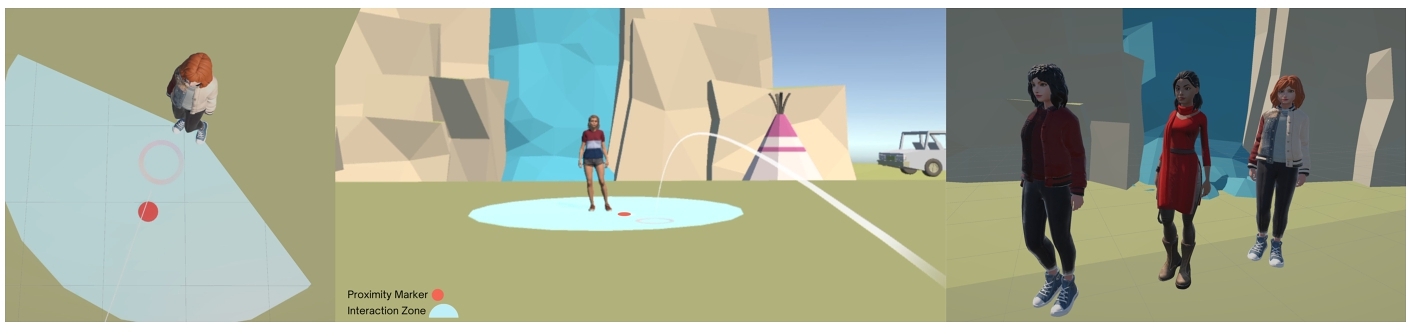
The VR system was developed in Unity 6000 and deployed on a Meta Quest 3 headset. The virtual environment (VE) was designed to mimic typical SVR environments, consisting of a 22 m × 22 m open-world area (See Figure 1).
We had 10 participants (5m, 5f), aged 23-61 (M: 33.8, SD: 14.67). In terms of VR experience, 6 described themselves as novice or beginner, 3 as expert or advanced, and 1 as intermediate. Our experiment was approved by our institution's ethics board.
3.1 Experiment Procedure
At the beginning of the experiment, participants used a controller in VR to position a female virtual avatar. They were asked to position the avatar ‘at a distance you would be comfortable having a conversation with her’. This distance served as their preferred IPD throughout the study and was computed as the Euclidean distance on the XZ plane from the participant's head-mounted display (HMD) to the avatar's head. Participants confirmed their chosen distance with a controller button. The avatar used the same animation set as the agents employed later in the study.
Participants then completed two experimental blocks in counterbalanced order: adjusted teleportation and standard teleportation (our baseline). Each block had three trials. At the start of each trial, an agent appeared at either side of the VE, positioned 10 m away from the participant. Participants approached the agents using teleportation and then engaged the agent in conversation. After each block participants completed a questionnaire. In both blocks, participants were also able to turn discretely using a controller. Participants were given time to freely navigate the virtual environment to account for learning effects. The total experiment lasted approximately 30 minutes.
3.2 Conversational Agents
All agents were implemented using ReadyPlayerMe avatars, with varied appearances and clothing to minimize repetition effects. Conversational capabilities were provided using ConvAI. ConvAI allows modification of personality traits, such as extraversion and agreeableness. All agents were configured identically with average values set for each trait, ensuring consistent personality. The agents engaged participants in neutral conversations (e.g., discussing favourite foods or movies). For example, a prompt provided to ConvAI was: “You are a kind, friendly person. You are interested in food, and like to ask about people's favourite cuisines."
Participant gender was not controlled. Therefore, all agents were female to avoid confounding gender effects on IPD [10]. The agents’ order of appearance was randomised for each participant.
3.3 Adjusted Teleportation
For the purposes of this experiment, an interaction zone was defined as the area surrounding the conversational agent that indicated the participant's intent to engage in conversation (please see Figure 1). This was set to be 2.5*IPD; i.e. an interaction zone of radius 237.5cm would result from an IPD of 95cm. Teleport destinations selected outside this zone were interpreted as part of the participant's approach, likely prompting additional teleports. Selecting a destination within the interaction zone indicated that the participant had likely chosen a position from which to converse.
When a teleport destination was selected within the interaction zone, adjusted teleportation was triggered. The selected destination was automatically modified to match the participant's preferred IPD. Any subsequent teleports during the same interaction were not adjusted, allowing participants to voluntarily fine-tune their position if desired. Such subsequent teleports were termed corrective teleports for analysis purposes. This design choice was made to preserve user agency and to prevent the intervention from becoming obvious through repeated automatic adjustments. We also anticipated that corrective teleports would be rare, given that the adjusted position corresponded to participants’ self-reported preferred IPD.
Importantly, adjusted teleportation was visually indistinguishable from standard teleportation; participants could not determine from visual feedback that any modification was occurring.
3.4 Measurements
After each block, participants underwent the Personal Space Invasion Anxiety Level (PSIAL) questionnaire [18], as per other work on adapted teleportation techniques for IPD regulation [22]. The vocabulary of some questions was adapted to suit the context of our experiment, as per [22]. For each trial we measured the number of ‘correction teleports’ made. A correction teleport included any subsequent teleport made after an initial teleport within the interaction zone.
For the baseline condition (no adjustment) we recorded the user's IPD to the agent as the average XZ Euclidean distance during their conversation, logged every 0.5 seconds (as per [5]). We also measured the magnitude and direction of each adjustment i.e., a participant with an IPD of 88cm who teleports 101cm from the agent corresponds to a 13cm backward correction. Finally, after both blocks concluded, we collected qualitative feedback on whether participants had noticed any differences in their approach to the agents using teleportation.
3.5 Objectives & Hypotheses
The objective of our study is to explore the feasibility of adjusted teleportation for regulating IPD, specifically when approaching a virtual human to interact. Standard teleportation (i.e., without adjustment) serves as a baseline for comparison. Based on these goals, we formulate the following hypotheses:
H1: Adjusted teleportation can be used to modify a teleport destination near an agent without being detected. Prior work has shown that teleport destinations can be adjusted without detection by up to 1.64m backwards and 0.98m forwards for teleports of approximately 9m [6]. As our environment supports similar teleport distances, we expect adjustments to remain imperceivable.
H2: Participants will experience lower personal space invasion anxiety (PSIAL) in the adjusted teleportation condition compared to the baseline. Previous techniques that regulate IPD have been shown to reduce PSIAL compared to standard teleportation [22].
H3: The number of corrective teleports will not differ between the baseline and adjusted conditions. Prior research indicates that users tolerate uncomfortable distances when using teleportation, suggesting adjusted teleportation may not affect the frequency of corrective teleports [5].
H4: Participants will converse with the agent at a distance closer than their preferred IPD in the baseline condition. Teleportation can impair distance estimation, leading users to overshoot and interact with agents at distances closer than their comfort distance [5, 12].
H5: Adjustments will be predominantly backward, reflecting participants’ tendency to overshoot. This pattern is expected because estimation errors often lead users to overshoot, requiring compensatory backward adjustments [5, 12].
4 Results
We compared the PSIAL results using a mixed-design ANOVA with teleport type (adjusted, baseline) as a within-subjects factor, and block order as a between-subjects factor. The data was normally distributed as per the Shapiro-Wilk test and there were no outliers. Statistical significance is reported at p < 0.05, and analysis was conducted using R Studio 4.5.1. Distance is reported in metres.
We found a significant within-subjects effect for block type (F(1, 8) = 18.69, p < .01, $\eta ^{2}_{p} = 0.7$, 1 − β = 0.96). When participants approached using the adjusted teleportation, they reported less personal space invasion anxiety (M: 3.8, SD: 5.16) than with the baseline condition (M: 6.7, SD: 5.08). There were no significant order effects.
The number of correction teleports for each condition was analysed using a Wilcoxon signed-rank test, as the data were non-normally distributed count values with a high proportion of zeros. The test was one-tailed in accordance with the directional hypothesis. This difference did not reach statistical significance.
A paired-samples t-test was conducted to compare participants’ preferred IPD (M: 1.31, SD: 0.65) and their average IPD in the baseline condition (M: 1.62, SD: 0.52). This data was normally distributed according to the Shapiro-Wilk test. There was no significant difference between the conditions, t(9) = 1.75, p = 0.115, with a mean difference of 0.32.
When asked whether participants noticed any difference between blocks (aside from conversational context) one participant said: ‘I thought I was closer to the second group (adjusted condition) of agents, it might be my teleportation but I am not sure’. 5 reported no differences and 4 reported differences attributed to the agents, reporting differing levels of friendliness or body language. The average adjustment made was 0.68 (SD: 0.76). 7 of the 30 adjustments made were backwards adjustments, the remaining were forward adjustments.
5 Discussion
In this study, participants approached conversational agents via teleportation, with destinations automatically adjusted to match their self-reported preferred IPD. A standard teleportation condition served as the baseline for comparison.
Consistent with H1, teleport adjustments were largely imperceivable. Only one participant reported noticing differences in their teleportation behaviour between conditions. Most participants instead attributed perceived differences between blocks to the conversational agents themselves. Therefore, we partially accept H1, acknowledging that the adjustment was generally undetected.
As per H2, participants reported significantly lower PSIAL in the adjusted teleportation condition. This suggests that adjusted teleportation can reduce discomfort of impaired personal space regulation. This is in line with prior work demonstrating that IPD regulation techniques can reduce PSIAL [22]. Our method achieves similar benefits without requiring an explicit user interface.
As per H3, no significant difference was observed in the number of corrective teleports between the adjusted and baseline conditions. The majority of participants had no corrective teleports. Thus, this interpretation aligns with prior work indicating that users often avoid additional locomotion actions due to the perceived effort or potential disruption to the interaction flow [5]. However, the more nuanced nature of corrective behaviour needs more investigation. Subtle actions, such as leaning or small steps, may have occurred to compensate for uncomfortable distances but went undetected.
We expected participants to interact with agents at distances closer than their self-reported preferred IPD during the baseline condition (H4). Contrary to this, participants maintained greater distances, although the difference was not statistically significant. This contrasts with prior work linking reduced IPD with teleportation [5]. One possible explanation is the use of a large, open virtual environment promoted greater IPD [17]. This could also suggest that self-reported IPD may not be reliable. The small sample size may also have reduced statistical power and thus limits our ability to account for individual differences.
Adjustments were predominantly forward, not backwards (as expected with H5), meaning that participants were automatically moved closer to the agents than they initially intended. In line with the H4 findings, this could be due to the open world environment, or further suggest that participants may not accurately estimate their true IPD preference.
Our method for measuring preferred IPD may have made the study's purpose somewhat apparent. However, most participants believed the study focused primarily on the conversational agents. Overall, our findings simultaneously highlight the potential and limitations of adjusted teleportation for IPD regulation. Adjusted teleportation was largely imperceptible and successfully reduced PSIAL, indicating the benefits are largely comfort related rather than efficiency or navigational. It also highlights that self-reported IPD may not fully capture situational IPD preferences, and that environmental context may play an important role.
6 Limitations & Concluding Remarks
This pilot study explores adjusted teleportation as a means of regulating personal space in social VR. Although limited by a small sample size (N = 10) and a single virtual environment, this study provides initial, exploratory evidence that subtle teleportation adjustments reduce personal space invasion anxiety during social interactions. Future work could examine the role of prior VR experience and investigate how conversational agents and dialogue content influence IPD.
The effectiveness of this method depends on accurately estimating users’ preferred IPD. Future work could explore adaptive approaches that infer preferences from users’ post-teleport movement, while carefully considering data privacy and consent. Overall, adjusted teleportation shows promise as a socially aware locomotion technique for improving comfort in social VR.
Acknowledgments
This work was conducted with the financial support of the Research Ireland Centre for Research Training in Digitally-Enhanced Reality (d-real) under Grant No. 18/CRT/6224 and RADICal (Grant No. 19/FFP/6409).
References
- Jim Blascovich. 2002. Social influence within immersive virtual environments. In The social life of avatars: Presence and interaction in shared virtual environments. Springer, 127–145.
- Costas Boletsis. 2017. The new era of virtual reality locomotion: A systematic literature review of techniques and a proposed typology. Multimodal Technologies and Interaction 1, 4 (2017), 24.
- Doug A Bowman, David Koller, and Larry F Hodges. 1997. Travel in immersive virtual environments: An evaluation of viewpoint motion control techniques. In Proceedings of IEEE 1997 Annual International Symposium on Virtual Reality. IEEE, 45–52.
- Lucia A Cherep, Alex F Lim, Jonathan W Kelly, Devi Acharya, Alfredo Velasco, Emanuel Bustamante, Alec G Ostrander, and Stephen B Gilbert. 2020. Spatial cognitive implications of teleporting through virtual environments.Journal of Experimental Psychology: Applied 26, 3 (2020), 480.
- Rose Connolly, Lauren Buck, Victor Zordan, and Rachel McDonnell. 2025. The Impact of Navigation on Proxemics in an Immersive Virtual Environment with Conversational Agents. IEEE Transactions on Visualization and Computer Graphics (2025).
- Rose Connolly, Victor Zordan, and Rachel McDonnell. 2026. Perceptually-Guided Adjusted Teleporting: Perceptual Thresholds for Teleport Displacements in Virtual Environments. arXiv preprint arXiv:2601.09632 (2026).
- Guo Freeman, Samaneh Zamanifard, Divine Maloney, and Dane Acena. 2022. Disturbing the peace: Experiencing and mitigating emerging harassment in social virtual reality. Proceedings of the ACM on Human-Computer Interaction 6, CSCW1 (2022), 1–30.
- Edmund T Hall and Edward T Hall. 1966. The hidden dimension. Vol. 609. Anchor.
- Leslie A Hayduk. 1983. Personal space: Where we now stand.Psychological bulletin 94, 2 (1983), 293.
- Tina Iachini, Yann Coello, Francesca Frassinetti, Vincenzo Paolo Senese, Francesco Galante, and Gennaro Ruggiero. 2016. Peripersonal and interpersonal space in virtual and real environments: Effects of gender and age. Journal of Environmental Psychology 45 (2016), 154–164.
- Kim R Kanaga and Mark Flynn. 1981. The relationship between invasion of personal space and stress. Human Relations 34, 3 (1981), 239–248.
- Julian Keil, Dennis Edler, Denise O'Meara, Annika Korte, and Frank Dickmann. 2021. Effects of virtual reality locomotion techniques on distance estimations. ISPRS International Journal of Geo-Information 10, 3 (2021), 150.
- Joan Llobera, Bernhard Spanlang, Giulio Ruffini, and Mel Slater. 2010. Proxemics with multiple dynamic characters in an immersive virtual environment. ACM Transactions on Applied Perception (TAP) 8, 1 (2010), 1–12.
- Divine Maloney, Guo Freeman, and Donghee Yvette Wohn. 2020. " Talking without a voice" understanding non-verbal communication in social virtual reality. Proceedings of the ACM on Human-Computer Interaction 4, CSCW2 (2020), 1–25.
- Joshua McVeigh-Schultz, Anya Kolesnichenko, and Katherine Isbister. 2019. Shaping pro-social interaction in VR: an emerging design framework. In Proceedings of the 2019 CHI conference on human factors in computing systems. 1–12.
- Manuel Mello, Lennie Dupont, Tahnée Engelen, Adriano Acciarino, Aline W. de Borst, and Beatrice de Gelder. 2022. The influence of body expression, group affiliation and threat proximity on interactions in virtual reality. Current Research in Behavioral Sciences 3 (2022), 100075. https://doi.org/10.1016/j.crbeha.2022.100075
- Mark Roman Miller, Cyan DeVeaux, Eugy Han, Nilam Ram, and Jeremy N Bailenson. 2023. A large-scale study of proxemics and gaze in groups. In 2023 IEEE Conference Virtual Reality and 3D User Interfaces (VR). IEEE, 409–417.
- Nasser Nassiri, Norman Powell, and David Moore. 2004. Avatar gender and personal space invasion anxiety level in desktop collaborative virtual environments. Virtual Reality 8, 2 (2004), 107–117.
- Daniel Pohl and Markus Achtelik. 2019. Personalized personal spaces for virtual reality. In 2019 IEEE Conference on Virtual Reality and 3D User Interfaces (VR). IEEE, 1128–1129.
- Sharif Razzaque. 2005. Redirected walking. The University of North Carolina at Chapel Hill.
- Jörgen Rosén, Granit Kastrati, Aksel Reppling, Klas Bergkvist, and Fredrik Åhs. 2019. The effect of immersive virtual reality on proximal and conditioned threat. Scientific reports 9, 1 (2019), 17407.
- Miao Wang, Wen-Tong Shu, Yi-Jun Li, and Wanwan Li. 2025. Can I Get There? Negotiated User-to-User Teleportations in Social VR. IEEE Transactions on Visualization and Computer Graphics (2025).
- Robin Welsch, Sylvia Rothe, and Sven Mayer. 2021. Proxemics in Virtual Reality: What Should We Put to the Test in Social VR?. In Proc. of Social VR Workshop–A New Medium for Remote Comm. & Coll.
- Michael J White. 1975. Interpersonal distance as affected by room size, status, and sex. The Journal of Social Psychology 95, 2 (1975), 241–249.
- Dennis Wolf, Michael Rietzler, Laura Bottner, and Enrico Rukzio. 2021. Augmenting teleportation in virtual reality with discrete rotation angles. arXiv preprint arXiv:2106.04257 (2021).
- Haley E Yaremych and Susan Persky. 2019. Tracing physical behavior in virtual reality: A narrative review of applications to social psychology. Journal of experimental social psychology 85 (2019), 103845.
- Katja Zibrek, Elena Kokkinara, and Rachel McDonnell. 2017. Don't stand so close to me: investigating the effect of control on the appeal of virtual humans using immersion and a proximity-based behavioral task. In Proceedings of the ACM symposium on applied perception. 1–11.
- Katja Zibrek, Benjamin Niay, Anne-Hélène Olivier, Ludovic Hoyet, Julien Pettre, and Rachel McDonnell. 2020. The effect of gender and attractiveness of motion on proximity in virtual reality. ACM Transactions on Applied Perception (TAP) 17, 4 (2020), 1–15.

This work is licensed under a Creative Commons Attribution 4.0 International License.
CHI EA '26, Barcelona, Spain
© 2026 Copyright held by the owner/author(s).
ACM ISBN 979-8-4007-2281-3/26/04.
DOI: https://doi.org/10.1145/3772363.3798445