Empowering Marginalized Narratives through Pixel Art.
A Case Study of The Video Game of My Life and the Metzineres Association
DOI: https://doi.org/10.1145/3840416.3840417
Expanded 2026: Expanded 2026: Conference on Animation and Interactive Art, Linz, Austria, September 2026
The Video Game of My Life is a project merging video games, digital art, and social activism. It was selected for the sixth edition of the Simfonies de Ciutat (City Symphonies) program, that stems from a collaboration between the association of women in media (Dones Visuals) and the CCCB (Barcelona Contemporary Culture Center). This 10–15-minute piece utilizes a 1980s arcade aesthetic to visualize the dissident experiences of “womxn,” specifically those facing homelessness and addiction in Barcelona's Raval neighborhood. In a landscape strained by gentrification and tourism, the project grants agency to individuals often rendered invisible by society. Rooted in Barcelona province, The Video Game of My Life hit the program's criteria for novelty and visually challenging narratives by introducing underrepresented imageries. By translating lived survival into a creative medium, the project confronts the harsh realities of drug use and urban displacement through an artistic lens focused on social justice.
ACM Reference Format:
Maria Pagès, Nea Ehrlich, Ruben Tous and Lasse Loepfe. 2026. Empowering Marginalized Narratives through Pixel Art.:A Case Study of The Video Game of My Life and the Metzineres Association. In Expanded 2026: Conference on Animation and Interactive Art (Expanded 2026), September 09-11, 2026, Linz, Austria. ACM, New York, NY, USA, 11 Pages. https://doi.org/10.1145/3840416.3840417
1 Introduction
The project The Video Game of My Life is the intersection between video game, digital art and social activism. At its core, the project proposes the creation of a video game utilizing the 1980s arcade machine aesthetic to give form to the alternative, dissident, and often invisible circumstances of womxn—a term used to encompass female, transgender women, nonbinary individuals, and women of color. The woman depicted in the project experience homelessness and drug addiction in the Raval neighborhood in Barcelona, where gentrification and tourism strain against the everyday life of longtime residents. By basing a video game on these lived experiences, the project aims to confront the reality of drug use and survival through a creative medium that grants visibility and agency to those often rendered invisible by society.
1.1 The Program Simfonies de Ciutat (City Symphonies)
The project The Video Game of my Life was granted in the sixth edition of Simfonies de Ciutat 2027 (City Symphonies), and it must be developed during 2026 as part of the five pieces that will be directed by five filmmakers throughout 20261 . City Simphonies is a program for artistic production of audio-visual experimental shorts that stems from a collaboration between the association of women in media (Dones Visuals) and the Center of Contemporary Culture of Barcelona (CCCB). The elected directors are Dones Visual’s associates who have to undertake an authorial and artistic piece of 10–15 minutes. These works must challenge conventional storytelling and have to be rooted in some part of Barcelona province. Other criteria of election are the proposal's novelty, the introduction of underrepresented imageries, and an authorial and artistic approach, as much as a visually challenging narrative [7].
The Video Game of My Life was elected over 75 projects due to some specific features and challenges that the piece will face during the process of production until the delivering of the final cut on 11th February 2027. Homeless womxn in extreme life conditions who regularly attend the Metzineres association headquarters, will develop an individualized mini-game. The non-profit association Metzineres provides a "shelter space" that offers physical relief and primary aid without traditional governmental support. Using the aesthetics of pixel art, they will achieve a game art piece that will be quick to play, easy to program and challenging to create.
1.2 Pixel Art Aesthetics and Audio-visual Experimentation
The visual challenge of proposing pixel art aesthetics is more than a nostalgic choice because it will pervade the audio-visual piece and the mini-games to promote experimental storytelling. The use of digitally pixelated images is usually discarded in hyperrealist AAA video games and also in HD traditional cinematic spectacles, because its low resolution is assimilated to low quality images. Stagnancy in blockbuster games has contributed to a “renaissance” of pixel art games as public tastes shifted to more varied and experimental experiences [3]. Audio-visual experimentation is also one of the goals of the project, placing the result in the domain of expanded cinema. To shift from traditional cinematic frontiers, pixel art short animations and loops will be superimposed to live-action footage during the production, and they will be assembled to recorded gameplay from the mini-games to produce the final artistic piece “in the frontiers of interactive, performative and networked media.” [18]
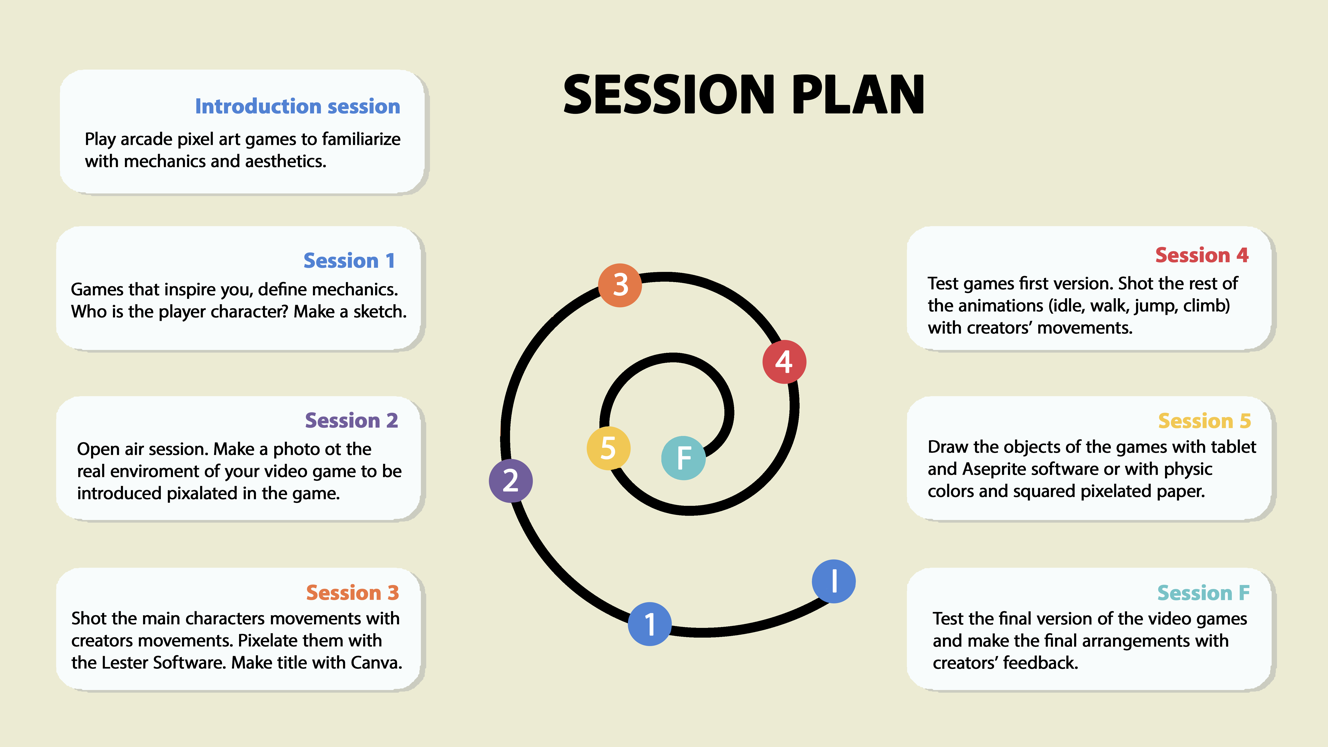
The seven-phase design-based research workshop outlines a collaborative, iterative framework for co-creating situated video games. The process initiates with an introductory session with arcade video games to explore arcade games’ mechanics, establish game goals, and map out conceptual parameters like characters, obstacles, and win conditions. Transitioning to a field-based research phase, participants capture environmental assets in the Raval neighborhood, taking photographs and videos that will later be pixelated for in-game integration. The prototyping phase leverages localized animation production, recording the movements of womxn creators to generate comprehensive character animations—such as walking, jumping, and defending—via Lester software, alongside graphic title creation. Following an evaluation of initial versions, participants draw remaining game objects using Aseprite or physical graph paper. The iterative design cycle culminates in a closure session where a final "Gold version" is rigorously tested and refined using critical feedback from the womxn creators.
This paper engages with the main goals of the audio-visual project, whose roots lie in: a) the design and instruction of mini-games; b) the technical development of Lester [22], a novel method and software tool to automatically synthesize retro-style 2D animations from live-action videos; c) the historical research and implementation of feminist representation and methodologies in the animation and video game industries; d) the theoretical research of (cinematic and interactive) animated non-fiction; e) a strong commitment to the activist potential of interactive visual culture.
1.3 Feminist Methodologies and Gendered Industry Context
A feminist perspective on video games has long been shaped by both critique and reclamation. The historical gender gap in programming evolved as the field transitioned from a feminized role established by pioneers like Ada Lovelace and the ENIAC operators2 into a masculinized industry [10], [2]. In response to these historical inequities, feminist video game studies advocate for the decentralization of male perspectives to foster greater diversity within the medium [20]. Scholars have explored "queer mechanics" and alternative norms in independent games [14], while others have focused on bringing intersectional voices to the forefront of gaming discourse [15].
Since the 1990s, scholars and activists have interrogated the medium's dominant structures—its hypersexualized female characters, exclusionary design cultures, and masculinist player norms—while simultaneously carving out alternative spaces. Early interventions, influenced by cyberfeminism [13] and media theory [6], exposed how game mechanics and narratives often reproduce patriarchal logics, positioning women as objects rather than subjects of play. In response, feminist designers, artists, and researchers began to reimagine games as sites of situated knowledge and embodied storytelling, trying to decenter masculine perspectives in gaming [17]. This shift reframes games not merely as entertainment but as cultural texts capable of articulating lived experiences, particularly those marginalized by mainstream media [23]. However, persistent obstacles remain: structural inequalities in the industry, online harassment, limited funding for experimental or critical games, and the continued marginalization of non-normative voices all constrain the broader adoption of feminist game practices [19].
Feminist game-makers have increasingly turned to interactive forms to explore trauma, memory, care, and resistance, using gameplay as a method for engaging with difficult or silenced histories. These works often function as both narrative and process: they invite players not only to witness but to participate in acts of empathy, reflection, and ethical decision-making. Developing a video game is a costly and complex endeavor, and the opportunity for marginalized populations to participate in this sector remains limited. While data from Spain suggests that women constitute over half of video game consumers, they remain underrepresented in the professional sphere, making up only 26% of the industry workforce [5]. This disparity is exacerbated when intersectional parameters—such as race, migration status, economic instability, or addiction—are considered, creating layers of exclusion that prevent diverse voices from entering the field [4].
Transgender developers like Anne Anthropy serve as pivotal examples of the shift to feminist methodologies that emphasize embodied and often under-represented experiences. Her works, such as Dys4ria, utilize accessible design tools to challenge stereotypical narratives. Similarly, organizations like Arsgames in Spain promote alternative gaming cultures, digital inclusion, and citizen participation. Organizations such as Games for Change (G4C) further highlight the growing movement to utilize digital games for ethical understanding and real-world impact. These efforts counteract a prevailing industry culture that has historically perpetuated "rape culture, homophobia, and toxic masculinities."[8] By emphasizing a gender perspective and diversity, the Video Game of My Life project aligns itself with these academic and activist movements.
The project's geographic and social focal point is the Raval neighborhood in Barcelona. Despite its status as a central tourist hub, the area contains a "hidden reality" involving a collective subjected to extreme structural violence: womxn experiencing homelessness and drug addiction. Founded by activist Aura Roig, Metzineres is not a traditional rehabilitation center; rather, it is an innovative "shelter environment" for those surviving multiple vulnerabilities3 . Unlike hierarchical sociocultural institutions, Metzineres operates on a horizontal hierarchy, providing a safe space where participants can rest, change clothes, and support one another without fear of criminalization. For these womxn, navigating the city for basic needs like food or hygiene can consume an entire day due to the scattered nature of free services. The association's main goal is not only to offer shelter, but also to empower those womxn to become the subjects of their lives rather than let themselves go by adverse urban circumstances. The project The Video Game of My Life aims to confront these circumstances of drug use and survival in a form that can act as an awakening of conscience for those who may be unfamiliar with this often-undiscussed reality.
1.4 The Strategic Use of Game Design: Empowerment, Self-expression and Activism
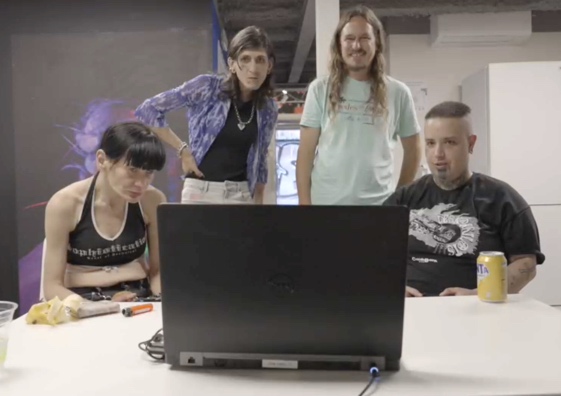
A Game design can be understood as a form of creative self-expression that parallels practices found in art therapy. Rather than focusing on the production of a polished final artifact, the design process itself enables individuals to externalize thoughts, emotions, and lived experiences through interactive systems. By translating personal narratives into mechanics, rules, and symbolic elements, participants engage in a structured form of meaning-making that goes beyond traditional storytelling. This process allows for reflection, reinterpretation, and a sense of authorship over one's experiences. Importantly, the game creation process proposed here is iterative: participants propose game mechanics and narrative ideas during the workshops, which are then implemented between sessions by professional game designers and programmers using the open-source engine Godot, similar to the muse-based game design approach proposed by Rilla Khaled [16]. In subsequent meetings, participants play these prototypes, reflect on them, and propose modifications. This cycle reinforces agency and continuous engagement, as ideas are repeatedly translated, tested, and reinterpreted.
Game design in The Video Game of My Life functions as a powerful form of creative self-expression. By translating personal narratives into digital mechanics and rules, the womxn at Metzineres will be able to engage in a structured form of meaning-making that goes beyond traditional storytelling to define how their own life situations represented. A central part of this process involves the creation of symbolic gameplay elements: participants design their own "power ups" to represent moments of empowerment and "collectibles" based on items they value in their actual daily lives. This iterative cycle—supported by workshops where users first familiarize themselves with mini-games before creating their own—ensures that the final work reflects their intimate experiences and body movements. By using tools like Lester (explained below); Graphic Tablets used to facilitate the drawing and animation process for participants unfamiliar with digital art; and Aseprite (a simple pixel art software used to create and animate "sprites"—loops of animation representing basic actions like walking or jumping) to transform their body movements and their imageries into a playable digital format, the participants gain a sense of authorship and a literal "voice" within the ludic world, which strengthens their agency.
The mini-game result of the project offers a highly effective format for extending social impact, as mini-games are brief, accessible, and easy for a broad audience to learn. As conceptual "persuasive games," they can focus on a single, well-defined idea, distilling the complex realities of structural violence and addiction into concise interactive experiences[1]. This accessibility is vital in contemporary contexts characterized by information overload, as the games are compatible with smartphones and web browsers for rapid dissemination[11]. By allowing players to engage with the subject through interaction rather than passive observation, the format encourages active perspective-taking—essentially inviting the public to "walk in someone else's shoes".
1.5 Agency and Ethical Impact of Technology
The production of The Video Game of My Life raises a specific and non-trivial technical challenge: the participants must be able to appear in the game (to be genuinely present in it) while being protected from visual identification. Historically, animation was often culturally distanced from "the real". However, since the 1990s—and notably following the 2008 success of Waltz with Bashir (Ari Folman, 2008) 4 —the genre has shifted away from fantasy to become a firm means of exploring factual content. Using animation to portray ‘the real’ reflects a cultural shift whereby animation departs from childhood- or fantasy-oriented imagery, to engage increasingly with factual content [9]. As such, a central mechanism in this process is the concept of "masking" [8]. In this case study, the aesthetics chosen are a pixelated form of rotoscoped animation that echoes earlier arcade games whilst maintaining the anonymity of the protagonist women of Metzineres. This is not merely pragmatic but an aesthetically and politically meaningful representational choice.
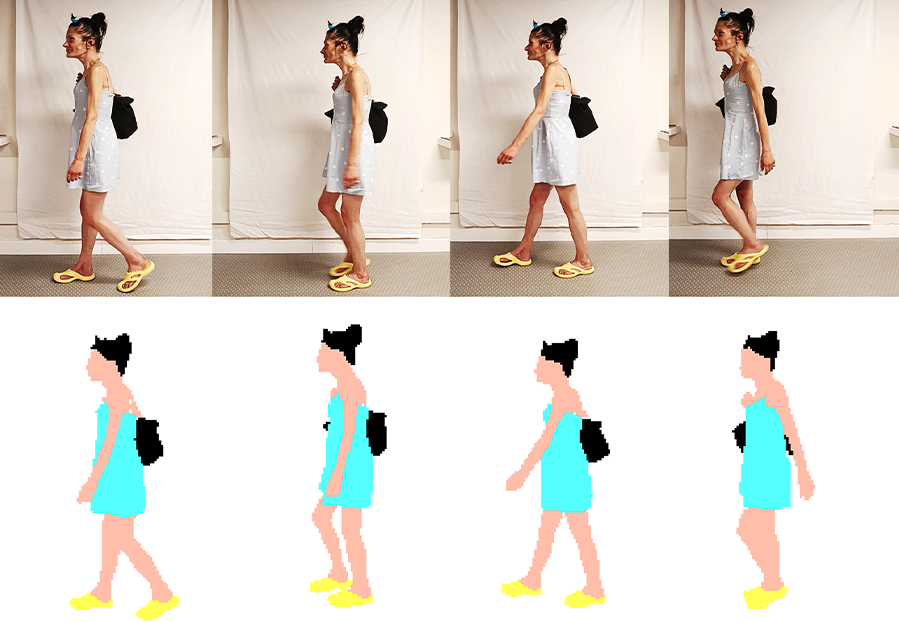
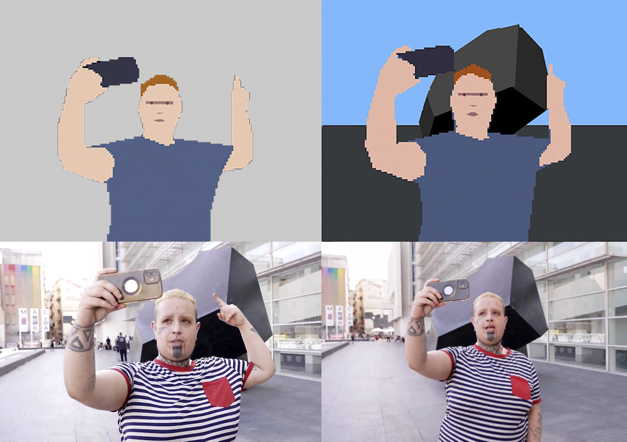
Rotoscoping, understood here as a frame-by-frame transformation of live-action footage into a 2D hand-drawn animation, has a long history in both cinema and video games. In order to include a rotoscoping stage in The Video Game of My Life, the Lester editor [21] was introduced into the project. The tool is based on a novel method [22] to automatically synthesize retro-style 2D animations from videos, developed at the Computer Architecture department of Universitat Politècnica de Catalunya in Barcelona, Spain.
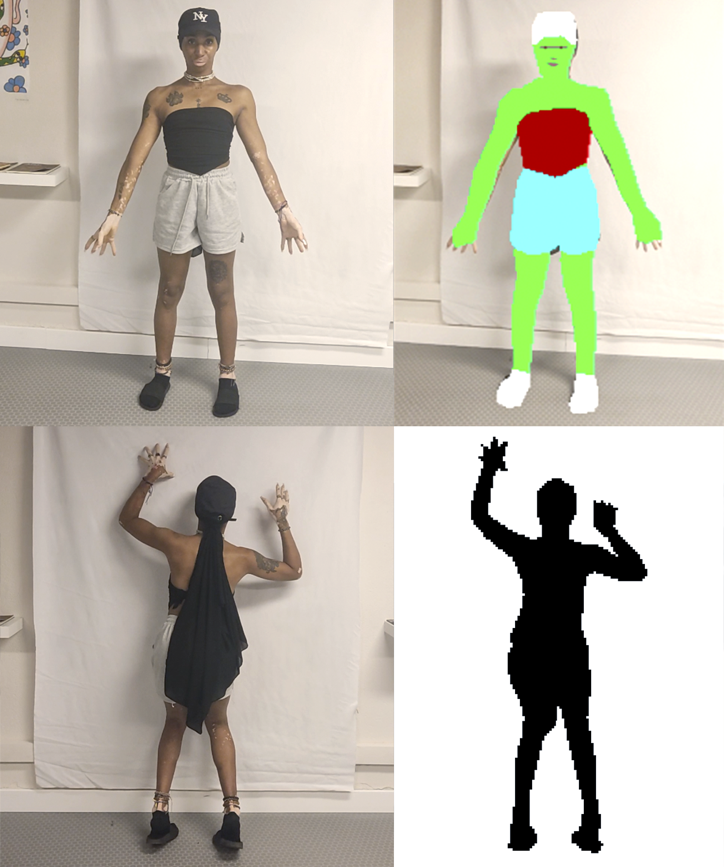
The Lester technique transforms live-action footage of real people into stylized 2D animations, and the degree of abstraction it introduces is directly controllable: a participant's silhouette, gesture, and movement can be faithfully preserved while their face and any identifying features are rendered unrecognizable. This is not anonymization by erasure but by transformation. The person remains visible, in motion, embodied, while being protected. As active participants in this ongoing, community-driven initiative, the creators of Lester are part of the project, working with the protagonists of the game, continuously able to adapt the tool throughout the process, incorporating significant modifications to meet the project's specific requirements. The technical approach is, ultimately, in service of the project's human and ethical dimensions. The local-first architecture ensures that participants' footage never leaves the production environment, a requirement that in this context is ethical before it is technical. The reduction in manual labor enabled by automatic mask propagation makes it feasible for a small team to produce a game with non-professional contributors without placing an unreasonable production burden on either side.
The use of animation to depict marginalized or underrepresented groups, such as immigrant and/or homeless womxn, introduces significant ethical considerations. Animation serves as a respectful aesthetic that facilitates representation while safeguarding the anonymity and privacy of the subjects. However, the act of obscuring a face carries a risk of suggesting invisibility or dehumanization. To mitigate this, character design and additional narrative elements are employed to evoke a sense of presence and existence rather than reducing protagonists to generic symbols. In the retro game tradition that Lester draws from, pixel art originated as a technical constraint (limited resolution and color depth) that artists progressively transformed into a distinctive aesthetic language.
It is a gestural, kinetic form of characterization particularly well-suited to a project where the participants' expressive contribution is precisely their physical presence. As a result, the viewer sees the protagonists as real people, as agents in the world. The game offers them a mode of visibility that they can control, one that is legible, dignified, and connected to a recognizable cultural tradition.
Beyond its technical capabilities, Lester embodies a set of ethical commitments that align closely with the values of the project. As a local-first desktop application, it processes all footage entirely on the user's machine, requiring no cloud infrastructure and ensuring that sensitive data is in a secure place. Built with efficiency in mind, it runs on modest hardware, lowering the barrier to access and making professional-grade animation tools available to small teams and non-institutional contexts alike. Lester is free and open-source, distributed without licensing costs or proprietary lock-in. Crucially, it relies on deterministic computer vision methods rather than generative AI, avoiding the ethical concerns and significant energy footprint associated with large-scale neural inference.
1.6 Specificity of the project
We could find isolated examples of children or women empowered through game coding in STEM oriented contexts (Fisher and Harvey, 2013), but none of them had the intersectional approach or the inclusion of marginalized perspectives of the experience presented in this text. Giving them a voice through game design reversed the often-overlooked situations of womxn who use drugs: they are invisible in terms of data collection, as well as in care and harm reduction services[36]. We speculate that this may be a reason why the video game workshop had the highest attendance rate among activities proposed by the association.
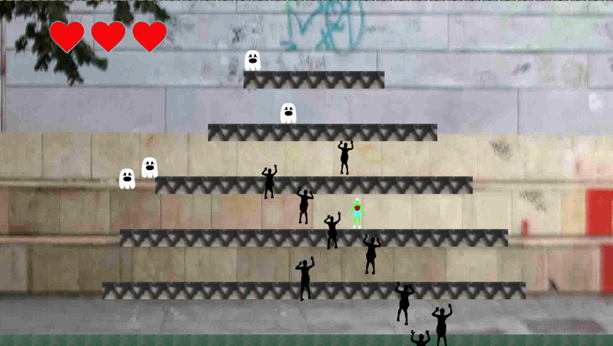
What makes this project unique is that the routines of Metzineres’ womxn have a voice in the video games’ mechanics and narratives, and the fact that they also answered with agency to the degrading treatment they often experience in real life. Throughout the iterative design process, the creators’ voices were not merely integrated but functioned as the primary organizing principle of the narrative, establishing absolute sovereignty over the game's core mechanics and structural design. Within this framework, creative expression remained uncompromised, bounded exclusively by prevailing technological constraints. As they are subject to stigma for using drugs and for breaking gender norms, these womxn have learned to survive multiple forms of violence. This violence is underpinned by sexism, classism and racism, and takes intimate faces such as partner's violence and trafficking. For these participants, drug consumption is a mechanism for survival. It enables them to navigate the hazardous environments of sex work, and resisting the acute dangers of homelessness, wherein staying awake with stimulants is a calculated tactic to avoid sexual violence on the streets. Below, we provide some examples of what was previously discussed.
To make an idle animation for the game “Ravalingos”, the creators were asked to think about what they do in a waiting situation, and an answer was to smoke crack pipe. So, the idle animation depicted a relaxed moment of drug consumption from live-action shooting that later was pixelated and introduced in the in-game. In the game “The anarchist cat”, some mechanics reverberate with the creator's routines, that include arbitrary police detention, so the main obstacle of this game is a policeman that stops violently the player while asking for card identification. The creator of the same game described exhaustively how the policeman's death animation must depict him cut in two pieces. The awareness of the marginalized position of the creator of the “Mezineres” game was expressed through the externalization of her anger against cultural elite institutions, such as the Contemporary Museum of Art in Barcelona (MACBA). This emotional link was introduced in the video games’ goal, which is to demolish the MACBA piece by piece with an iron hammer using a player character in the form of an MDMA rock (a synthetic drug).
2 Conclusion
The project The Video Game of my Life is an audio-visual short chosen and funded in the sixth edition of Simfonies de Ciutat (City Symphonies). The project matched the program's criteria, such as novelty, underrepresented imageries, artistic proposition and visually challenging narratives. Homeless womxn in extreme life conditions developed an individualized mini-game using the aesthetics of pixel art that would provide material for the audiovisual experimental short.
Aligned with the strong points of the project, the use of digitally pixelated images (usually discarded in AAA video games and cinematic spectacles) pervaded the video game as much as the final piece. The games’ pipeline used open source resources and open access repositories that made them easier to disseminate. The mini-games that resulted hindered their pixel art aesthetic to the authorial piece, that was a collage of gameplay from the imageries recreated by the design of the game. The games were only played by the users of the homeless womxn association's Metzineres, but also were introduced into the general public in cloud-based collaborative platforms as GitHub or the Metzineres web, exploring the potential of mini-games in order to achieve a positive use and to reach a broader public.
The mini-games from the workshops are a self-expression of fears or wonders of the womxn creators of the games, and in that sense, they are a work of art and a personal representation of a ludic and a fictional world. Pixel art challenges prejudices about visual hierarchy, thus about inferior and massively produced digital images, bridging it to forms of self-expression and empowerment, low budget productions and environmentally less impactful entertainment media. The final piece also challenged traditional cinematic storytelling by introducing experimental cinema through different media, achieving a short film in the intersections of cinema, video games and animation.
Acknowledgments
The authors wish to express their gratitude to Dones Visuals and the Centre de Cultura Contemporània de Barcelona (CCCB) for funding the project The Video Game of my Life as part of the sixth edition of Simfonies de Ciutat (City Symphonies) 2027. We would also like to acknowledge the Centre de la Imatge i la Tecnologia Multimèdia (CITM) at the Polytechnic University of Catalonia for providing the technical resources necessary to support the video game workshops. The development of the Lester software has been financed by Project PID2024-160996OB-I00, under grant agreement MICIU/AEI/10.13039/501100011033 and FEDER, UE, and by Generalitat de Catalunya (AGAUR) under grant agreement 2021-SGR-00478.
References
- Ian Bogost. 2007. Persuasive games: the expressive power of videogames. MIT Press, Cambridge, Mass. Retrieved from http://site.ebrary.com/id/10190451
- Shira Chess. 2020. Play like a feminist. The MIT Press, Cambridge, Massachusetts.
- Jonathan Cooper. 2021. Game anim: video game animation explained (2nd edition ed.). CRC Press.
- Kimberlé Crenshaw. 1989. Demarginalizing the intersection of race and sex: a black feminist critique of antidiscrimination doctrine, feminist theory and antiracist politics. Univ. Chic. Leg. Forum 1 (1989), 139–167.
- DEV Association. 2024. Libro blanco del desarrollo español de videjuegos 2024. DEV.
- Mary Ann Doane. 1987. The desire to desire: the woman's film of the 1940s. Indiana University Press, Bloomington and Indianapolis.
- Lucía Egaña. 2025. Un arte que transforme el mundo. Notícies. Retrieved March 28, 2026 from https://donesvisuals.cat/un-arte-que-transforme-el-mundo/
- Nea Ehrlich. 2011. Animated Documentaries as Masking. Animation Studies. Retrieved April 29, 2026 from https://oldjournal.animationstudies.org/nea-ehrlich-animated-documentaries-as-masking/
- Nea Ehrlich. 2021. Animating truth: documentary and visual culture in the 21st century. Edinburgh University Press, Edinburgh. Retrieved from https://openresearchlibrary.org/content/932c6c1a-c36a-48d0-89ec-6dcca0a046ba
- Nathan Ensmenger. 2010. The computer boys take over: computers, programmers, and the politics of technical expertise (First MIT Press paperback edition ed.). MIT Press, Cambridge, Massachusetts.
- Ling Feng, Yanqing Hu, Baowen Li, H. Eugene Stanley, Shlomo Havlin, and Lidia A. Braunstein. 2015. Competing for Attention in Social Media under Information Overload Conditions. PLOS ONE 10, 7 (July 2015), e0126090. https://doi.org/10.1371/journal.pone.0126090
- Kishonna L. Gray, Gerald Voorhees, and Emma Vossen. 2018. Feminism in play. Palgrave Macmillan, Cham, Switzerland. Retrieved from https://search.ebscohost.com/login.aspx?direct=true&scope=site&db=nlebk&db=nlabk&AN=1909436
- Donna Jeanne Haraway. 1991. Simians, cyborgs, and women: the reinvention of nature. Routledge, New York. Retrieved from http://site.ebrary.com/id/10714843
- Todd Harper, Meghan Blythe Adams, Nicholas Taylor, and Gerald Voorhees. 2018. Queerness in play. Palgrave Macmillan, Cham, Switzerland. Retrieved from https://search.ebscohost.com/login.aspx?direct=true&scope=site&db=nlebk&db=nlabk&AN=1917673
- Yasmin B. Kafai. 2017. Diversifying Barbie and Mortal Kombat: Intersectional Perspectives and Inclusive Designs in Gaming. Lulu.com.
- Rilla Khaled. 2012. Muse-based game design. In Proceedings of the Designing Interactive Systems Conference. 721. https://doi.org/10.1145/2317956.2318065
- Jennifer Malkowski and TreaAndrea M. Russworm. 2017. Gaming representation: race, gender, and sexuality in video games. Indiana University Press, Bloomington, Indiana. Retrieved from http://www.dawsonera.com/depp/reader/protected/external/AbstractView/S9780253026606
- Janine Marchessault and Susan Lord. 2007. Fluid screens, expanded cinema. University of Toronto Press, Toronto. https://doi.org/10.3138/9781442684355
- Maria Pagès Rovira and Noemí Blanch de la Cueva. 2025. Videojocs: guies per a una docència universitària amb perspectiva de gènere - Xarxa Vives d'Universitats. Xarxa Vives. Retrieved November 13, 2025 from https://www.vives.org/book/videojocs-guies-per-a-una-docencia-universitaria-amb-perspectiva-de-genere/
- Adrienne Shaw. 2012. Do you identify as a gamer? gender, race, sexuality, and gamer identity. New Media Soc. (2012).
- Tous. 2025. Lester. rtous.github.io. Retrieved April 28, 2026 from https://rtous.github.io/lester/
- Ruben Tous. 2024. Lester: Rotoscope Animation through Video Object Segmentation and Tracking. Algorithms 17, 8 (2024), 330. https://doi.org/10.3390/a17080330
- Dmitri Williams, Nicole Martins, Mia Consalvo, and James D. Ivory. 2009. The virtual census: representations of gender, race and age in video games. New Media Soc. 11, 5 (August 2009), 815–834. https://doi.org/10.1177/1461444809105354
- Atul Adya, Paramvir Bahl, Jitendra Padhye, Alec Wolman, and Lidong Zhou. 2004. A multi-radio unification protocol for IEEE 802.11 wireless networks. In Proceedings of the IEEE 1st International Conference on Broadnets Networks (BroadNets’04) . IEEE, Los Alamitos, CA, 210–217. https://doi.org/10.1109/BROADNETS.2004.8
- Sam Anzaroot and Andrew McCallum. 2013. UMass Citation Field Extraction Dataset. Retrieved May 27, 2019 from http://www.iesl.cs.umass.edu/data/data-umasscitationfield
- Martin A. Fischler and Robert C. Bolles. 1981. Random sample consensus: a paradigm for model fitting with applications to image analysis and automated cartography. Commun. ACM 24, 6 (June 1981), 381–395. https://doi.org/10.1145/358669.358692
- Chelsea Finn. 2018. Learning to Learn with Gradients. PhD Thesis, EECS Department, University of Berkeley.
- Jon M. Kleinberg. 1999. Authoritative sources in a hyperlinked environment. J. ACM 46, 5 (September 1999), 604–632. https://doi.org/10.1145/324133.324140
- Matthew Van Gundy, Davide Balzarotti, and Giovanni Vigna. 2007. Catch me, if you can: Evading network signatures with web-based polymorphic worms. In Proceedings of the first USENIX workshop on Offensive Technologies (WOOT ’07) . USENIX Association, Berkley, CA, Article 7, 9 pages.
- James W. Demmel, Yozo Hida, William Kahan, Xiaoye S. Li, Soni Mukherjee, and Jason Riedy. 2005. Error Bounds from Extra Precise Iterative Refinement. Technical Report No. UCB/CSD-04-1344. University of California, Berkeley.
- David Harel. 1979. First-Order Dynamic Logic. Lecture Notes in Computer Science, Vol. 68. Springer-Verlag, New York, NY. https://doi.org/10.1007/3-540-09237-4
- Jason Jerald. 2015. The VR Book: Human-Centered Design for Virtual Reality. Association for Computing Machinery and Morgan & Claypool.
- Prokop, Emily. 2018. The Story Behind. Mango Publishing Group. Florida, USA.
- R Core Team. 2019. R: A Language and Environment for Statistical Computing. R Foundation for Statistical Computing, Vienna, Austria. https://www.R-project.org/
- Brian K. Reid. 1980. A high-level approach to computer document formatting. In Proceedings of the 7th Annual Symposium on Principles of Programming Languages. ACM, New York, 24–31. https://doi.org/10.1145/567446.567449
- Roig, Aura. 2017. Guerra contra les drogues, Guerra contra les dones. Retrieved August 19, 2017 from http://www.social.cat /opinio/7107/guerra-contra-les-drogues-guerra-contra-les-dones
- John R. Smith and Shih-Fu Chang. 1997. Visual Seek: a fully automated content-based image query system. In Proceedings of the fourth ACM international conference on Multimedia (MULTIMEDIA ’96). Association for Computing Machinery, New York, NY, USA, 87–98. https://doi.org/10.1145/244130.244151
- TUG 2017. Institutional members of the LaTeX Users Group. Retrieved May 27, 2017 from https://tug.org/instmem.html
- Alper Yilmaz, Omar Javed, and Mubarak Shah. 2006. Object tracking: A survey. ACM Comput. Surv. 38, 4 (December 2006), 13–es. https://doi.org/10.1145/1177352.1177355
Footnote
1List of projects of Simfonies de Ciutat 2027: https://donesvisuals.cat/seleccionades-simfonies-de-ciutat-2027/
2These women names are Betty Snyder Holberton, Jean Jennings Bartik, Kathleen McNulty Mauchly Antonelli, Marlyn Wescoff Meltzer, Ruth Lichterman Teitelbaum and Frances Bilas Spence.
3For more information about the Metzineres project, see: https://metzineres.org/ca/
4The film won a Golden Globe Award, a BAFTA award, an Annie award and it was nominated for an Academy Award for Best Foreign Language Film.

This work is licensed under a Creative Commons Attribution 4.0 International License.
Expanded 2026, Linz, Austria
© 2026 Copyright held by the owner/author(s).
ACM ISBN 979-8-4007-2865-5/2026/09
DOI: https://doi.org/10.1145/3840416.3840417