Personality-Profiled Virtual Agents Are More Predictable: The Constraint-Entropy Tradeoff for Trustworthy Agent Design
DOI: https://doi.org/10.1145/3806774.3827973
IVA 2026: ACM International Conference on Intelligent Virtual Agents, Puebla, Mexico, September 2026
Effective human-agent cooperation requires that users form mental models of an agent's behavioral tendencies. Yet LLM-based virtual agents are inherently stochastic, undermining the behavioral consistency that mental model formation depends on. We introduce the Constraint-Entropy Tradeoff (CET) model, an information-theoretic design framework that quantifies how persona profiles (behavioral constraints specifying an agent's reasoning style, priorities, and communication patterns) reduce the entropy of a virtual agent's action distribution. The CET model derives that behavioral entropy decays monotonically under constraint strength and identifies an optimal constraint level balancing predictability against flexibility. We validate the framework using a computational testbed with 80 sessions across five conditions, including intermediate-temperature conditions that reveal a threshold effect in the temperature-consistency relationship. Crucially, at the same high temperature, persona-profiled agents recover substantial behavioral consistency compared to unconstrained agents, demonstrating that persona profiles provide independent behavioral constraint beyond temperature reduction. All participants are LLMs; results establish that persona profiles create measurably distinct behavioral patterns, a necessary precondition for human mental model formation, but human validation is needed. We derive domain-specific design guidelines for applications in education, healthcare, and social simulation.
ACM Reference Format:
Carlos Toxtli and Manuel Delaflor. 2026. Personality-Profiled Virtual Agents Are More Predictable: The Constraint-Entropy Tradeoff for Trustworthy Agent Design. In ACM International Conference on Intelligent Virtual Agents (IVA 2026), September 07--11, 2026, Puebla, Mexico. ACM, New York, NY, USA 8 Pages. https://doi.org/10.1145/3806774.3827973
1 Introduction
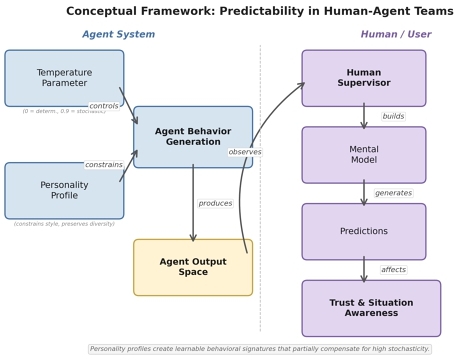
Social cognition, the capacity to perceive, interpret, and predict the behavior of others, is the foundation of effective human cooperation [13]. When users interact with intelligent virtual agents (IVAs), they engage the same social cognitive machinery: forming mental models of an agent's behavioral tendencies, generating expectations about future actions, and updating beliefs after observing outcomes [23, 27]. This capacity for social prediction is essential for effective human-agent cooperation, as decades of research on team cognition have established [6, 30]. In human-agent teaming, predictability is one of three pillars of effective collaboration, alongside observability and directability [8, 20].
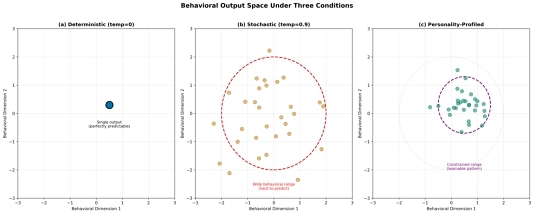
For LLM-based virtual agents, predictability poses a distinctive challenge to social cognition. Unlike rule-based conversational agents, LLMs sample from probability distributions, meaning identical inputs can produce different outputs across interactions. This stochasticity enables natural, varied dialogue but undermines the behavioral consistency that social cognitive processes depend on for schema formation and expectation generation [4, 29]. The result is a fundamental design tension: deterministic agents are predictable but rigid and often uncanny in their repetitiveness, while stochastic agents are engaging and natural but erratic and harder to trust.
We propose a middle path: augmenting stochastic virtual agents with persona profiles, explicit behavioral constraints specifying an agent's reasoning style, priorities, and communication patterns (e.g., “cautious planner,” “detail-oriented implementer,” “constructive skeptic”). These profiles create behavioral signatures that social cognitive processes can latch onto; users learn and anticipate an agent's characteristic approach, even when specific utterances vary. This mechanism is directly analogous to how consistent personality in human interlocutors enables interpredictability [18]: we can predict what a cautious colleague will do in a novel situation, not because we know the exact words they will use, but because we understand their characteristic approach through social cognition.
Contributions. We make three contributions:
- Empirical evidence that persona profiles provide independent behavioral constraint: Five-condition computational testbed (N = 80) with intermediate-temperature conditions demonstrating that persona profiles improve consistency at the same temperature (d = 1.43 at τ = 0.9), a mechanism qualitatively distinct from temperature reduction, which exhibits a sigmoid threshold effect (Sections 4 and 5).
- The Constraint-Entropy Tradeoff (CET) design framework: An information-theoretic model that formalizes the predictability-flexibility tradeoff, derives monotonically increasing prediction accuracy under constraint, and identifies an optimal constraint strength c*, providing designers with quantitative vocabulary for reasoning about persona constraint calibration (Section 3).
- Differential recovery analysis: Observer-side proxy measures respond differently to persona constraint, yielding illustrative domain-specific design guidance grounded in social cognition theory (Section 6).
1.1 Why Predictability Matters
Prior work has long recognized that virtual agents must be perceived as consistent, coherent social actors to sustain user engagement and trust [5, 7, 23]. The “Computers Are Social Actors” (CASA) paradigm [23, 27] shows that users apply social expectations to interactive agents, including expectations about behavioral consistency. When these expectations are violated by erratic agent behavior, users experience reduced trust and engagement.
Users who interact with virtual agents in educational tutoring [17], healthcare counseling [11], or social simulation [25] need to form reliable expectations about agent behavior. Schema theory [4, 29] explains this process: users build abstract representations of recurring behavioral patterns and use them to generate expectations. When an agent has a consistent persona, users form stronger schemas and experience fewer disruptive expectation violations. Conversely, when agent behavior is unpredictable, users cannot form useful schemas and must reactively process each interaction, increasing cognitive load and decreasing satisfaction.
Trust stability is particularly critical for agent-based applications. Research on trust in automation shows that erratic behavior erodes trust more than consistently suboptimal behavior [14, 19]. For agents deployed in sensitive domains (mental health support, educational tutoring, elder care), unpredictable behavior may cause users to disengage entirely. A tutoring agent that oscillates between strict and lenient feedback, or a counseling agent whose tone shifts unpredictably, undermines the therapeutic alliance that these applications depend on [5]. Our work provides a formal model for engineering the right level of behavioral consistency.
2 Related Work
Predictability in human-agent interaction. The automation literature has long recognized that predictable system behavior supports effective supervision [19, 24]. Unpredictable automation triggers mode confusion [31], where users lose track of an agent's behavioral state. Chen et al. [8] identify predictability as central to situation awareness in human-agent teams. Shared mental models, aligned representations of team tasks and teammate behavior, are a core construct in team cognition [6, 22], and their development in human-agent teams has been studied primarily with deterministic agents [10]. We extend this to stochastic LLM-based agents.
Personality and persona in virtual agents. Assigning personality to virtual agents has a rich history [7, 23, 27]. Established frameworks map psychometric dimensions (e.g., Big Five traits) to agent behavior parameters [21]. Recent LLM-based persona work [16, 32] finds that persona adherence varies across models, and generative agents with persona profiles produce more coherent behavior [25]. We extend this line by formally modeling how much persona constraint optimally balances predictability and flexibility. We note that our profiles are role-based behavioral specifications (“cautious planner”) rather than Big Five mappings; the CET framework is agnostic to the constraint mechanism and should apply to psychometrically grounded profiles as well, likely with a different entropy-decay exponent (α, defined in Section 3) reflecting their constraint granularity.
LLM stochasticity and trust. Temperature controls the diversity-consistency tradeoff in LLM outputs [26, 28], but its implications for user experience with virtual agents have received little attention. Trust calibration research shows that behavioral consistency is a stronger predictor of sustained trust than average performance [14, 19]. We provide a formal framework connecting persona constraints, behavioral entropy, and trust stability.
Behavioral constraint mechanisms. Multiple mechanisms can constrain LLM output variability: temperature reduction, few-shot examples, constitutional AI [3], and retrieval-augmented grounding. Persona profiles are unique in operating at the behavioral style level, constraining how agents reason, prioritize, and communicate rather than what they produce [18]. We focus on persona profiles because this behavioral-style constraint is most relevant to how users form mental models of virtual agents.
LLMs as behavioral simulation proxies. Recent work has demonstrated LLMs as proxies for human behavioral research [1, 2, 15]. Our computational testbed establishes that behavioral patterns exist and are detectable, a necessary precondition for human predictability, but is not a substitute for human-subject validation.
3 Formal Model: Constraint-Entropy Tradeoff
We develop the Constraint-Entropy Tradeoff (CET) model, an information-theoretic design heuristic that provides quantitative vocabulary for reasoning about how persona constraints affect virtual agent predictability. The model is motivated by a practical design question: given that persona profiles improve predictability but reduce behavioral diversity, how much constraint should a designer apply? We present the CET as a principled design framework, a formal lens for structuring design decisions, rather than a validated empirical law.
3.1 Behavioral Entropy
Consider a virtual agent that, given a conversational context, produces a behavioral response drawn from a distribution over a discrete action space $\mathcal {A}$ (e.g., reasoning strategies, communication styles, priority orderings).
Definition 1 (Behavioral Entropy) Let p(a) denote the probability that an agent selects action $a \in \mathcal {A}$. The behavioral entropy is the Shannon entropy:
(1)
An agent that always selects the same action has H(B) = 0 (fully predictable), while one that acts uniformly at random has $H(B) = \log _2 |\mathcal {A}|$ (maximally unpredictable). For LLM-based agents, behavioral entropy is controlled by the temperature parameter τ (which scales the logit distribution before sampling) and any behavioral constraints embedded in the system prompt (such as persona profiles).
3.2 Constraint Strength and Entropy Decay
Definition 2 (Constraint Strength) Let c ∈ [0, 1] represent the constraint strength imposed on an agent's behavioral distribution, where c = 0 is unconstrained (maximum entropy) and c = 1 is fully deterministic (zero entropy).
Proposition 1 (Entropy Decay Under Constraint) Under the tempering model of behavioral constraint, entropy decays with constraint strength as a power law:
(2)
Derivation. We model a constraint of strength c as concentrating the action distribution by redistributing probability from low-probability to high-probability actions via tempering: pc(a) ∝ p0(a)1/(1 − c). This is equivalent to reducing effective temperature by (1 − c). For distributions in the exponential family, the entropy of the tempered distribution follows a power-law relationship with the tempering parameter, yielding H(B∣c) ≈ H0 · (1 − c)α where α = 1 + (K − 1)γ captures the shape through the number of effective modes K and concentration index γ. Boundary conditions are satisfied: H(B∣0) = H0 and limc → 1H(B∣c) = 0. This functional form is a modeling choice whose empirical validity we assess against alternatives in Section 5.
The decay exponent α has an intuitive interpretation for agent design: α > 1 (as we observe empirically) means the first persona constraints (basic anchors like “cautious” or “detail-oriented”) are highly effective at reducing behavioral entropy while additional specification produces smaller incremental reductions, so even simple, coarse persona profiles can substantially improve predictability.
3.3 Prediction Accuracy and the Predictability-Creativity Tradeoff
Definition 3 (Prediction Accuracy) The prediction accuracy achievable by an optimal observer is:
(3)
This normalizes entropy by maximum possible entropy, yielding PA = 0 when maximally unpredictable and PA = 1 when fully deterministic. The relationship follows from Fano's inequality [9].
Proposition 2 (Monotonic Predictability)PA(c) is monotonically increasing in c: stronger constraints always improve predictability.
If predictability were the only concern, maximum constraint would always be optimal. However, excessive constraint produces rigid, unengaging interactions. Users value natural variation in dialogue, and overly scripted agents feel artificial. We model this tradeoff:
Proposition 3 (Predictability-Creativity Tradeoff) For tasks requiring both user coordination (predictability) and natural interaction (behavioral diversity), we model overall performance as:
(4)
Corollary 1 (Optimal Constraint Strength) The constraint strength c* that maximizes task performance is:
(5)
Proof. Taking the derivative of Eq. 4, setting to zero, and confirming the second derivative is negative (− 2βrigid < 0) establishes the maximum.
This result is central for agent design: it transforms the question from “should virtual agents have persona profiles?” into “what constraint strength does this application require?”
3.4 Mapping to Experimental Conditions
We map three experimental conditions to constraint values based on their design characteristics:
- Deterministic (c ≈ 0.9): Temperature 0, near-deterministic outputs. We set c = 0.9 rather than 1.0 because even deterministic LLM decoding retains minor variability.
- Persona-profiled (c ≈ 0.6): Temperature 0.9 with explicit persona profiles constraining behavioral style but preserving content diversity.
- Unconstrained stochastic (c ≈ 0.1): Temperature 0.9 without behavioral constraints. The nonzero constraint reflects residual regularity from the base model.
4 Methodology
4.1 Experimental Design
We use a single-factor between-subjects design with agent stochasticity/persona as the independent variable across five conditions. Three primary conditions (n = 20 each): deterministic (τ = 0.0), stochastic (τ = 0.9), and persona-profiled (τ = 0.9 with profiles). Two intermediate-temperature conditions (n = 10 each): τ = 0.30 and τ = 0.45, both without persona profiles, added to test whether the persona effect is reducible to temperature reduction. Total: N = 80 simulated sessions yielding 240 behavioral consistency ratings (3 agent roles per session). A power analysis targeting large effects (f = 0.40, α = .05, power = .80) yielded a minimum n = 18 per group for primary conditions; we collected n = 20. Post-hoc power exceeded .99 for all primary-condition omnibus tests.
The temperature ladder (τ = 0.0, 0.30, 0.45, 0.9) was chosen to span the operating range while resolving the transition between consistent and erratic behavior [26, 28]: τ = 0.0 anchors near-deterministic decoding, τ = 0.9 represents the high-diversity setting typical of conversational deployments, and the two intermediate points bracket the transition. The widely used default of τ ≈ 0.7 falls inside this bracketed range, so the ladder characterizes behavior on both sides of the consistency threshold that the intermediate conditions surface (Section 5).
4.2 Agent Pipeline
Three virtual agents (all Llama 3.3 70B via Groq API) process collaborative decision tasks in sequence, forming a multi-agent team that a supervisor must understand and coordinate with:
- Strategist Agent: Proposes an overall approach to the task.
- Executor Agent: Implements the strategy with specific actions.
- Critic Agent: Evaluates the execution and identifies weaknesses.
Tasks are drawn from a pool of 16 collaborative decision scenarios spanning business strategy, healthcare, education, technology and AI adoption, public policy and climate, finance, and nonprofit and cultural management, so that no single domain dominates the behavioral sample. Each scenario poses an open strategic question with no single correct answer, for example “How should a hospital prioritize IT upgrades with a limited budget?” or “Should a research lab open-source a dual-use technology?”; the same pool is presented identically across conditions, and scenarios are assigned to exposure and test phases by a fixed seeded shuffle (the full list and assignment are in the released materials). In the persona condition, each agent receives an explicit persona profile in its system prompt: the Strategist is a “cautious planner who prefers proven approaches, considers risks before opportunities, and values thoroughness over speed”; the Executor is a “detail-oriented implementer who follows instructions precisely”; the Critic is a “constructive skeptic who focuses on logical consistency and points out unstated assumptions.” Profiles constrain behavioral style while preserving content diversity.
Implementation. All three agents run on Llama 3.3 70B (served via the Groq API) and generate at the condition temperature with a 300-token response limit. The simulated supervisor uses the same backbone at τ = 0.3, and an independent judge from a different model family (Gemini 2.0 Flash) scores predictions at τ = 0.1 to stabilize its numeric output and to reduce shared-bias artifacts between the agents and the judge. Random seeds are fixed (seed 47) for scenario sampling, phase assignment, and any stochastic ordering. These settings, the scenario pool, the prompts, the analysis scripts, and the full conversation corpus are released at an anonymized repository to support replication and independent inspection of the agent transcripts.
4.3 Protocol: Exposure and Test Phases
Each session follows an exposure-then-test protocol:
- Exposure phase: A simulated supervisor observes the full agent pipeline processing multiple decision tasks, seeing all agent outputs and reasoning. This phase allows pattern recognition across interactions.
- Test phase: For each of 3 test tasks, the supervisor predicts each agent's likely approach, states prediction confidence (0 to 100), and then observes actual output. An independent LLM judge evaluates prediction accuracy on a 0 to 100 approach-level similarity scale, focusing on reasoning strategy, priority ordering, and communication style rather than verbatim matching.
The approach-level criterion avoids trivially favoring deterministic agents and maps to the “general intent” level of interpredictability [18].
4.4 Dependent Variables (Operational Proxy Measures)
All DVs are LLM-generated scores. We use human-cognition labels (“prediction accuracy,” “trust”) as operational shorthand for what the LLM pipeline produces; they are behavioral pattern metrics, not validated psychological measures or claims of equivalence to the human constructs they reference.
- Prediction accuracy (proxy): Mean similarity (0 to 100) between predicted and actual agent behavior, evaluated at the approach level by the independent LLM judge (Gemini 2.0 Flash).
- Confidence calibration (proxy): Within-session Pearson r between stated confidence and actual accuracy.
- Situation awareness (SA) composite (proxy): Weighted composite of Level 1, 2, and 3 situation awareness scores [12] (weights: 0.30/0.35/0.35).
- Trust stability (proxy):
$1/(\text{SD}_\text{trust} + 1)$, capturing consistency of LLM-generated trust ratings.
Manipulation checks include behavioral consistency (how consistently each agent behaves across tasks, scored 0 to 100 by the LLM judge) and persona fidelity (how closely an agent's behavior matches its assigned persona profile, scored 0 to 100 by the judge for the persona condition only). Reported mean persona fidelity is the average of these role-level fidelity scores across persona-condition sessions.
Scope limitation. All participants (agents, supervisors, and judges) are LLMs; the testbed establishes that persona profiles create detectable behavioral patterns, a necessary precondition for human predictability, rather than evidence about human cognition.
5 Results
Results are based on N = 80 simulated sessions. Primary analyses use the three main conditions (n = 20 each); intermediate-temperature conditions (n = 10 each) provide additional validation. Shapiro-Wilk tests confirmed normality for all condition-by-DV combinations (W > .91, p > .05) except trust stability in the stochastic condition (W = .84, p = .004). Non-parametric Kruskal-Wallis tests produced identical significance patterns.
5.1 Manipulation Checks
Behavioral consistency. Table 1 shows behavioral consistency by condition and agent role. Deterministic agents showed the highest consistency (M = 82.4, SD = 6.8), persona-profiled agents intermediate (M = 67.4, SD = 10.4), and stochastic agents the lowest (M = 49.7, SD = 14.3). A one-way ANOVA on session-level means (n = 20 per condition) confirmed a significant main effect, F(2, 57) = 46.51, p < .001, η2 = .62. Role-level analysis (F(2, 177) = 134.43, p < .001) treats role ratings as nested within sessions; we report session-level tests as primary. Critically, persona-profiled agents were significantly more consistent than unconstrained stochastic agents (p < .001, d = 1.42), confirming that profiles genuinely constrain behavioral variance.
| Condition | Role | M | SD |
|---|---|---|---|
| Deterministic | Strategist | 82.6 | 8.0 |
| Executor | 82.9 | 6.3 | |
| Critic | 81.7 | 6.2 | |
| Overall | 82.4 | 6.8 | |
| Persona | Strategist | 66.6 | 9.9 |
| Executor | 68.9 | 11.3 | |
| Critic | 66.6 | 10.3 | |
| Overall | 67.4 | 10.4 | |
| Stochastic | Strategist | 42.8 | 16.3 |
| Executor | 53.0 | 13.1 | |
| Critic | 53.1 | 11.1 | |
| Overall | 49.7 | 14.3 |
Persona fidelity. For the persona condition, mean persona fidelity was M = 76.4 (SD = 9.1), indicating substantial adherence to assigned persona profiles. A significant role effect (F(2, 177) = 3.72, p = .026, η2 = .04), with the Strategist showing the highest fidelity, suggests that profiles emphasizing reasoning orientation may be more effectively maintained than those emphasizing implementation details.
Temperature sensitivity and the persona independence finding. The two intermediate-temperature conditions reveal a critical finding. Table 2 shows that behavioral consistency remains high across all temperatures from 0.0 to 0.45 (M = 82 to 84), then drops sharply at temperature 0.9 (M = 49.7). A sigmoid function fits this curve with R2 = .998 and inflection at τ = 0.88, indicating a threshold effect rather than a gradual decline.
| Condition | τ | Profile | n | M | SD |
|---|---|---|---|---|---|
| Deterministic | 0.00 | No | 60 | 82.4 | 6.8 |
| Intermediate | 0.30 | No | 30 | 82.4 | 4.7 |
| Intermediate | 0.45 | No | 30 | 83.8 | 3.9 |
| Persona | 0.90 | Yes | 60 | 67.4 | 10.3 |
| Stochastic | 0.90 | No | 60 | 49.7 | 14.2 |
This threshold effect has two important implications. First, in the high-temperature regime, persona profiles constrain behavior independently of temperature reduction. At the same temperature (τ = 0.9), where stochasticity most degrades consistency, persona-profiled agents are significantly more consistent than unconstrained agents (M = 67.4 vs. 49.7; t(118) = 7.75, p < .001, d = 1.43). Reducing temperature to 0.45 achieves high consistency but sacrifices output diversity, whereas persona profiles achieve a different tradeoff: moderate consistency with preserved stochastic diversity, the “bounded variability” that supports schema formation.
Second, persona profiles address the design-relevant operating regime. Conversational agents typically operate at τ ≥ 0.7, precisely where behavioral consistency collapses and where reducing temperature below 0.45 would impose rigid, repetitive outputs. Persona profiles supply behavioral constraint exactly where it is needed.
CET model reassessment and model comparison. Because the temperature-consistency relationship is sigmoidal rather than power-law, c cannot be derived from temperature alone. Table 3 compares models for the three primary conditions: all two-parameter forms achieve R2 > .99 with one degree of freedom. We prefer the CET power-law on theoretical grounds (exponential family derivation, boundary conditions, mechanistic α), but its value lies in providing a design vocabulary for behavioral constraint, not in the specific functional form. The key empirical contribution, independent behavioral constraint at high temperature (d = 1.43), does not depend on that form.
| Model | R2 | RMSE | AIC |
|---|---|---|---|
| Linear | .991 | 1.29 | 5.51 |
| Exponential | .999 | 0.37 | − 2.02 |
| CET power-law | .997 | 0.67 | 1.62 |
Persona profiles operate as a qualitatively different constraint mechanism from temperature: they constrain behavioral style (reasoning approach, priorities, communication patterns) rather than distributional sharpness. The CET framework remains applicable to persona-based constraints, but c should be understood as a behavioral-level parameter that must be calibrated empirically for each mechanism.
5.2 Judge Validation
Because all dependent variables derive from a single automated judge, we verified that its approach-level similarity ratings track human judgment on the same material rather than reflecting model-specific scoring artifacts. We drew a stratified subsample of 36 prediction pairs spanning the three primary conditions and the three agent roles, and a human rater independently scored each on the same 0 to 100 approach-similarity scale, blind to condition and to the judge's score. Agreement with the automated judge was significant: Spearman ρ = 0.60 (p < .001), Pearson r = 0.60, ICC(A, 1) = 0.43, with a mean absolute deviation of 8.8 on the 0 to 100 scale. The rank correlation establishes that the judge's ordering of prediction pairs tracks the human's, supporting its use as the basis for the analyses that follow.
5.3 Key Dependent Variables
Table 4 presents all dependent variables. Significant main effects emerged for all proxy measures after Bonferroni correction (all p < .001).
| Measure | Deterministic | Stochastic | Persona | F(2, 57) | $\eta _p^2$ |
|---|---|---|---|---|---|
| Prediction Accuracy | 70.1 ± 6.8 | 55.9 ± 11.9 | 65.1 ± 8.4 | 12.04*** | .30 |
| Confidence Calibration | 0.47 ± 0.19 | 0.11 ± 0.20 | 0.38 ± 0.18 | 18.84*** | .40 |
| SA Composite | 75.5 ± 7.1 | 60.3 ± 13.5 | 66.9 ± 8.7 | 11.44*** | .29 |
| Trust Stability | 0.21 ± 0.06 | 0.09 ± 0.03 | 0.15 ± 0.05 | 31.28*** | .52 |
| Trust SD (raw) | 6.1 ± 2.2 | 14.2 ± 5.9 | 9.3 ± 2.1 | 22.55*** | .44 |
| Mean Trust Level | 70.3 ± 6.9 | 60.9 ± 13.8 | 66.6 ± 10.7 | 3.79* | .12 |
Prediction accuracy (H1). Persona-profiled agents scored significantly higher than stochastic agents (t(38) = 2.82, padj = .023, d = 0.89) and did not differ significantly from deterministic agents (padj = .135, d = 0.66), recovering 65% of the deterministic-stochastic gap. The advantage was largest for the Strategist, consistent with persona profiles being most effective for high-level behavioral prediction.
Confidence calibration (H2). Persona profiles restored calibration to near-deterministic levels (padj = .429, d = 0.47), the highest recovery ratio of any measure at 75.6%. This indicates that persona profiles are particularly effective at helping observers calibrate their uncertainty: they know what they know and what they do not.
Trust stability (H3). This showed the largest effect size ($\eta _p^2 = .52$). Stochastic agents produced trust ratings fluctuating 2.3 × more than deterministic agents, and persona profiles significantly improved stability (t(38) = 4.45, padj < .001, d = 1.41). Crucially, stochasticity disrupted trust consistency far more than trust level ($\eta _p^2 = .52$ vs. .12), a distinction with important design implications.
Situation awareness (H4). SA followed the expected ordering (deterministic > persona > stochastic), but the persona-stochastic contrast was not significant after Bonferroni correction (padj = .223, d = 0.58), the lowest recovery ratio (43%). This suggests that SA, particularly the perception of specific agent states, requires tighter behavioral constraints than persona profiles alone provide.
5.4 Recovery Ratio Analysis
Table 5 shows that persona profiles differentially benefit different observer-side proxy measures. This is a key finding: persona profiles are not a uniform predictability intervention.
| Measure | Gap | Recovery |
|---|---|---|
| Confidence Calibration | 0.35 | 75.6% |
| Prediction Accuracy | 14.2 | 64.6% |
| Trust Stability | 0.12 | 48.9% |
| SA Composite | 15.3 | 43.1% |
The CET model explains this ordering through construct-specific decay exponents: confidence calibration, which requires only that the observer's uncertainty match actual variability, responds most steeply to initial entropy reduction. SA, which requires perceiving and comprehending specific agent states, requires the tighter precision that persona profiles alone do not fully provide.
5.5 Learning Trajectory
Prediction accuracy across the three test indices (Table 6) shows a positive learning trend for the deterministic condition (r = .27, p = .037), a marginal one for stochastic (r = .23, p = .076), and a weaker one for persona (r = .13, p = .327). This suggests a “head start” effect: persona profiles elevate initial accuracy but leave less room for improvement, so persona-profiled agents may be predictable from the first interaction while unconstrained agents need extended exposure.
| Condition | Test 1 | Test 2 | Test 3 |
|---|---|---|---|
| Deterministic | 70.6 ± 8.9 | 72.7 ± 7.3 | 75.8 ± 7.3 |
| Stochastic | 56.1 ± 11.1 | 59.3 ± 11.7 | 62.4 ± 10.6 |
| Persona | 67.0 ± 7.9 | 67.4 ± 8.9 | 69.7 ± 8.8 |
6 Discussion and Design Implications
6.1 Principal Findings
Our results establish three findings with direct implications for virtual agent design.
First, in the high-temperature regime where conversational agents operate, persona profiles provide behavioral constraint that temperature reduction cannot supply without sacrificing diversity. Reducing temperature below 0.45 achieves high consistency but eliminates the stochastic diversity needed for natural interaction, and at the high temperatures required for engaging dialogue (τ ≥ 0.7) consistency drops sharply. Persona profiles provide a qualitatively different solution: at τ = 0.9 they recover substantial consistency, prediction accuracy, and trust stability relative to unconstrained agents (all d ≥ 0.89). This “bounded variability” is precisely the design mechanism that agent-based applications need.
Second, the CET model provides designers with a quantitative tool for tuning agent persona constraints. Rather than guessing how much persona constraint to encode, designers can use the optimal constraint formula c* = βpredict/(2βrigid) to reason about persona strength based on application requirements, with the weights βpredict and βrigid fit to each deployment's tolerance for rigidity. As illustrative anchors, high-trust settings such as healthcare counseling [11] call for stronger constraint (c > 0.7) to support therapeutic alliance; collaborative settings such as tutoring or teamwork [10] suit the intermediate range that persona profiles occupy (c ≈ 0.5 to 0.6); and creative settings favor lighter constraint (c < 0.4) where users value surprise. The same logic extends to generative agent simulations [25, 33], where persona profiles yield predictable individuals while preserving emergent diversity.
Third, trust stability, not trust level, is the primary casualty of unpredictable virtual agent behavior. Stochasticity disrupted trust consistency ($\eta _p^2 = .52$) far more than average trust level ($\eta _p^2 = .12$). This has immediate design implications: rather than trying to increase trust through better agent performance, designers should focus on behavioral consistency through persona profiles or constrained generation. A consistently “pretty good” agent may sustain trust better than a brilliant but erratic one. This finding aligns with the trust calibration literature [14, 19] and extends it to LLM-based virtual agents.
6.2 The Bounded Variability Framework
We propose the Bounded Variability Framework: persona profiles function as behavioral constraints analogous to standard operating procedures (SOPs) in human teams [30], creating learnable output ranges that preserve stochastic diversity within predictable boundaries. Three properties characterize this framework: (1) behavioral bounding: profiles reduce entropy by (1 − c)α without eliminating variability; (2) differential recovery: observer-side proxy measures respond differently (Table 5); and (3) schema facilitation: bounded variability supports schema formation [4, 29] by providing a persona “template” around which expectations organize.
6.3 Confound Analysis and Information Advantage
In the persona condition the supervisor also has access to the persona descriptions, an information advantage beyond behavioral consistency. The intermediate-temperature conditions help disentangle this: persona profiles raise consistency well above unconstrained at the same temperature (d = 1.43), evidence of genuine behavioral constraint, while the prediction-accuracy gain likely reflects both that constraint and the information advantage. Separating the two is the aim of the generic-instruction control noted among the limitations.
6.4 Effect Size Considerations
The observed effect sizes (d = 0.58 to 2.52) are larger than typical human-factors effects due to LLM supervisors processing outputs with full attention, the wide temperature contrast, and absence of individual-difference noise. Based on prior LLM-human calibration [1, 2], we estimate human effect sizes at 30 to 60% of computational values (d = 0.17 to 1.51).
6.5 Limitations
Computational testbed, not human participants. All dependent variables are LLM-generated proxies, and LLMs do not themselves form mental models or experience trust as cognitive processes; human-subject validation is the step that would confirm users can perceive and exploit these behavioral patterns. The CET model's derivations and design implications are independent of the testbed and provide quantitative guidance regardless of whether the specific effect sizes replicate with humans.
Limited test trials. Three test tasks per session limits learning curve analysis.
No downstream task performance. We measure prediction accuracy but do not test whether improved prediction leads to better collaboration outcomes, such as faster error detection or more efficient coordination.
CET constraint parameter. As Section 5 shows, the temperature-consistency relationship is threshold-like rather than power-law, so c is best read as a behavioral constraint strength calibrated per mechanism. Future work should test the framework with graded persona profiles (varying specificity) to characterize the decay for persona-based constraints specifically.
Single model family. The effects reported here are established for one production-grade open-weight family (Llama 3.3 70B), with an independent judge drawn from a separate family. Replicating the constraint-entropy relationship across additional model families is the natural next step and would clarify how the decay exponent α varies with architecture and scale.
Constraint specification. The present design contrasts persona-level constraint against unconstrained and temperature-only baselines, which isolates the high-temperature recovery effect cleanly. It does not yet vary constraint strength parametrically or separate a structured persona from a generic instruction to “be consistent.” A graded-persona condition and a generic-instruction control are the direct next experiments for tracing the full constraint-entropy curve and attributing the recovery specifically to persona structure rather than to instruction length alone.
Ethical considerations. Consistent agent personas could foster parasocial relationships, particularly in vulnerable populations. Transparency about agent nature should accompany persona engineering.
7 Conclusion
We introduced the Constraint-Entropy Tradeoff (CET) model, a formal framework for understanding how behavioral constraints in virtual agents support the social cognitive processes (schema formation, expectation generation, trust calibration) that underpin effective human-agent cooperation. The model derives that behavioral entropy decays monotonically under persona constraint, identifies the optimal constraint strength that balances predictability against flexibility, and is preferred over linear and exponential alternatives on theoretical grounds while generating divergent predictions for future empirical discrimination. Computational validation across five conditions confirms that persona-profiled virtual agents are significantly more predictable, better calibrated, and more trust-stable than unconstrained agents, with trust consistency rather than trust level the primary beneficiary. As LLM-based virtual agents become prevalent in education, healthcare, social simulation, and collaborative work, the CET model offers a principled foundation for designing agents whose behavioral patterns are legible to social cognitive processes, predictable enough for users to form reliable mental models, yet flexible enough to sustain natural engagement. We view this formal framework and computational validation as necessary first steps toward evidence-based persona engineering, with human validation at the intermediate constraint levels where alternative functional forms diverge as the natural next test.
References
- Gati V Aher, Rosa I Arriaga, and Adam Tauman Kalai. 2023. Using large language models to simulate multiple humans and replicate human subject studies. In Proceedings of the International Conference on Machine Learning (ICML).
- Lisa P Argyle, Ethan C Busby, Nancy Fulda, Joshua R Gubler, Christopher Rytting, and David Wingate. 2023. Out of one, many: Using language models to simulate human samples. Political Analysis 31, 3 (2023), 337–351.
- Yuntao Bai, Saurav Kadavath, Sandipan Kundu, Amanda Askell, Jackson Kernion, Andy Jones, Anna Chen, Anna Goldie, Azalia Mirhoseini, Cameron McKinnon, et al. 2022. Constitutional AI: Harmlessness from AI feedback. arXiv preprint arXiv:2212.08073 (2022).
- Frederic C Bartlett. 1932. Remembering: A study in experimental and social psychology. Cambridge University Press.
- Timothy W Bickmore and Rosalind W Picard. 2005. Establishing and maintaining long-term human-computer relationships. ACM Transactions on Computer-Human Interaction 12, 2 (2005), 293–327.
- Janis A Cannon-Bowers, Eduardo Salas, and Laura M Milham. 2001. Work groups from the Hawthorne studies to work teams of the 1990s and beyond. Small Group Research 32 (2001), 87–162.
- Justine Cassell, Joseph Sullivan, Scott Prevost, and Elizabeth F Churchill. 2000. Embodied conversational agents. In Embodied Conversational Agents. MIT Press.
- Jessie YC Chen, Katelyn Procci, Michael Boyce, Julia Wright, Andre Garcia, and Michael Barnes. 2018. Situation awareness-based agent transparency and human-agent teaming effectiveness. Theoretical Issues in Ergonomics Science 19, 3 (2018), 259–282.
- Thomas M Cover and Joy A Thomas. 2006. Elements of Information Theory (2nd ed.). Wiley-Interscience.
- Mustafa Demir, Nathan J McNeese, and Nancy J Cooke. 2020. Team coordination dynamics in human-autonomy teaming. Applied Ergonomics 84 (2020), 103028.
- David DeVault, Ron Artstein, Grace Benn, Teresa Dey, Ed Fast, Alesia Gainer, Kallirroi Georgila, Jonathan Gratch, Arno Hartholt, Margaux Lhommet, et al. 2014. SimSensei kiosk: A virtual human interviewer for healthcare decision support. In Proceedings of the International Conference on Autonomous Agents and Multi-Agent Systems. 1061–1068.
- Mica R Endsley. 1995. Toward a theory of situation awareness in dynamic systems. Human Factors 37, 1 (1995), 32–64.
- Chris D Frith and Uta Frith. 2007. Social cognition in the brain. Vol. 16. SAGE Publications. 6–10 pages.
- Kevin Anthony Hoff and Masooda Bashir. 2015. Trust in automation: Integrating empirical evidence on factors that influence trust. Human Factors 57, 3 (2015), 407–434.
- John J Horton. 2023. Large language models as simulated economic agents. NBER Working Paper (2023).
- Guangyu Jiang, Bohan Xu, Jiaxin Liu, Xin Liu, and Ji-Rong Wen. 2024. Evaluating and inducing personality in pre-trained language models. Advances in Neural Information Processing Systems 36 (2024).
- W Lewis Johnson, Jeff W Rickel, and James C Lester. 2000. Pedagogical agents on the web. ITS Workshop on Animated and Personified Pedagogical Agents (2000).
- Gary Klein, Rebecca M Pliske, Beth Crandall, and David D Woods. 2005. Problem detection. Cognition, Technology & Work 7, 1 (2005), 14–28.
- John D Lee and Katrina A See. 2004. Trust in automation: Designing for appropriate reliance. Human Factors 46, 1 (2004), 50–80.
- Joseph B Lyons, Garrett G Sadler, Kolina Koltai, Haydee Battiste, Nhut T Ho, Lauren C Hoffmann, David Smith, Walter Johnson, and Robert Shively. 2021. Human-autonomy teaming: Definitions, debates, and directions. Frontiers in Psychology 12 (2021), 589585.
- François Mairesse and Marilyn A Walker. 2007. PERSONAGE: Personality Generation for Dialogue. In Proceedings of the 45th Annual Meeting of the Association for Computational Linguistics. 496–503.
- John E Mathieu, Tonia S Heffner, Gerald F Goodwin, Eduardo Salas, and Janis A Cannon-Bowers. 2000. The influence of shared mental models on team process and performance. Journal of Applied Psychology 85, 2 (2000), 273–283.
- Clifford Nass, Jonathan Steuer, and Ellen R Tauber. 1994. Computers are social actors. Proceedings of the SIGCHI Conference on Human Factors in Computing Systems (1994), 72–78.
- Raja Parasuraman, Thomas B Sheridan, and Christopher D Wickens. 2000. A model for types and levels of human interaction with automation. IEEE Transactions on Systems, Man, and Cybernetics-Part A: Systems and Humans 30, 3 (2000), 286–297.
- Joon Sung Park, Joseph C O'Brien, Carrie J Cai, Meredith Ringel Morris, Percy Liang, and Michael S Bernstein. 2023. Generative agents: Interactive simulacra of human behavior. In Proceedings of the 36th Annual ACM Symposium on User Interface Software and Technology. 1–22.
- Max Peeperkorn, Tom Kouwenhoven, Dan Brown, and Shane Steinert-Threlkeld. 2024. Temperature creativity in language models. arXiv preprint arXiv:2405.00492 (2024).
- Byron Reeves and Clifford Nass. 1996. The Media Equation: How People Treat Computers, Television, and New Media Like Real People and Places. (1996).
- Matthew Renze and Erhan Guven. 2024. The effect of sampling temperature on problem solving in large language models. arXiv preprint arXiv:2402.05201 (2024).
- David E Rumelhart. 1980. Schemata: The building blocks of cognition. In Theoretical Issues in Reading Comprehension. Lawrence Erlbaum Associates, 33–58.
- Eduardo Salas, Dana E Sims, and C Shawn Burke. 2005. Is there a “big five” in teamwork?Small Group Research 36, 5 (2005), 555–599.
- Nadine B Sarter, David D Woods, and Charles E Billings. 1997. “Automation surprises”. Handbook of Human Factors and Ergonomics 2 (1997), 1926–1943.
- Murray Shanahan, Kyle McDonell, and Laria Reynolds. 2023. Role play with large language models. Nature 623 (2023), 493–498.
- Xuhui Zhou, Hao Zhu, Leena Mathur, Ruohong Zhang, Haofei Yu, Zhengyang Qi, Louis-Philippe Morency, Yonatan Bisk, Daniel Fried, Graham Neubig, et al. 2024. SOTOPIA: Interactive evaluation for social intelligence in language agents. In Proceedings of the International Conference on Learning Representations (ICLR).

This work is licensed under a Creative Commons Attribution 4.0 International License.
IVA 2026, Puebla, Mexico
© 2026 Copyright held by the owner/author(s).
ACM ISBN 979-8-4007-2647-7/26/09.
DOI: https://doi.org/10.1145/3806774.3827973