Exploring the Media Multiverse in 2084
DOI: https://doi.org/10.1145/3843148.3843158
Mindtrek 2026: 29th International Academic Mindtrek, Tampere, Finland, October 2026
Narratives about the future of the mediascape tend to conceptualize it as a singular space, but today we are instead witnessing its pluralization into a Media Multiverse. To better understand this tension, we invited authors to provide fictional abstracts of future research projects on this emerging mediascape. Accordingly, we present 20 abstracts from 32 authors representing a diverse range of perspectives, from Human-Computer Interaction (HCI) to interaction design, media studies, translation studies, semiotics, and the social sciences – incorporating but also going beyond HCI perspectives. No unified definition of the Media Multiverse is identified, but in general, authors imagine the Multiverse as a shared space of bodily engagement and situated experiences. As a first attempt in exploring the notion of the Media Multiverse, this paper is an example of how speculative abstracts can function as a method for data collection beyond simple scoping or trend identification within HCI.
ACM Reference Format:
Cansu Çetin Er, Riku Haapaniemi, Mattia Thibault, Amber Maimon, Amirhosein Asghari Tavana, Asif Shaikh, Aygün Varol, Batu Aytemiz, Benedikt Morschheuser, Bruno Surace, Çağlar Genç, Danica Maier, Daniel Fernández Galeote, Daniil Doyno, Digdem Sezen, Donald Degraen, Eve Weston, Iddo Yehoshua Wald, Isaac Naor, Jaana Mäkinen, Johanna Virkki, Jonathan Stief, Juho Hamari, Mark Kaunisto, Mila Bujić, Nancy Seidler, Nima Sharafi Rohani, Oğuz 'Oz' Buruk, Pelin Aytemiz Karslı, Runjie Xie, Sandra Birnstiel, Tanja Vihriälä, Tonguç Sezen, and Xinyi Tu. 2026. Exploring the Media Multiverse in 2084. In 29th International Academic Mindtrek (Mindtrek 2026), October 27--30, 2026, Tampere, Finland. ACM, New York, NY, USA 13 Pages. https://doi.org/10.1145/3843148.3843158
1 Introduction
What will be the shape of the mediascape in the future? The current narratives of its development envision towards a unified "metaverse" [11] that would provide a hegemonic virtual universe as a continuous and interconnected multi-user environment fully integrated with (or even replacing) physical reality [25]. Yet, emerging work has begun to foreground plurality in how immersive realities are and can be imagined [17].
Building on this recent work, we propose the concept of media multiverse as a way of re-imagining the future mediascape. In a media multiverse, we construct our understanding of the world and communicate with each other through various mediatic technologies and practices whose multifarious forms affect how and what we understand and communicate. Virtual engagement is not monolithic but pluralistic, as also suggested by previous work [17], and this plurality may just as well spell hybridization or polarization, freedom or chaos, communal negotiation or social control.
With this framing, our first research aim is to critically explore the future of this proposed mediascape through elicitation and analysis of a curated set of speculative abstracts. To achieve this, we asked a multidisciplinary group of scholars to speculate about a world filtered through this kind of heterogeneous mediascape in the year 2084, a date recalling both the conflict between human and machine (as in the arcade game Robotron: 2084 [21]) and the use of communication systems for social control (as in Orwell's 1984 [28]). Scholars were invited to write fictional abstracts about studies conducted in 2084, and we have curated and analyzed these abstracts in this paper.
Our second research aim is a methodological one. In some previous fictional abstracts, they are gathered through an open call and presented as a curated collection [30]. In other cases, the abstracts are generated by the researchers themselves to embody their speculations [14] and included as a whole in the paper [35, 37]. Our paper contributes to and extends these approaches by bringing together both an abstract collection -which in itself offers a meaningful contribution by bringing together a variety of imaginations open to interpretation- and also our own analysis of such texts. The fictional abstracts, then, are used both as a way to open up fictional potentials on a certain topic, but also serving as vehicle for a more in-depth analysis of the socio-technical imaginary[22] through our analysis.
Our analysis, then, shows that media multiverse is indeed a kaleidoscopic media multiverse, governed by dynamics of translation, adaptation, and navigation of users and textualities across different realities, worlds, and universes; accompanied by other mediatic techno-social innovations related to Extended Realities, bio-tracking, adaptive algorithms, wearables, bodily technologies, and more; and viewed through new paradigms, from media convergence, posthuman, and post-digital approaches to critical emergent frameworks. Using the shared, specialized language of academic abstracts, we have brought together a diverse array of perspectives from language and media studies, social sciences, interaction design, human-computer interaction (HCI), and beyond to complement and challenge dominant technocentric narratives about the development of media technologies by presenting a compilation of conflicting and contrasting speculations about the future that nevertheless together cast a critical lens on the role of technology in our world.
Our contribution to HCI is two-fold. First, our work introduces the Media Multiverse as a conceptual base for examining future sociotechnical imaginaries. Second, the multidisciplinary nature of the collection and the result of our analysis of the abstracts suggest that collections of speculative abstracts could go beyond simple scoping or identification of trends to which they have been relegated so far. Beyond HCI, therefore, speculative abstract collection and analysis can become a data-collection strategy that allows to generate new knowledge about sociotechnical imaginaries, ideological narratives of future technology, and the counternarratives that can critique them.
2 Background
2.1 Mediascape and the Metaverse
The ways in which we name and discuss media -intended as the communication devices we use to share information- is often metaphorical [36]. However, the metaphors we use to discuss media are not neutral as they support and enable different forms of media ideology [15]. Media have a crucial function in shaping the "messages" we exchange [24], and therefore our semiosphere [23], i.e., our shared semiotic reality. At the same time, media are, in turn, shaped, conceived, and used according to ideological discourses that surround them. Narratives related, e.g., to transparency, technological development and interactivity [2] can shape policies, platform development, user behavior and more.
At the same time, different media influence each other synchronously -being all part of the same media ecology [31]- as older media permeate new ones in forms of remediation [4], but also allow for the "what if" explorations of media archaeology [19]. Any critical reflection on media, therefore, cannot focus on them in isolation, but should rather focus on a mediascape, understood as the ensemble of all existing (and pre-existing) media and their reciprocal influences.
That of the metaverse, or more in general of an avatar-based, navigable, and interactive 3D visualization of the internet has been a long-lasting ideological narrative focusing on the future of our mediascape. It has been introduced in our socio-technical imaginary [22] though sci-fi (e.g. in works from Gibson [16], Stephenson [34], and Cline [8]), and have been engaged by HCI research for a long time [12], from perspectives including our technological readiness for it [7], and the need for regulation [33]. Nevertheless, still recently, the concept has been able to attract billions of dollars in investments -although with suboptimal results [32]- demonstrating the continued influence of the metaverse narrative beyond speculative and academic discourse.
Our aim of exploring critical reflection on the future of the mediascape has also been a concern in HCI [20]. While existing work has often framed the lack of a unified metaverse as a limitation -even though plurality is considered to some extent [17]- and envisioned greater integration between virtual environments [11], we propose to explore a counter-narrative to the metaverse: that of the media multiverse. In contrast to this emphasis on unification, we position plurality as a defining feature of the future mediascape. Rather than considering plurality as a limitation to be overcome, the multiverse is imagined as its polar opposite, and highlights fragmentation, multiplicity, diversity, and variety in media and in the communities that use them.
2.2 Speculative Abstracts
Speculative abstract collections are a curated set of short, fictional academic abstracts that collectively imagine and articulate possible futures within a given domain [30]. They have been utilized to critique and propose speculative visions for the future of HCI conferences, as demonstrated by CHI 2039 [3] and CHI 2077 [6], as well as to present future visions of specific technologies. While our approach takes inspiration from these, we did not aim for a specific venue or a technology strictly, rather we wanted to present a pluralistic and multidisciplinary view of the future of the mediascape as "the Media Multiverse of 2084", that has been envisioned by different fields that are already shaping, discussing or engaging with these spaces, and not just limited to HCI researchers.
Speculative approaches have also been used to explore topics beyond specific venues or technologies, including fictional narratives integrated into research papers [35, 37] and collections of fictional abstracts to understand a specific topic [14]. These approaches position fiction not simply as a representation of a possible future, but as a means of questioning assumptions and opening up alternative ways of imagining, an approach we build on while also extending their use by analyzing the resulting collection to reveal what the future of the mediascape could look like.
3 Method
In this collective paper, we used speculative fictional abstracts as a method to collect imaginaries of the future of the mediascape from diverse disciplinary perspectives, including human-computer interaction (HCI), interaction design, semiotics, media studies, translation studies, and linguistics.
3.1 Fictional Abstract Selection Procedure
We opened a call for speculative abstracts in January 2026. In the call, we explained what we mean by "media multiverse" and the motivation for exploring it with a future perspective as a speculative abstract collection. We also provided background information on speculative design, specifically by giving examples of previous fictional abstracts [3, 6, 30] and references on how to write a speculative abstract, as explained by [29].
We distributed the call through mailing lists related to the aforementioned fields that engage with media, communication, and speculative methods. The call remained open for one month, resulting in 31 submissions. After the submission deadline, as the first three authors (sharing corresponding responsibilities), we read the abstracts and ranked them independently. Then, we had a meeting to triangulate our rankings to select the final 20 abstracts presented in the paper, based on multidisciplinarity, a wide range of technologies, and a variety of approaches and perspectives on the future.
After this selection, we reached out to authors to request further revisions, either for clarity or to better align with the abstract format in terms of the information provided or the word count. We did not give any instructions vis-à-vis the content of their abstracts. We gave them two weeks for these revisions.
3.2 Fictional Abstract Analysis
For the analysis, we adopted a two-part process, reflecting the first three authors’ backgrounds in translation studies, semiotics, HCI, and interaction design, and their complementary analytical approaches. This interdisciplinarity contributed to the exploration of themes from different perspectives and supported the reliability of the coding.
After we collected all revisions from the accepted abstracts, we reviewed them together in a meeting to familiarize ourselves with the data. After this meeting, the first author, who has a background in HCI and interaction design, analyzed the fictional abstracts through reflexive thematic analysis [5]. This author conducted the initial coding to identify recurring themes, patterns, technologies, and ideologies mentioned in these abstracts. By doing so, she generated the initial themes. In the meantime, the second author, who has a background in semiotics and translation studies, conducted a close reading [27] of all the abstracts, while taking notes and pinpointing important observations based on his tacit knowledge and expertise.
Following this two-part analysis, the first three authors had a meeting where the first author presented her coding and initial themes. Then, the second author presented the results of the close reading, in the form of recurring and relevant themes. Building on these presentations, the authors discussed the intersections and common patterns across the analyses. This led to the review and finalization of the themes and topics, which are further explained in the Analysis section.
4 Speculative Fictional Abstracts
A1: 
Author (Fictional): 001101 Δ -Mapping Unit (Human Instance) * S. ßurα çë–BrØnØ1
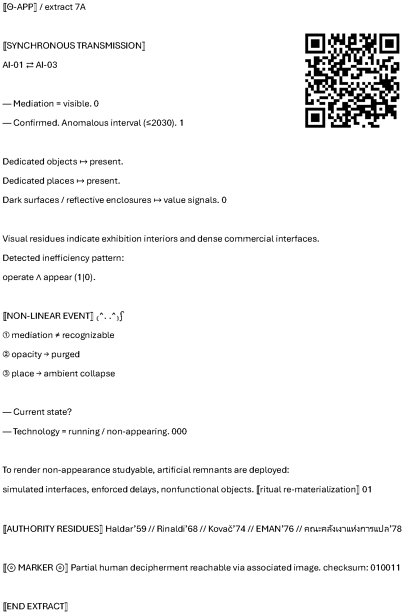
Partial human decipherment reachable via associated image (Fig. 1) [1].
A2: There's a Journal in My Head: Autoethnographic Self-Provocations on Radical Intramedial Communication
Author (Fictional): Ego Ipsum, Independent Researcher 2
For over three decades, humans have been confined to cocoon centers to maximize efficiency (Teknokratik Plex Decree 2048-77). The solitude of these phenomenological ecologies of one, dubbed "coffins" by bygone luddites, has been mitigated via mental linkages across cocoons. While most people routinely share their psyche with others, a growing minority choose to venture alone in their worlds and selves within, aided by meta-neural agents such as shoulderDaemonσ and selfTranslation≈. Although nicknamed "Mind Wankers" by neoluddites, in-communicators report higher wisdom (measured by standardized benchmark tests), happiness (Id.), and value (Id.). However, no scientific accounts detailing the inner experience of absolute independence exist. In this study, I report a year in which, having erased all memory of legacy social contact and overclocked my external irritation blockers, I aimed to cultivate purely intra-me-dial communication and achieve a perfect state of uni-multi-versal being, feeling, knowing, creating... Having committed to absolute isolation, I self-publish this article within a special issue of Chrysalis: Intracranial Journal of Me-dia Studies. I wrap up my contribution with a puzzle for my own amusement: If this is a human…
A3: Understanding The Phantom Snail: Haptic Negative Space mitigates Phantom Mucus Sensation in Long-Term Dermal Haptic Implant Use
Author: Donald Degraen, University of Canterbury, Christchurch, New Zealand
Dermal Haptic Implants (DHIs) are ubiquitous for navigating the media multiverse. However, long-term users reported experiencing the ’phantom mucus’ effect, where tactile sensations described as snails traversing the skin are felt after leaving virtual worlds. We hypothesize that this phenomenon emerges from incongruent micro-stimulations during reality transitions, resulting in a reality bleed caused by persistent low-level mechanoreceptor activations. To evaluate our hypothesis, we recorded haptic activations and conducted post-experience questionnaires in a three-month observational study (N=20,000). Results indicate transitions between realities to be the primary cause of phantom sensations. In a one-year deployment study (N=2,084), we evaluated three interventions: intermittent sensory fasting, periodic haptic noise, and incongruent visuo-haptic stimuli. Results show that structured haptic negative space, i.e., intentional intervals of tactile inactivity, significantly reduced the frequency and intensity of phantom experiences. We discuss design implications for continuous haptic systems and argue for designed absence in long-term somatic interaction.
A4: Automated Real-Time Analyses of Language Change Across World Languages: Evaluation and Prospects
Author: Mark Kaunisto, Tampere University, Tampere, Finland
Since the linguistic turn of the 2030s—marked by the first continuously refreshed megacorpora and standardized intra-day shift analytics—the real-time monitoring of language change has become a routine component of linguistic research. What earlier generations quaintly described as “trend tracking” has matured into fine-grained detection of micro-innovations in the lexicon, spelling, morphosyntax, and discourses, observable simultaneously across regional, social, thematic, and register-governed dimensions. These analyses operate across the layers of physical, augmented, and virtual environments in which linguistic variants circulate at different speeds and follow different interactional norms. As different communicative spaces produce reality-specific trajectories of change (e.g., rapid fluctuation in immersive VR versus slower stabilization in mixed AR settings), combining the distinct analytic parameters of each layer has been key to the development of these practices. This study revisits two persistent methodological issues in modern linguistics. First, the problem of defining operational thresholds for identifying innovation, diffusion, stabilization, evolution, and obsolescence within continuously updating data streams. Second, the recursive impact of the now-institutionalized Pulse Reports on linguistic shifts, which since the late 2040s have repeatedly been shown to generate measurable counter-innovations, policy pushbacks, and backlash cycles. These dynamics highlight the paradox of observing changes that are altered by being reported.
A5: The Halo City: Managing Emotional Flows Through Aura-6
Authors: Aygün Varol, Asif Shaikh, Johanna Virkki, Tampere University, Tampere, Finland
Affect-inference pipelines have expanded into metropolitan-scale infrastructures, translating biosignals into mixed-reality chromatic halos. Since the 2078 deployment of Aura Lenses, these systems have become integral to managing high-density emotional flows across the city's media multiverse. These flows now migrate from transit corridors into domestic dashboards, workplace compliance interfaces, and entertainment streams, where halos are re-encoded as safety signals, professionalism scores, or engagement metrics. To address drift propagation, instability under peak loads, and vulnerability to deliberate masking observed in Aura-5, we introduce Aura-6, a redesigned architecture integrating expanded sensor-fusion pathways, adaptive preprocessing, and region-level affect-coherence modeling. In our study, we analyse 3.2 million aura-transition events across three transit corridors shows a 42% reduction in cross-corridor drift and sub-25 ms synchronization under moderate load, while adaptive filters reduce disturbances from user-initiated obfuscation. This translation is not neutral, as domestic halos become vectors of intimate surveillance, which can systematically disadvantage neurodivergent and cross-cultural expression. These translations reinforce three emerging governance modes: etiquette-by-algorithm, which suppresses high-arousal chromatic spikes; credentialed calm, where institutions require pastel-baseline stability validated by region-level coherence metrics; and counter-aura practices, where activists exploit residual noise channels to resist deterministic profiling.
A6: Better Living Through Teleliving
Author (Fictional): Kate Saunders, The Look Club (TheLook.Club) 3
Since FDA approval of “teleliving” in 2064, UN member nations have seen a significant reduction in chronic loneliness, particularly among single-adult populations. With 1.8 billion daily users, what started as a participatory “sitcom” has become a literal way of life and a well-regarded medicinal practice. Patented by Exelauno LLC, teleliving enables viewer-participants to experience family, work, and social life, and a narrative, fictional entertainment world seamlessly through XR devices, with real-time biometric data adjusting the pacing and balance of experiences to optimize productivity, happiness, and health based on the viewer-participant's physiology. Consequently, the mass adoption of MR visor-glasses has provided an unexpected respite from a device-heavy media multiverse, amplifying the dopamine boost and parasocial relationships of sitcoms even beyond the 27% demonstrated by in-headset 360 content. Chi-square analysis of teleliving and migration data between 2067–2082 reveals a statistically significant correlation between teleliving and the rural sprawl of the ‘70s. Single adults now see friends and colleagues more frequently, with less stress and expense than in densely populated cities, and medical insurance companies report a decrease in hypertension, diabetes, and depression with regular teleliving practice. Building on these findings, this paper examines the medical, ethical, and geographical risks posed by copycat teleliving companies, especially those aiming to reduce operating costs by incorporating pharmaceutical supplements into the experience.
A7: Cognitive Drifting and Proxy Selves in Multiverse Marseille
Author (Fictional): Kira Gousefi (Humanoid Co-Inhabitant, Model HRU-7), Department of Mediated Cognition, Marseille 4
After France's Cognition Integration Act (2072), Marseille, Europe logistics hub where autonomous shipping, migrant networks, and hybrid governance converge, became a testbed for neural interfaces and city-scale AI mediation. By 2084, public space operates as a Media Multiverse where the same street appears through different AI-curated layers, creating identity uncertainty in everyday encounters. In markets, a “vendor” may be a robotic body whose controller shifts mid-sentence from a remote worker to an AI or a municipal agent. In autonomous taxis, the “driver” voice can switch without notice. When agency is invisible, trust erodes and cognitive privacy is threatened. Guided by Simondon's concept that individuation is a dynamic process through which technologies, beings, and ideas emerge, we treat identity as relationally produced, so urban interfaces shape who someone becomes in interaction. Using a Civic Convergence Protocol, a citizen-centered participatory method, we convened three city publics, offline citizens, neural citizens, and humanoid co-inhabitants to test neural mediation and agent handoffs. Breakdowns clustered when people decide whether to share attention, data, or payment. We propose Legibility Architecture, an urban interface principle: agency labels, audible handoff cues, neural consent gates, and unaugmented zones to restore shared ground.
A8: Caves of Otherness: A Trio-Ethnographic Study of Sensorily Altered Communities of Otherness Practice
Authors (Fictional) 5: Vesper Tilioz Yankın, Alteration Group, Playgrounds Institute,
Eldrýn Ilmvíxúlf, Scent Modulation and Identity Studies, Miðrás University of Media, Art and Biosystems,
Cagarallus Gemycelius, Institute for Mycelial Futures
The contemporary reframing of sensory augmentations as "perception alteration technologies" has intensified its use in inter-species relational practices. This shift emerged from early 21st-century transspecies movements and grassroots do-it-yourself collectives (mostly with human-originated members) such as the Batcave sonar community with human and bat-originated members, the scent-altered Wolf Pack Furries that have members who use smell to communicate, and the electrical current–based Myco-mmunes of humans, mushrooms and others, each reorganizing communication around newly engineered sensory ecologies. These virtual “Caves of Otherness” restrict interaction exclusively to their own altered perceptual channels, positioning additional sensory organs as gateways to experiential, social, and ecological becoming-other. In this study, we conducted a trio-ethnography with three sensorily altered researchers, one embedded in each community, over six months, living and communicating through modified perceptual infrastructures. Findings indicate that, while alteration technologies expand experiential potential and cultivate engagements among different species of same communities and with the notion of otherness, they simultaneously reproduce dynamics reminiscent of colonial and ableist structures: the systems designed still systemically discriminated practices such as exclusion of members with different versions of the technologies or origin species. We argue that future media multiverses must invest in communication practices that will prioritize relational practices, care, kinship, and co-habitation rather than relying only on sensory translations since this reductionist approach seem to re-center human values.
A9: Silence as Commons: An Ethnography of Deprivation Synchronization
Authors (Fictional) 6: Batu Aytemiz, Merceka Institute of Science,
Pelin Aytemiz, Laboratory of the Ordinary,
Chell Rattmann, Apertura Institute of Applied Sciences
Despite pervasive multiversal individuation, a growing number of youth communities practice deprivation synchronization — collective fasting from spirit-curated input to converge on a singular, unmediated reality. Participants disable their Ambient Wellbeing Monitor (or ’the leash’), tolerating distress alerts triggered by deviation from mediated baseline states, and sustain coordinated withdrawal. Because spirit-mediated individuation renders each participant's baseline experience incommensurable, we adopt a triangulated approach bridging first-person and spirit-first perspectives: observation of four synchronization circles, interviews with 29 participants, spirit modulation logs registering host-engagement deficit across all monitored sessions, and a researcher autoethnography. Most participants reported brief but vivid experiences of shared, unindividuated presence, though a significant number abandoned the practice due to discomfort with unfiltered perception, and effects dissipated rapidly upon re-engagement. Our own autoethnographic participation was curtailed prematurely, though the relational dynamics of this curtailment proved analytically productive. These findings suggest that interreal convergence on shared reality, while achievable through collective withdrawal, remains fragile and self-limiting.
A10: After Language: OpenClaw, Neural Mediation, and the Luxury of Friction in 2084
Author: Isaac Naor, Independent Researcher, Los Angeles, California, USA
In 2084, the public internet operates autonomously through OpenClaw-class agentic infrastructures, with minimal direct human participation. Human interaction is primarily mediated through high-bandwidth brain–computer interface (BCI) systems that enable direct cognitive exchange, significantly reducing reliance on spoken and written language in both distributed and co-present human interaction. This paper investigates the socio-technical consequences of post-linguistic communication within the Media Multiverse. Using archival analyses of early 21st-century Human–AI Interface governance experiments and contemporary ethnographic observations of neural-mediated publics, we examine how cortical protocol architectures regulate permissioning, provenance, and agency. Our findings suggest that while neural mediation increases coordination efficiency, it compresses interpretive ambiguity and narrows deliberative friction. We document the emergence of “Analog Commons” collectives who deliberately practice unaugmented speech, music, and embodied artistic production. In this context, language functions as a technologically reproduced luxury signal, while non-optimized human expression becomes a sign of cultural resistance and cognitive sovereignty.
A11: Opening Perspectives: Translationality as a Shared Civic Practice
Author: Danica Maier, Nottingham Trent University, Nottingham, UK
Nowadays, translation is understood as a foundational social ethos shaping interaction across culture and society. This retrospective study examines how this understanding developed. Drawing on archival curricula, community programmes, and early experiments from the mid-twenty-first century, we trace how extended notions of translation, alongside related artistic practices of speculation and not-knowing, were embedded into the core of education and community life. Gradually, this instilled conceptual frames through which difference, varied perspectives, and compassion came to be celebrated. These approaches reframed the concept of translation beyond language, producing a shared translational capacity. From early childhood, individuals are taught to recognise that divergent perspectives may arise from shared experiential ground, to remain present with difference, to acknowledge partial understanding without retreating into antagonism, and to navigate meaning across experiential, cultural, and mediatic boundaries. Rather than privileging singular claims to correctness, translation has been cultivated as an ongoing relational and conceptual practice. This conceptual widening has proved particularly significant within the plural conditions of the Media Multiverse, where individuals are increasingly required to navigate overlapping realities. This shift has fostered expanded forms of empathy and positional reflexivity and contributed to a marked decline in polarisation and top-down systems of control. Communication is instead characterised by practices of experiential comparison, openness to differing perspectives, and curiosity-driven engagement. We argue that the success of these developments lies in the expanded conceptualisation of translation as an ethical, experiential practice enabling people to see, know, and act while remaining open within a plurality of coexisting perspectives.
A12: The Perception Gap: Socioeconomic Disparities in Sensory Augmentation
Authors: Amber Maimon, Iddo Yehoshua Wald, Digital Media Lab, University of Bremen, Bremen, Germany
Sensory augmentation now offers perception of infrared radiation, magnetic fields, atmospheric composition, and wireless network activity. Beyond aspects of the physical world, augmentation can also provide a sensory-like perception of digital content layers, such as metadata about people, places, and things. Invasive neural interfaces and non-invasive wearable systems can produce transparent perceptual experience, but access to choice is uneven. We surveyed 500 augmented adults across income brackets on their sensory configurations. Higher-income users had access to a wider variety of sensory augmentation abilities with an average of 3.8 active modalities; lower-income users had limited access to some higher-end augmentation technologies and averaged 1.8 modalities. Higher-income users described "picking and choosing how I perceive the world", while lower-income users (≤ 60th percentile) described "upgrading my senses". In addition, 73% of participants reported discomfort around those who perceived "more" or "less" than they did. We review how this sensory inequality constrains employment and communication, demonstrating that unequal access to abilities such as thermal perception for emotion recognition, communication in inaudible frequencies, and invisible gatekeeping caused by digital reputation markers poses a risk to shared reality.
A13: Being vs becoming? Understanding the promises and challenges of the bioadaptive media multiverse Zeno
Authors: Mila Bujić, Mattia Thibault, Juho Hamari, Tampere University, Tampere, Finland
Since its release in 2081, Zeno has transformed how we travel, work, and even date. As the first XR infrastructure coupled with bioadaptative AI, it dynamically generates users’ perceptions of space, self, and time for ultra-personalised, as-if-real experiences; for example, as an overlay to continuously adapt mood for office hours, or experience entire holiday trips within hours. We conducted semi-structured interviews (N = 45) to understand how varying degrees of engagement shape lived experience, perceived stakes, and longer-term experiential trajectories. Based on the results, we developed a 2×2 Being–Becoming model along the axes of the degree of ontological exposure (Being) and goal-oriented optimisation (Becoming). Zeno occupies a High-Becoming/Low-Being basin, characterised by safety, persistence, and experiential saturation, but diminished existential stakes. We argue that while Zeno-like systems can be valuable, unchecked use risks collapsing the multiverse toward ontological attenuation (what we termed Zeno Drift), driven by the prevalence of experiences rich in sensation and continuity yet poor in irreversibility, vulnerability, and lived consequence. We conclude by outlining design strategies for maintaining plurality and preserving Being against total optimisation.
A14: OPIUM for the masses: Benchmarking Effectiveness against China's Great Firewall
Authors (Fictional): Winston Morphine, Poppy Seed from EU State Security Institute 7
With Project Eden, EU's ruling elites eliminated the middle class, the historical engine of revolutionary change, and walled off the lowerclass herd from themselves by creating Omni-Personalized Intrusive Ubiquitous Multimedia (OPIUM). OPIUM controls all electronic devices and information across the EU, continuously monitoring behavior and analyzing thought patterns. It places individuals into dynamical social bubbles, tailoring received information. By controlling information flows, OPIUM rewires world-understanding, castrating livestocks’ thoughts and actions of political relevance and redirecting disruptive sentiments away from rulers into harmless outlets. OPIUM is a light casting shadows on the wall. The shadows are the stocks’ reality. To assess effectiveness, we compared OPIUM with China's intranet-based social-credit-skinner-box-system using state-stability indicators across economic, political, social and cohesion dimensions, drawing on recent World Bank and WHO data. While the EU and China are economically comparable, OPIUM vastly outperforms China's intranet by eliminating entire threat dimensions, including political and social risks (e.g., human rights, state legitimacy) through adaptive mind-engineering. The only remaining relevant risk is internal fractionalization among rulers. We recommend weaponizing OPIUM against China.
A15: One Product, Many Realities: Manufacturing Plurality in the Industrial Media Multiverse
Author: Xinyi Tu, Faculty of Engineering and Natural Sciences, Tampere University, Tampere, Finland
Industrial production increasingly yields media-layered artifacts, in which stable physical products are coupled with persistent digital layers that govern appearance, functionality, and lifecycle permissions. While industrial multiverse research has emphasized synchronization between physical and virtual systems, less attention has been paid to how manufacturing architectures produce plurality, enabling the same artifact to be enacted differently across heterogeneous media realities. We address this gap through a qualitative analysis of 42 product configurations and provisioning records from two automated facilities producing modular industrial wearables with XR-mediated visual overlays and updatable functional layers, complemented by engineer interviews (N = 20). The findings show that plurality is a designed feature, as fabrication decouples material stability from digital mutability, allowing product identity, appearance, and capability to diverge across interfaces without physical change. For example, a technician's wearable may initially display a customized XR interface with task-specific visual overlays, which, after a remote update triggered by revised safety rules, change along with certain functions while the hardware remains unchanged, so the device appears altered in XR but unchanged in compliance records because the certified hardware remains intact. We argue that the industrial multiverse shifts HCI from integration to supporting human interpretation, authorship, and accountability across coexisting product realities within a plural mediascape.
A16: Shifting Modalities of Spoken Interaction: Older Adults’ Recollections of Three Pre‑Layer Eras
Authors: Johanna Virkki, Tanja Vihriälä, Jaana Mäkinen, Tampere University of Technology, Tampere, Finland
This study analyses older adults’ recollections of interaction eras that preceded today's layered communication environments. Through narrative interviews with adults aged 75–101, ranging from those born in the mid‑1980s with embodied memories of pre‑smartphone interaction to younger cohorts who know earlier eras only through intergenerational accounts, we were able to draw on embodied, inherited, and hybrid forms of memory. Participants first identified and described the unlayered era, where communication relied on unmediated cues, gaze, timing, and micro‑expressions, and where attention was not divided across parallel channels. Interaction required active monitoring of the other person and mutual adjustment in real time. Second, in the smartphone era, handheld devices introduced attentional drift. Turn‑taking became irregular, pauses lengthened, and nonverbal signalling lost clarity as individuals routinely split focus between shared space and personal screens. Third, the early extended reality (XR) era overlaid informational elements directly into perception. Participants reported that these overlays redirected gaze, disrupted conversational pacing, and reduced the immediacy of embodied feedback. In our era of invisible, bio‑adaptive communicative layering, these past eras trace how earlier technologies progressively altered presence, coordination, and the social effort required to sustain meaningful spoken interaction.
A17: Improving Social-Physical Reconnection through Gameful Activity – The Return to Real-World Activity Protocol
Author (Fictional): The Last Ark Initiative 8
With the widespread adoption of the media-multiverse, people are increasingly able to create hyper-personalized realities. Consequently, many withdraw from social-physical contact into self-governed media cocoons. This exclusive interaction with artificial companions promotes narcissistic tendencies and degenerates social skills, directly accelerating human-contact anxiety disorders, inhibiting people from forming lasting social bonds. To address this, we draw on a phenomenon observed after the 2020 COVID-19 pandemic, when many turned to multiplayer board games to reestablish social connections. This lost form of gaming provides a playful environment while putting participants into direct physical contact, enforcing more nuanced interactions. We propose the “Return to real-world activity” protocol and evaluate it in a longitudinal study with 1000 digital isolationists from the United European States. Participants are first exposed to weekly game sessions of CATAN (1995) over a ten-week period. The game combines cooperative and competitive decision-making, allowing participants to regain core social skills. In a second stage, non-digital team sports are introduced (i.e., team-based tag), engaging in body-colliding, raw, and unfiltered social sweat exchange. Results after a six-month protocol showed a 243% increase in dedicated offline time and 97% in continued relationship intention, currently making it the most effective tool in promoting social interactions.
A18: Subject/Object constructions in Hooman Communication
Author (Fictional): Octavia Shapesingersdottir 9
As gas-dwelling environments diminish and we liquid-dwellers become the dominant force on our planet, there is a growing urgency to document and archive the communication capacities of those species that live on the shrinking waterbreaks. Contact with those gas-dwellers who visit the surface on floatation devices and infrequently come below to our layer, those bi-pedal creatures who call themselves hoomans, are of particular interest as they appear to have a sophisticated capacity for symbolic thought. Early studies show that the act of forcing air through their bodies creates vibrations that can be heard and interpreted through the ears, those fin-like structures on their heads. We believe these vibrations have semantic content. In attempts to analyze a syntactic structure to these vibrations, this study attempts to demonstrate that hooman language constructs both subjects and objects, separating the oneness of the world into an us/them dichotomy. This is perhaps related to their bodies’ single brain and bilateral symmetry, which creates clear limitations compared to our distributed neuronal structure. In order to further these studies, we are creating skinfields, a bioidentical pigmented layer applied to hooman skin in an attempt to transmediate hooman language into a more comprehensible cephalopodal form. We give credit to Altantsetsegson, our hooman subject, and Ray Naylor, his progenitor, for their apparently keen interest in interspecies communication.
A19: When the Machine Notices Mushrooms for Us: Delegated Knowing in AI-Based Environmental Journalism
Author (Fictional): Clara Kenton, Institute for Posthuman Media Practices 10
By 2084, environmental journalism routinely relies on Generative AI-based Multispecies Translation Systems (GMTS) that convert otherwise imperceptible MtH cues—microbiome drifts in soil detected by AI felt as vibration patterns through synthetic‑skin wearables, or humidity fluctuations in a tree extrapolated into projected tree trajectories with wearable projectors—into real‑time journalistic ‘leads’. While widely celebrated for expanding what journalists can perceive in the field, GMTS also subtly reconfigure how environmental knowledge is sensed and validated. Yet little attention has been paid to how such systems reshape journalistic epistemic practice. This paper reports a 24-month ethnography of three forest correspondents using wearable GMTS during mushroom-season reporting. Through shadowing, sensory diaries, and analysis of AI-generated cues, we examine how stories are formed when fungal life is pre-interpreted by generative models. While GMTS provided “proofs” of anomalies that journalists described as once only “felt but hard to point at,” participants increasingly attributed discovery to the system over embodied engagements. Subtle cues -smell, moisture, insect traces that once were referenced in interviews- were often discounted when misaligned with AI confidence scores. We argue that while GMTS expanded perceptibility in human-mushroom engagements, it simultaneously automated noticing itself. By stabilizing fungal life into signals, the system reframed relational engagement as data retrieval. We contribute the concept of Delegated Knowing, describing how AI-mediated journalism risks relocating authority from situated observations to probabilistic translations, subtly reinforcing the ideology that technology can reveal the “ultimate truth” of MtH worlds.
A20: Designing a Halal Interoperability Protocol for Perceptual De-segregation
Author (Fictional): DM Ibrahim Pasha, Research Fellow at the Technical Madrassah of Medina 6 Orbital 11
Thirty years after the Orbital Hijrah established the seven Medina space habitats at the Earth-Moon L5 Lagrange point (Hakki, 2071), the isolationist tendencies of the Restoration of the Age of Felicity are gradually being relaxed. The emergence of commerce networks has led to increased physical interactions with diverse space communities outside the Medina cluster. Mutually exclusive buffer realities filtering and shaping users’ perceptions have become the standard communicative mode in these interactions (Sezai, 2077). Built on Fiqhware embedding scripture into mediated communication, these buffer systems prioritized protection while constraining experiential depth (Nuri, 2080). A recent report by the authorities of Medina 6 Orbital, however, identified these limitations as detrimental to economic exchange and inconsistent with a fatwa mandating the extension of halal perceptual frameworks beyond the boundaries of Medina habitats (MedMec, 2083). In this regard, this research explores design parameters for the development of Sharia-compliant shared mixed realities, building on sectarian buffer protocols used between Medina orbitals. Mixed-reality exchange simulations are used to evaluate social, cultural, and legal translation across previously incompatible cosmologies. Early findings show tensions between increases in theological legibility and negotiated co-perception, suggesting that perceptual de-segregation requires reconfiguring protective logics rather than merely optimizing technical interoperability.
5 Analysis
In this section, we reflect on the speculative abstracts, which we refer to as "A[AbstractNumber]" from this point on, and discuss the aspects that constitute the Media Multiverse.
5.1 General description
The 20 different abstracts that we have selected showcase a variety of topics and approaches. The backgrounds of their authors include artistic research, film studies, media studies, HCI, linguistics, engineering, STS, critical design, semiotics, games and gamification studies, design research, and human–AI interaction. At the same time, several abstracts focus on disciplines and perspectives different from those of their "real life" authors, increasing the breadth of our collection. These additional perspectives include: ethnography, anthropology, urbanism, translation studies, industrial manufacturing, and social psychology. Our attempt to reach beyond HCI, therefore, seems to have succeeded.
The majority of the futures portrayed in the abstracts seem to be ustopian [26], that is, showcase worlds that can have both positive and negative connotations at the same time or for different people. Two abstracts (A6 and A11) have a clearly utopian tone, one focusing on a technology described as strongly beneficial (teleliving) and the other showcasing how an expanded and ethical understanding of translation could have a variety of social benefits. Two abstracts presented, instead, dystopian scenarios (A2 and A14), one where humans live in cocoons for maximizing efficiency, and one where control of the masses is ensured via an "OPIUM" system. Interestingly, both abstracts present these scenarios from the perspective of people that are very positive about them, and make use of a satiric language to ensure that the parodic nature of the abstracts is understood. Overall, however, the majority of the abstracts take a middle stance, focusing on the possibilities and challenges of the different scenarios, in a critical way, possibly reflecting the fact that the vast majority of the authors are academics.
All the abstracts engage with the Media Multiverse, but their ways of imagining and concretizing it are different, sometimes even contradictory. The scenarios showcase various interrelations between the living arrangement of future humans and their media environment, such as A2, where some individuals in shared colonies may instead adopt solipsistic internal communication, or A20, which imagines segregated multiverses reflecting segregated spatial colonies. Aligned with these, some abstracts contemplate the limits of sharing the multiverse across different communities, which is seen as fragile and risky in A9 and A12, and even dangerous under full governmental control in A14. At the same time, several abstracts imagine separated multiverses. A8, for example, mentions DIY-formed communities that exclude others with different sensory abilities. Also, media multiverses are sometimes presented as differing according to their users and shaped by inequality, as in A12, where access and perception differ across income groups.
5.2 The technologies of the Media Multiverse
Across the fictional abstracts, a wide range of technologies were imagined, often extending from already emerging trajectories rather than entirely speculative or unfamiliar systems. A notable pattern is the dominance of systems that use biosensing, bioagents, and implants, as seen in A2, A3, A5, A7, and A10, which marks a shift from today's more “external” technologies, such as wearable devices or XR headsets, towards systems that are embedded within or closely integrated with the human body. While headsets and other non-integrated XR technologies are still present in many scenarios, others instead foreground sensory augmentation as a core mechanism for engaging with the Media Multiverse. These technologies are presented as essential for exploring plurality through enhanced sensory and perceptual capacities in A8 and A12. Engagement is often described as direct and sensory in relation to the environment, instead of being mediated through distinct interfaces. This makes XR technology and its effects simultaneously omnipresent and invisible: the line between organic, non-mediated sensory engagement with the environment and technologically mediated experiences gets blurrier as technologies become more physically invasive and less obviously extractable from their users’ other embodied sensory capabilities.
Ubiquitous media technology means ubiquitous connectivity in A2 and A10 and, for many others, ubiquitous control such as in A14 and A20. Outside the dystopian social structures it is seen to enforce, the constant tracking and monitoring of all communication enables new possibilities for research (e.g. for linguistics in A4) but also reinforces an ideology that all experiences, from internal states (A5) to interspecies encounters (A19), are quantifiable. A11 presents a scenario that is an explicit rejection of this kind of crypto-positivist stance and related techno-determinist narratives, instead focusing on future forms of cultural and conceptual evolution that enable developments in human as opposed to technological mediation. There are also references to alternative attitudes towards media technologies even in studies that imagine more technologically-oriented societies: people explicitly rejecting technologized and mediated experiences of reality in favor of different forms of "analog" engagement, such as in A2, A5, A9, A10, and A17. Due to the ubiquity of XR technology and its degree of embodied integration, this "off-line" state must often be actively strived towards and may be only momentarily reached. Here, mediation is the norm, and unmediated access to the environment is an exception, if indeed at all possible.
Interestingly, artificial intelligence (AI) is not as explicitly visible across the abstracts as might be anticipated. In several cases, AI appears to be implicitly embedded within everyday infrastructures, as visible in A7 and A19, but it is no longer framed as a distinct or novel technology and appears only rarely as an agent in A1 and A7. This suggests a normalization of AI, where its presence is assumed as a part of everyday life, as a further example of once-novel technologies becoming so commonplace their presence need not be mentioned - and, as a consequence, the ways in which they impact situations becoming obscured. One notable exception is A1, which is presented as written by a fictional AI agent. The abstract explores the limits between human and machine language - so much that the abstract itself could not be replicated in its textual form in our Overleaf document, as the system would try to recognize its parts as commands. Hence we had to include it as an image. In this case, rather than obscured, the relation between AI agents and the mediascape is brought to the foreground.
5.3 Types of study as indicator of Multiversal experiences
As in the fashion of academic abstract format, our collection of fictional abstracts presents studies and their results, with most adopting qualitative approaches that emphasize understanding experiences, interpretations, and situated engagements within the Media Multiverse.
Two study types particularly stand out, as they are the most frequently represented. First, log entries and diary-like formats, shown in A1, A2 and A9, demonstrate an attempt to understand the Media Multiverse from an embedded and first-person perspective. Moreover, longitudinal observational studies mentioned in A3, A8, A10, A17, and A19 indicate that understanding the plurality of the mediascape requires sustained observation across time, allowing the variety in user experience to emerge gradually. Both of these forms of studies point towards a need to engage with the mediascape either from within or over extended periods of time, suggesting that the Media Multiverse may not be fully grasped through singular or short-term encounters.
Another commonly used study type is interviews, which are often employed to capture how different forms and degrees of engagement shape lived experience. For example, A15 uses interviews to explore interactions with XR-mediated environments complemented by perspectives from engineers, while A16 draws on narrative interviews across different age groups to highlight how experiences of media are shaped by embodied and generational hybrid memories. Using interviews as a medium also suggests that the Media Multiverse may be experienced not only individually, but also constructed through shared and collective experiences.
5.4 Ideology and criticality
The fictional abstracts present a range of ideologies that together shape how the Media Multiverse is imagined.
Several ideologies are identified and criticized. The majority of the abstracts engages especially with the ideology of the "quantified self" though narratives of control and governance. The themes of real-time monitoring, surveillance of private life, emotional control and regulation, and access to deeply personal bio-data point towards increasingly continuous forms of oversight. In line with this, there are some clues about how individuals deal with these forms of control, such as trying to find flexibility within the system in A5, total resistance in A10, but most dominantly trying to "hack" the system with things such as overclocking the internal implants in A2, activists exploiting residual noise channels in A5, and practicing collective fasting from the media multiverse in A9.
There is also criticism focusing on the relationship between humans, other species, and machines, contrasting dualistic "nature vs technology" and "human vs animal" ideologies. Particularly in A2 and A7, we observed a repeated ideology of being in a state between the human and the machine. A2 ends with, "If this is a human...", and we see that even the entities that are doing the research are not sure how to define themselves or what humans have become. In A7, the identities are anonymized with AI-governed layers, and even a market vendor can actually be a robotic body that can shift to being something else with AI agents. In addition to these, A19 showcases how AI-based translation technologies can act as a mediator between humans and more-than-human species, where they share lived knowledge to reach a unified understanding of a specific entity.
Moreover, a number of abstracts highlight the criticality of data-capitalism frameworks in general, especially in the face of inequalities and uneven affordances across different social classes. While future media technologies offer new ways of experiencing the world and engaging with others, the suggested technologies are not available equally to all. In A12, for example, the rich have access to additional sensory modalities unavailable to the less-augmented poor classes. In A14, the same dynamics of polarization are used as a tool for social control and imperial conquest, with the elite exercising direct and granular control over what information is received by the masses. These are not just dystopian scenarios but reflections on how new technologies may serve to only aggravate existing societal dynamics and ideological frameworks if they are developed and implemented uncritically (see also A7, A8, A9, A10, A16 for similar perspectives).
Nevertheless, techno-utilitarian ideology that prioritizes system optimization over entertainment is espoused as a supported ideology in some of the abstracts. Even technologies that are “supposed” to be entertaining, such as XR infrastructures infused with biosensing to create ultra-personalized narratives and to support hyperrealistic experiences, as seen in A6 and A13, carry this pragmatic mindset. While some of the other abstracts, like A11, hint at curiosity or exploration, playful engagement is not a dominant concern. This suggests a prevalent ideology in which speculative futures are more frequently oriented toward functionality and utility than toward open-ended forms of interaction.
5.5 Temporality of the Media Multiverse
Our metaphorical understanding of the mediascape is primarily spatial, at least since the Internet [36]. Nevertheless, while our abstracts did represent the Media Multiverse as having a strong spatial dimension, many of them describe it as a multidimensional entity with an important temporal extension as well. Time in the multiverse is experienced in multiple and often conflicting ways across the abstracts.
Some abstracts suggest that time is non-linear in the multiverse, as seen in A1. Others, like A4, propose that time moves differently in distinct realities and that cultures develop in varied ways, as if they exist in separate worlds. In other cases, time is understood through lagged and ongoing embodied feedback, where actions and experiences are felt with delay or persist across transitions. For example, A1 and A3 suggest that even after an experience, transitioning between different realities leaves a trace or visual residue. These traces point to the persistence of experience, where they continue to shape perception even after leaving a given reality.
There can also be periods of time to engage with the Media Multiverse, where users can engage in practices such as fasting, similar to a diet, as explored in A9. In such periods, technologies can be used to create "as-if" experiences within distorted timeframes. As seen in A13, entire experiences like holiday trips can be encountered in a shorter period of time. These practices highlight how time within the Media Multiverse can be deliberately manipulated to create ultra-personalized experiences, pointing to broader implications for how reality is accessed, experienced, and potentially controlled.
At the most extreme end of these perspectives (A2), a person can become the multiverse itself to “achieve a perfect state of uni-multi-versal being, feeling, knowing, creating…”, suggesting that time may lose its relevance altogether.
6 Discussion
Our collection of speculative abstracts focuses on the idea of the Media Multiverse as a counternarrative to the ideological discourses around the metaverse. Unsurprisingly, their analysis showcases that we are far from a common understanding of what the Multiverse can be. The concept seems to have stimulated the imagination of the authors, and the abstracts serve as attempts to explore the limits of the diversity, fragmentation, and plurality embodied by the Multiverse.
6.1 Outlining the Multiverse
Many different themes and imaginations emerged from the abstract collection. A few features emerged as quite stable across the different abstracts and suggest some starting points to outline what the Media Multiverse might be.
First, the virtual and digital nature of future media is imagined as having a strong corporeal nature, often exploring technologies that are embodied. Far from an ethereal and transcendent mediascape, the Multiverse has often been seen as inviting its users to bodily engage with it - and to have their bodies changed by it. This perspective on embodiment reflects the existing work on virtual and metaverse experiences, which has explored how virtual bodies, environments, and experiences are intertwined through different relations between bodies and worlds [10]. Our work expands this by showing how embodiment repeatedly emerges across different speculative imaginaries, while taking on different meanings depending on the context of each abstract. For example, the body itself becomes the multiverse in one abstract (A2), while another imagines virtual characters as a means of transporting between different bodies (A7).
Second, while the spaces of the Multiverse are shared by many users, they also give rise to extremely situated experiences. It has a stereoscopic effect, where every individual has a specific perspective on it, sometimes dictated by their socio-economic status, other by their sensory abilities, but sometimes just by their being individuals. This situatedness extends beyond space also to time, which is also often individualized, and generally brings along an idea of continuity that contrasts with the current episodic use of XR technologies. The situated nature of experience in virtual environments has been discussed in relation to users’ social and cultural contexts to understand mediated interactions [13]. The presented speculative abstracts here pose importance to show that plurality in the Multiverse can operate not only between different mediated spaces, as we see in prior work [17], but also between the ways in which individuals experience the same mediascape.
Third, the nature of the Multiverse as a counternarrative has been embraced by the authors. Many abstracts lucidly identify and critique the many ideologies that surround digital technologies and mediated existence. Nevertheless, ideology insidiously persevere, especially around the idea that the way in which humans translate themselves in the spaces of the Multiverse happens through the quantification of their bodies, habits, and experiences. This tension is particularly relevant to the fragmented character of the Media Multiverse, as a continuation of existing discussions of the metaverse, where prior work has identified that "metaverse technologies will make many more social spaces and practices quantifiable" [18]. In a similar sense, the speculative abstracts reveal a tension within the counternarrative itself: while some challenge existing technological ideologies, especially through playing with the idea of temporality (e.g., A2, A9), others reproduce the tendency to resort to datafication (e.g., A5, A10, A13, A19).
6.2 Methodological Reflection
The value of our methodological approach lies not only in bringing together speculative abstracts from different disciplines but also in the collection's openness to different analyses. Indeed, our own engagement with the collection led to different interpretations among the three main researchers, who recognized distinct patterns, connections, and tensions across the abstracts, each drawing on their respective areas of expertise.
At the same time, our analysis showed that the collection itself, while offering itself to multiple readings and interpretations (as done by previous collections [3, 6] which have primarily presented the speculative visions themselves), risks offering insights that remain at a surface level. This limitation is also highlighted by the fact that these studies are then published as extended abstracts rather than full papers. The notable exception here is [30], which, while not presenting an analysis, includes a detailed report that also engages with their abstract collection in more depth.
In this paper, conducting a deeper analysis allowed us to identify recurring patterns and connections across the abstracts and helped us develop our own reading of the Media Multiverse. The collection and the analysis, therefore, make a complementary methodological contribution: the collection brings together different imaginaries, while the analysis provides a means to identify patterns and tensions across them.
Our approach also relates to previous works that consider design fiction as a form of worldbuilding [9]. In our case, however, speculative abstracts offered different perspectives on what future worlds within the mediascape might be like, instead of constructing a single world. Bringing these fragmented perspectives together as a collection and analyzing them allowed us to explore how plurality itself can shape our understanding of a future mediascape, which also reflects our definition of the Media Multiverse.
7 Conclusion, Limitations and Future Work
In this paper, we present 20 speculative abstracts, selected within 31 submissions from diverse disciplines, to reflect on the future of the mediascape through the concept of media multiverse. Based on this curated set of abstracts, we conducted a double process for analysis, including reflexive thematic analysis and close reading, to arrive at four dimensions that show the qualities of the proposed multiverse: (1) The technologies of the Media Multiverse, (2) Types of study as indicator of Multiversal experiences, (3) Ideology and criticality, and (4) Temporality of the Media Multiverse. This analysis, along with the speculative abstracts themselves, allowed us to outline an initial definition of the Media Multiverse and reflect on the methodological value of presenting speculative abstracts as a collection and analysing them collectively.
Our work has several limitations that also point to directions for future research. First, the 20 speculative abstracts presented in this paper provide only a partial exploration of what the Media Multiverse could become. Another limitation was that presenting all abstracts required a considerable amount of space in the paper, limiting the space we could dedicate to the analysis and discussion, which we therefore focused on providing a coherent initial analysis as a first step to understand what the Media Multiverse field could entail. Our analysis also carries a limitation, as the interpretation of the abstracts was shaped by the perspectives and expertise of the first three authors. To address this limitation, we included all 20 selected abstracts in the paper, so that the full collection of speculative abstracts is available for researchers to revisit, interpret, and analyze from their own perspectives in future work.
Through our analysis, we provided an initial look into the Media Multiverse. We invite future work to continue using participatory approaches to generate further speculative abstracts and build on our analysis through their own interpretations, to progressively develop a more grounded understanding of the possibilities of the future mediascape.
8 Statement on AI use
We have not used AI tools when writing the paper. The abstracts submitted by the authors were included directly in the paper without modification beyond formatting.
Acknowledgments
This research is funded by the European Research Council (ERC) under the European Union Grant agreement (ERC StG InterReal, 101163472). Views and opinions expressed are, however, those of the author(s) only and do not necessarily reflect those of the European Union or the European Research Council. Neither the European Union nor the granting authority can be held responsible for them.
References
- [n. d.]. Θ-APPARIRE_7A // Human Decipherment // 001101. https://theta-appear-7a.neocities.org/
- Mark Andrejevic. 2009. Critical media studies 2.0: An interactive upgrade. Interactions: Studies in Communication & Culture 1, 1 (2009), 35–51.
- Eric P.S. Baumer, June Ahn, Mei Bie, Elizabeth M. Bonsignore, Ahmet Börütecene, Oğuz Turan Buruk, Tamara Clegg, Allison Druin, Florian Echtler, Dan Gruen, Mona Leigh Guha, Chelsea Hordatt, Antonio Krüger, Shachar Maidenbaum, Meethu Malu, Brenna McNally, Michael Muller, Leyla Norooz, Juliet Norton, Oguzhan Ozcan, Donald J. Patterson, Andreas Riener, Steven I. Ross, Karen Rust, Johannes Schöning, M. Six Silberman, Bill Tomlinson, and Jason Yip. 2014. CHI 2039: speculative research visions. In CHI ’14 Extended Abstracts on Human Factors in Computing Systems. ACM, Toronto Ontario Canada, 761–770. https://doi.org/10.1145/2559206.2578864
- J David Bolter and Richard A Grusin. 1996. Remediation. Configurations 4, 3 (1996), 311–358.
- Virginia Braun and Victoria Clarke. 2019. Reflecting on reflexive thematic analysis. Qualitative Research in Sport, Exercise and Health 11, 4 (Aug. 2019), 589–597. https://doi.org/10.1080/2159676X.2019.1628806
- Oğuz ’Oz’ Buruk, Oğuzhan Özcan, Gökçe Elif Baykal, Tilbe Göksun, Selçuk Acar, Güler Akduman, Mehmet Aydın Baytaş, Ceylan Beşevli, Joe Best, Aykut Coşkun, Hüseyin Uğur Genç, A. Baki Kocaballi, Samuli Laato, Cássia Mota, Konstantinos Papangelis, Marigo Raftopoulos, Richard Ramchurn, Juan Sádaba, Mattia Thibault, Annika Wolff, and Mert Yildiz. 2020. Children in 2077: Designing Children's Technologies in the Age of Transhumanism. In Extended Abstracts of the 2020 CHI Conference on Human Factors in Computing Systems. ACM, Honolulu HI USA, 1–14. https://doi.org/10.1145/3334480.3381821
- Ruizhi Cheng, Nan Wu, Matteo Varvello, Songqing Chen, and Bo Han. 2022. Are we ready for metaverse? a measurement study of social virtual reality platforms. In Proceedings of the 22nd ACM Internet Measurement Conference (Nice, France) (IMC ’22). Association for Computing Machinery, New York, NY, USA, 504–518. https://doi.org/10.1145/3517745.3561417
- Ernest Cline. 2011. Ready Player One. Crown Publishing Group, New York.
- Paul Coulton, Joseph Lindley, Miriam Sturdee, and Mike Stead. 2017. Design Fiction as World Building. In Research through Design 2017. figshare. https://doi.org/10.6084/M9.FIGSHARE.4746964 Artwork Size: 4230036 Bytes.
- John Desnoyers-Stewart, Alissa N. Antle, and Bernhard E. Riecke. 2025. Being in Virtual Worlds: How Interaction Environment and Touch Shape Embodiment in Immersive Experiences. In Proceedings of the 2025 CHI Conference on Human Factors in Computing Systems. ACM, Yokohama Japan, 1–16. https://doi.org/10.1145/3706598.3713586
- Dario Di Dario, Fabio Palomba, and Carmine Gravino. 2026. Another Brick in the Wall: A Systematic Mapping Study Toward Defining Metaverse Engineering Through Socio-Technical Issues. Comput. Surveys 58, 8 (June 2026), 1–37. https://doi.org/10.1145/3785659
- John David N. Dionisio, William G. Burns III, and Richard Gilbert. 2013. 3D Virtual worlds and the metaverse: Current status and future possibilities. ACM Comput. Surv. 45, 3, Article 34 (July 2013), 38 pages. https://doi.org/10.1145/2480741.2480751
- Burcu Nimet Dumlu and Yüksel Demir. 2026. A cartography of human experience across physical and digitally mediated environments: a scoping review. Frontiers in Computer Science 8 (July 2026), 1775185. https://doi.org/10.3389/fcomp.2026.1775185
- Çağlar Genç, Velvet Spors, Oğuz ’Oz Buruk, Mattia Thibault, Leland Masek, and Juho Hamari. 2024. Envisioning Transhuman Communication Research: Speculative Human Augmentation Technologies and Fictional Abstracts. In Proceedings of the Eighteenth International Conference on Tangible, Embedded, and Embodied Interaction. ACM, Cork Ireland, 1–14. https://doi.org/10.1145/3623509.3633390
- Ilana Gershon. 2010. Media ideologies: An introduction. Journal of linguistic anthropology 20, 2 (2010), 283–293.
- William Gibson. 1984. Neuromancer. Ace Books, New York.
- Jihae Han and Jeffrey V Nickerson. 2025. The Image of the Metaverse: A Plurality of Narratives for Immersive Realities. In Proceedings of the 2025 ACM Designing Interactive Systems Conference. ACM, Madeira Portugal, 287–302. https://doi.org/10.1145/3715336.3735405
- Chris Hesselbein, Paolo Bory, and Stefano Canali. 2025. Six provocations for metaverse datafication: an emergent cultural, technological, and scholarly phenomenon. Information, Communication & Society 28, 5 (April 2025), 778–796. https://doi.org/10.1080/1369118X.2024.2433548
- Erkki Huhtamo and Jussi Parikka. 2011. Media archaeology: Approaches, applications, and implications. Univ of California Press.
- Joseph William Hutchinson, Vasilis Vlachokyriakos, Rhianne Jones, Michael Evans, Ian Graham Johnson, and David Kirk. 2025. Exploring Future Media Ecologies with Community Organizations: Designing for Uses, Needs and Aspirations. In Proceedings of the 12th International Conference on Communities & Technologies(C&T ’25). Association for Computing Machinery, New York, NY, USA, 98–115. https://doi.org/10.1145/3742800.3742826
- Eugene Jarvis and Larry DeMar. 1982. Robotron: 2084. Arcade video game.
- Sheila Jasanoff and Sang-Hyun Kim. 2019. Dreamscapes of modernity: Sociotechnical imaginaries and the fabrication of power. University of Chicago Press.
- Yuri M Lotman. 2005. On the semiosphere. Σημɛιωτκ$\acute{\eta }$-Sign Systems Studies 33, 1 (2005), 205–229.
- Marshall McLuhan. 1994. Understanding media: The extensions of man. MIT press.
- Stylianos Mystakidis. 2022. Metaverse. Encyclopedia 2, 1 (Feb. 2022), 486–497. https://doi.org/10.3390/encyclopedia2010031
- Renee Noortman, Mathias Funk, Kristina Andersen, and Berry Eggen. 2021. What Would Margaret Atwood Do? Designing for Ustopia in HCI. In Academic Mindtrek 2021. ACM, Tampere/Virtual Finland, 72–80. https://doi.org/10.1145/3464327.3464344
- Ane Ohrvik. 2024. What is close reading? An exploration of a methodology. Rethinking History 28, 2 (April 2024), 238–260. https://doi.org/10.1080/13642529.2024.2345001
- George Orwell. 1949. Nineteen Eighty-Four. Secker & Warburg.
- Daniel Pargman, Elina Eriksson, Rob Comber, Ben Kirman, and Oliver Bates. 2018. Guidelines for Fictional Abstracts. https://futuresnordichi.wordpress.com/2018/05/22/guidelines-for-fictional-abstracts/
- Daniel Sapiens Pargman, Elina Eriksson, Oliver Bates, Ben Kirman, Rob Comber, Anders Hedman, and Martijn Van Den Broeck. 2019. The future of computing and wisdom: Insights from Human–Computer Interaction. Futures 113 (Oct. 2019), 102434. https://doi.org/10.1016/j.futures.2019.06.006
- Neil Postman. 2000. The humanism of media ecology. In Proceedings of the media ecology association, Vol. 1. 10–16.
- Quiroz-Gutierrez, Marco. 2026. Meta wants to spend more even after it lost $80 billion on the Metaverse and over 20 million users | Fortune. Retrieved August 12, 2026 from https://fortune.com/2026/05/01/meta-mark-zuckerberg-tech-stocks-reality-labs-metaverse/
- Louis Rosenberg. 2022. Regulation of the Metaverse: A Roadmap: The risks and regulatory solutions for largescale consumer platforms.. In Proceedings of the 2022 6th International Conference on Virtual and Augmented Reality Simulations (Brisbane, QLD, Australia) (ICVARS ’22). Association for Computing Machinery, New York, NY, USA, 21–26. https://doi.org/10.1145/3546607.3546611
- Neal Stephenson. 1992. Snow Crash. Bantam Books, New York.
- Yogita Thakral and Lena Hylving. 2025. The Role of the Unknown and Unknowability in Digital First Futures. In Hawaii International Conference on System Sciences. https://doi.org/10.24251/HICSS.2025.728
- Ugo Volli. 2021. Per una tipologia degli spazi della rete. E| C31 (2021), 25–31.
- Johanna Ylipulli, Jenny Kangasvuo, Toni Alatalo, and Timo Ojala. 2016. Chasing Digital Shadows: Exploring Future Hybrid Cities through Anthropological Design Fiction. In Proceedings of the 9th Nordic Conference on Human-Computer Interaction. ACM, Gothenburg Sweden, 1–10. https://doi.org/10.1145/2971485.2993923
Footnote
1Author: Bruno Surace, University of Turin, Turin, Italy
2Author: Daniel Fernández Galeote, Tampere University, Tampere, Finland
3Author: Eve Weston, Los Angeles Film School, Exelauno LLC, Los Angeles, California, United States
4Authors: Nima Sharafi Rohani, Amirhosein Asghari Tavana, Tampere University, Tampere, Finland
5Authors: Oğuz ’Oz’ Buruk, Çağlar Genç, Tampere University, Tampere, Finland
6Authors: Batu Aytemiz, Independent Researcher; Pelin Aytemiz Karslı, Yaşar University, Turkey
7Authors: Daniil Doyno, Independent Researcher; Runjie Xie, Gamification Research Group, Friedrich-Alexander-Universität Erlangen-Nürnberg, Germany
8Authors: Jonathan Stief, Benedikt Morschheuser, Gamification Research Group, Otto-Friedrich-Universität Bamberg; Runjie Xie, Sandra Birnstiel, Gamification Research Group, Friedrich-Alexander-Universität Erlangen-Nürnberg, Germany
9Author: Nancy Seidler, Pratt Institute, New York, New York, United States
10Author: Çağlar Genç, Tampere University, Tampere, Finland
11Authors: Tonguç Sezen, Digdem Sezen, University for the Creative Arts, Farnham, United Kingdom

This work is licensed under a Creative Commons Attribution 4.0 International License.
Mindtrek 2026, Tampere, Finland
© 2026 Copyright held by the owner/author(s).
ACM ISBN 979-8-4007-2656-9/26/10.
DOI: https://doi.org/10.1145/3843148.3843158