1 Introduction
“I wasn't planning on ever being in an alternative school,” said Maryanne (a pseudonym). On the verge of graduation, Maryanne had “a lot of plans” for her future. Her mother wanted her to be a lawyer; Maryanne was thinking maybe she would be a Certified Nurse Assistant. “Or if everything fails,” she continued, “a corrections officer,” given the nearby prison.
Continuing her recollection, she explained,
I was always wanting to walk with a real class, the people I grew up with. My dad actually was a super senior at the [town] High School. And back when they used to put their faces on the wall, my dad was up there for the class of whatever. So [I'd] look at that every day, like yep, I can do it. And then I got my student ID back when I was supposed to be in 11th grade. It said 10th. I'm like... I gotta change something. I gotta do something different. Because that school obviously wasn't working for me.
Being “so far behind,” Maryanne wondered at the time, “am I gonna make it in real school?” A year later, she looks back and answers, “I don't think I would have. If I would have stayed.” Despite her deep familial and social ties to the public school in town, Maryanne decided that in order to reach her goals, she needed to transfer to the school down the street, where she would take classes from the modern equivalent of a one-room schoolhouse. In doing so, Maryanne joined a growing number of students across the country who turn to alternative schools when “the status quo education is not successful” [44]. What distinguished her new program and allowed her to “make it” to graduation was the opportunity to complete her classes online.
Maryanne was one of the only students present at the alternative school the day of her interview, late in the school year. Despite spotty internet access in the rural county, most of her classmates had chosen to conduct their electronic lessons from home. But Maryanne had been down that road before - it was where her school problems started. With the abrupt shift to emergency remote learning due to the COVID-19 pandemic, Maryanne recalled her response to Zoom classes - “I would not do it. I refused... I'm not good at being behind a computer screen. So that's why I was also skeptical about coming to alternative because it's all on the computer.” But the hybrid nature of the school, working on the computer within a physical classroom setting, ended up working for her.
Through design workshops and ethnographic fieldwork, this manuscript explores how students in hybrid alternative high-schools, like Maryanne, navigate their conflicting desires for nurturing educational environments that promote learning as a human right and efficient certification that frames school as workforce preparation. We highlight two competing visions in students’ designs of future educational technologies: one of affirmative and supportive spaces that address student mental health, sense of community, and identity needs; another that prioritizes expediency through self-paced, on-demand learning. We make three key contributions: 1) documenting how students struggle to navigate competing educational purposes; 2) analyzing how current hybrid school structures meet and conflict with student desires; 3) demonstrating how students’ technology design ideas embody these tensions, sometimes offering paths forward for creative reconciliation. We argue that hybrid schools represent a critical site for understanding the future of educational technology, and advocate for designing digital tools and platforms that balance multiple educational purposes while supporting diverse student needs in increasingly digitized educational landscapes.
Educational technology (“EdTech”) platforms like those used in hybrid schools are typically developed by private companies and adopted by public school systems without adequate consideration of how they serve or obstruct values of democratic education. This research aims to understand how hybrid school arrangements might be organized to address the forces that make traditional schools hostile and untenable institutions. We situate ourselves within research on digital platforms and tools in the classroom in combination with educational scholarship on how schools function in society. In doing so, we aim to answer the following research questions:
-
RQ1 - How do students in hybrid alternative schools envision the purpose of schooling?
-
RQ2 - In what ways does the current structure of hybrid schools coalesce or conflict with student desires?
-
RQ3 - How do proposed design ideas from participants reflect desired forms of schooling?
This project looks to those marginalized by dominant school infrastructures to reimagine schooling technologies dedicated to their needs and desires. This work contributes understanding of the unique needs, desires, and practices of marginalized youth around hybrid schools. In doing so, it expands the focus of research on virtual schooling beyond narrow and quantified academic achievement to encompass broader goals of schooling and social justice [8, 12], including a focus on the growing prevalence of hybrid schools as an option between virtual and in-person education.
2 Literature Review
2.1 Purposes of Public Schools in the U.S.
Let us first step back and reflect on the function of schools at large in the American context, which set the stage for their online and hybrid counterparts. Schools, particularly public elementary and secondary schools, “are burdened with conflicting goals” [47]. Educational historian David Labaree [42] identifies these as “democratic equality (schools should focus on preparing citizens), social efficiency (they should focus on training workers), and social mobility (they should prepare individuals to compete for social positions)” (p39). While particular aims have been more or less prominent throughout the history of American education, these often opposing approaches co-exist, with “different interest groups competing for dominance over the curriculum and, at different times, achieving some measure of control, depending on local as well as general social conditions” [38, p7]. American schools have also been designed with different purposes in mind for different groups of people as part of a wider colonialist and White supremacist worldview that has shaped national infrastructures [16].
When schooling as a formal endeavor was first spreading across the U.S., many school leaders “considered training the students to think more important than preparing them for any particular career” [23, p3]. Progressive education reformers emphasized the role of schools in promoting social cohesion, democratic citizenship, and national improvement [10, 38, 80]. These Progressives competed with advocates of the “social efficiency” model, who backed differentiated instruction based on the expected “role [students] would play as adult members of the social order” [38, p76-77]. Both groups to some extent saw their mission as extending beyond the particulars of the curriculum to include social and cultural values and norms. Further, schools have also been positioned as a space to nurture the emotional well-being of students at both and individual and community level, with women's teaching responsibilities often positioned as that of a community-wide mother figure [23, 29]. While the attainment of individual economic stability has been frequently invoked as the reason for students to attend school, simultaneous attention to schooling's contribution to the common good, in whatever form, has never disappeared completely from public discourse [23, 42, 65]. The 1980s saw an intensification of the positioning of U.S. schools as vital to national economic strength through the preparation of a skilled workforce [23, 70, 80]. At the same time, as a means to promote human development, education is considered a fundamental human right [81]. Among enslaved people in the United States, education “represented a reclamation of human dignity” [54, p5]. Thus, schools have come to be understood as responsible for this wide range of outcomes. The legacies of these contradictory philosophies continue to structure foundational components of public education. This is particularly important when trying to understand the growing role of digital technologies in supporting these often conflicting approaches to education.
2.2 Online Education & the Rise of Virtual and Hybrid Schools
The National Center for Education Statistics defines virtual schools as, “having instruction during which students and teachers are separated by time and/or location and interact via internet-connected computers or other electronic devices” [56]. During the 2021-2022 school year, approximately 578,659 K-12 students were enrolled in full-time public virtual schools in the U.S. [51]. While some states have developed their own virtual school models [6, 78], most states and districts adopt infrastructure provided by for-profit companies such as Stride K12, Edmentum, or Connections Academy (owned by academic publishing giant Pearson), which include both academic curricula and platforms to track student progress. While some programs were initially targeted to particular student groups such as “gifted’’ students, student parents, or those facing significant health concerns, enrollment has ballooned as more students either pursued online and hybrid schooling or were pushed into it by limited academic choices [2, 17, 33, 52, 64, 67]. Policymakers, scholars, and journalists have criticized poor academic outcomes linked to online schools and warned that private corporations that stand to profit from virtual learning platforms are undermining public education and furthering school segregation by targeting families in low-income communities with sub-par academic programming [2, 17, 64, 67, 85]. Yet many seek out this option for increased autonomy, because of bullying in brick-and-mortar schools, and for mental health reasons, among other things [18].
Some schools pair a mostly or entirely online curriculum with in-person classroom space staffed with one or more certified teachers. We refer to schools where the vast majority of instruction takes place online, primarily through third-party platforms, but where students are required or strongly encouraged to attend in-person for a substantial part of the school week, as “hybrid schools.’’ These are often public, non charter schools which are often classified as “alternative school” programs. The National Center for Education Statistics defines alternative schools as “schools that provide nontraditional education, address needs of students that typically cannot be met in regular schools, serve as adjuncts to regular schools, or fall outside the categories of regular, special education, or vocational education” [56]. While this description of hybrid schools matches most of those students attended in this study, and the primary format of schooling we engage in with our design workshops, we see more and more traditional school programs utilizing online learning platforms as a means of content and instructional delivery.
It would be remiss of us not to forefront the role of the COVID-19 pandemic in influencing many parents’, teachers’, and students’ views of virtual and hybrid learning. While most parents initially supported school building closures [37, 59], almost 90% of parents surveyed across Texas, California, Washington, and New York “worried about their children falling behind academically due to coronavirus-related school closures” [31, 48, 69, 76]. While it's difficult to determine whether concerns stemmed from online instruction itself or pandemic-related stress [3, 32], many directed their frustration specifically at virtual education, making pandemic-era remote learning the reference point for most Americans and limiting our understanding of virtual schooling outside crisis circumstances. In contrast, our work explores the ideas of students engaging hybrid schooling as it currently exists, highlighting concerns that arise even when students have chosen a hybrid option.
2.3 CSCW and Related Approaches to Educational Technologies and Online Learning
There has been an extensive focus in CSCW and HCI on online learning and educational technologies [39]. As early as 1988, computer-mediated education was understood to have the potential to create more democratic and engaging classroom environments [27, 58]. Much of the work in this area has focused on how to improve existing modes of schooling through digital tools or how to translate long-term, in-person pedagogy online [34]. Others discuss systems for engaging parents in their children's learning [71, 84]. Several papers have explored the challenges posed by hybrid learning environments, where data captured by interactions with technology may miss important patterns from what is happening in person [1, 15]. Kumar et al. argue that “technology use is an integral part of elementary school classrooms” and thus that privacy and security issues must be addressed [40]. Tan et al. [74] point out the necessity of including teachers and students when integrating new technologies into classroom management. As in this study, Liang et al. use design research to understand gender diverse youth's needs for an online sex ed resource [45]. These works all encourage us to approach the study of online learning within a broader context that takes into account networks of relationships and technologies - people, platforms, privacy, policies, and beyond.
After emergency remote learning suddenly became widely adopted in 2020, there was a further explosion of scholarship focused on managing schooling in that context [5, 11, 20, 22, 28, 43, 46, 49, 50, 62, 72, 75, 83, 86, 87]. In conjunction with the above, discussions of how students, families, and educators managed this phase of online learning remind us that even fully “virtual” schooling is hybrid in that the people engaging those platforms are working between online and offline spaces. Papers like that by Michaelson et al. outline the wide range of supports students required during this time [49], which overlap with the forms of support students desire in current hybrid school environments. While many of these may be taken for granted or go unnoticed in design within traditional schools, it becomes increasingly necessary to proactively consider how these tasks are made more challenging when schooling is digitized.
A number of recent studies have focused on how the digitization of schooling brings to the foreground tensions of connection and control [21, 29, 30, 41, 46, 68]. We understand this to be directly related to the often conflicting structure and purpose of public schooling in the United States. What can be loving attention in one context (e.g., checking in with students who are facing difficulties) can be interpreted as intrusive in another (e.g., being overbearing and surveillant of students’ personal lives). The contradictions of digitization in the classroom can take many forms. Increased digitization can expand classroom surveillance, both by making visible to school authorities previously unknown behaviors and by increasing documentation of activities that might have before been indistinguishable or maintained primarily in memory [21, 41]. New technologies allow schools to communicate with students asynchronously off-campus, track student interactions with learning platforms, and facilitate easy classification and quantification of behavioral disputes [21, 41]. In other words, many technologies designed to help facilitate work in the classroom can and have been used against students. Or as Chang et al. [4] put it in their work to develop speculative designs with students, “Emergent technologies like artificial intelligence have been proposed to address issues of inequity in schools, yet tend to ossify the status quo.” This follows a pattern similar to that Fox et al. [19] have established whereby it is frequently the perspectives of managers, not workers, that are embedded into new technologies. As these studies show, most schools already incorporate digital platforms and education technology into their operation. Some scholars have expressed alarm that these interventions have removed educator autonomy and diminished holistic pedagogical approaches [63, 88]. Others emphasize that while digitization may shift professional responsibilities, educators are still pivotal to student success because of the way they enact care [9, 29, 34, 46].
Our project began with the desire to envision how digital technologies could be designed to turn the tide in favor of implementing support rather than surveillance, especially from a student perspective. Drawing on prior literature, we set out to understand how to enhance relationships and community within online learning. Hence, our first two research questions that focus on conflicting purposes of public schooling and how those tensions interact with what students want out of their education. However, we soon discovered that for many students, belonging and connection in online schooling was secondary to, and could even be in conflict with, their main goal of getting out of school as seamlessly as possible. This inspired our third research question, which gets at how students might use design to represent their desired forms of schooling.
Given prior research showing that students and teachers seek virtual schools despite their documented flaws and the many strains on schools apparent in the switch to remote learning due to the COVID-19 pandemic, we saw an opportunity to use community-based and participatory design methods to imagine technologies that address how students view the purposes of schooling. This project was partially inspired by the work of Tuck et al. [79] who emphasize the importance of centering student perspectives about alternative educational pathways in working to develop new conceptualizations. Through this work, we seek to address the gap between traditional classroom settings and online learning, where students turn to hybrid models to meet their needs. We hope these findings allow us to strike a balance between uses of technology to nurture community and protect autonomy better in the design of digital school platforms, facilitating connections for marginalized students without exposing them to further harm.
3 Methods
3.1 Data Collection
Data collection for the study took place in 2023 and 2024, with workshops building on ongoing ethnographic work with virtual and hybrid school participants in the Midwestern United States, including 22 semi-structured interviews, 12 of whom were also involved in the workshops. Researchers worked with community partners to facilitate six future workshops [55] with teachers, students, parents, and members of relevant community groups. The three hybrid schools in which the majority of students were enrolled were local public alternatives run by school districts – graduates received a high-school degree rather than a GED. We conducted workshops in one urban and one rural area approximately 500 miles apart in two neighboring states.
3.1.1 Ethnographic Fieldwork and Interviews. The first author conducted observations in the hybrid school where Workshops 1, 2, and 4 took place on approximately 65 days over the course of the 2022-2023 and 2023-2024 school years. She generally sat with students at the school while they worked on their laptops, sometimes watching over their shoulders (with permission). She also joined in on several in-person school field trips and activities (such as sexual education workshops, career and college fairs, prom, graduation) and virtual staff meetings. Her role was largely observational, but she also provided occasional tutoring assistance to students and explored the school's digital platform through a guest account created by the classroom teacher - reading instructional text, watching course videos, and taking a few quizzes. While present, she would speak informally with students and teachers about daily events, including asking students to reflect on their interpretations of particular interactions and dynamics, and would sometimes be included by students and educators in their social and professional conversations. During each session, the first author would record fieldnotes [13] with general happenings, school routines, various technologies used, and her perceptions of the emotions and social dynamics at play. Participants were all introduced to the researcher and her project and made aware that she was taking notes and that they could ask her to stop at any time.
Interviews took place at the school described above and with several students and staff at the rural hybrid school where Workshop 3 took place, in a region where the first and third author had previously conducted other community-based research. Questions involved students’ and teachers’ prior school experiences, how they found out about the hybrid school option and what led them to choose that route, the benefits and challenges of their current form of schooling, and how their school had changed over their time there. Interviews were audio recorded and transcribed by an automated service, with researchers verifying transcripts and correcting any errors.
The data from this ethnographic and interview work contributed to the design of the workshop protocol and supplemented issues raised in the workshops.
3.1.2 Futures Workshops. The design of the future workshops we conducted was adapted from foundational literature on participatory design [35, 36, 55] as well as our prior research experience conducting future workshops [24, 25]. Future workshops consist of three phases [55], each of which with a different purpose: Phase 1, critiquing the present; Phase 2, envisioning the future; and Phase 3, implementing or moving from the present to the future. In going through each of these phases, researchers “involve participants in new perspectives on their work, and help to develop new concepts and new initiatives” (p1067). Further, as Kensing and Madsen describe [36], future workshops are “a technique meant to shed light on a common problematic situation, to generate visions about the future, and to discuss how these visions can be realized” (p156).
Our version of the future workshop was developed iteratively among the research team and tested in two different pilot workshops, first with middle and high school students in the third authors’ social network, and second with LGBTQ+ college students in the rural region where Workshop 3 took place, most of whom had completed at least a portion of high school in a virtual school setting due to the pandemic. The finalized workshop that we deployed ran 60-90 minutes and was structured in two halves corresponding with the three phases of future workshops. In the first half of the workshop, participants were prompted to brainstorm and discuss as a group what typical problems they faced in school and their desires in response to these problems. We prompted participants to think about both dream and nightmare scenarios that could exist in the future responsive to their problems and desires. In the second half of the workshop, participants worked in small groups to brainstorm and create low-fidelity mock-ups of design futures that sought to address or embody their future vision for school. Groups were provided material such as Legos, paper, markers, and Play-Doh to construct their mock-ups. Groups presented their mock-up to the facilitator at the end of the workshop and were provided with guiding questions to answer about the purpose, inspiration, and design features of their ideas.
Workshops were conducted by the first author of the paper and were audio recorded and transcribed, first using an automated transcription service and then verified by the first and second authors. Photos were taken throughout the workshops, including of the mock-ups. Participants were each paid $25 for their time and provided a meal or snack. This practice both supports broader participation in the research, increasing its validity, and acknowledges the value of expertise participants bring about their lived experiences [14]. Details about each of the workshops are below.
-
Workshop 1 (September 2023) - urban Midwestern city: 10 LGBTQ+ students and allies, enrolled in a hybrid school.
-
Workshop 2 (October 2023) - urban Midwestern city: 4 LGBTQ+ students, half enrolled or previously enrolled in a hybrid school, half enrolled in “brick and mortar” schools that had also experienced remote learning during the beginning of the COVID-19 pandemic.
-
Workshop 3 (November 2023) - rural Midwestern town: 12 students, enrolled in an “alternative” hybrid school.
-
Workshop 4 (February 2024) - urban Midwestern city: 8 students, enrolled in a hybrid school.
-
Workshop 5 (May 2024) - urban Midwestern city: 3 hybrid school staff and 4 LGBT Center staff from the school district from Workshops 1, 2, and 4. All work with LGBTQ+ youth and education programming.
-
Workshop 6 (October 2023) – rural Midwestern region: 2 school district staff, 1 educator, 1 parent, 1 college student.1
Researchers attempted to conduct three additional workshops in the rural region unaffiliated to particular schools. To do so, we worked with community partners in the area: a local library that hosted a LGBT youth group, a regional convening for LGBTQ+ youth and their allies, and the broader school district in which the rural alternative school from Workshop 3 is located. However, we were unable to secure enough registrants to move forward. This resulted in the majority of our participants being currently affiliated with hybrid school programs, though the vast majority of them had experience with fully remote learning either prior to or because of the pandemic. While this primary focus on hybrid schools is a limitation of this particular research, there is great opportunity in focusing on hybrid schools specifically due to a dearth of research in this space [30]. As we will demonstrate in the Discussion, we see hybrid schools as a key site for understanding what the future of online learning might look like.
3.2 Data Analysis
Preliminary analysis of workshop, interview, and observational data began during and shortly after site visits through writing field notes and reflective memoing [13]. Ethnographic fieldnote and interview data was iteratively analyzed by the first author in an abductive fashion [77], attending to both themes aligning with prior literature on virtual schooling and relationships and emerging insights not identified in advance. Once data collection for the workshops neared completion, two members of the research team independently conducted first cycle open coding [66] on the workshop transcripts to identify quotes that could speak to important themes present in the data and that had been identified during the memoing process. These themes were clustered and organized by the team, then utilized to develop a codebook that was used for a second cycle of focused coding [66] on the workshop transcripts conducted by the second and third authors. The first author then identified data from fieldnotes and interviews that touched on these codes and incorporated that into ongoing analysis to contextualize workshop details and provide more analytical depth to participant subject positions and interpretations.
The research team met multiple times a week for the duration of data analysis to discuss the interpretation and application of the codes. As Emerson et al. [13] explain, this data analysis process that leads to focused coding and relies upon memoing, fieldnotes, and open coding, “involves building up…[and] further elaborating analytically interesting themes, both by connecting data that may not have appeared together and by further delineating subthemes and subtopics that distinguish difference and variations with the broader topic” (p191). This ensures that the themes, which are translated in the Findings below, cover a wide range of experiences. Our final codebook, which includes codes, definitions, and exemplar quotes, is included in Appendix A.
4 Findings
In this section, we highlight what students express as the role of schooling in their lives, and how these roles are aligned with and/or diverge from current structures of hybrid alternative schools. We emphasize a tension that arises between the desire for school to be a nurturing community space and a more transactional approach that emphasizes degree completion. Finally, we discuss how students’ design futures fit into their desired frameworks. The unique aspects of the hybrid school environment both intensify and alter typical school dynamics. With few exceptions, these findings relate to students who have opted to use a digital schooling platform. This difference, we believe, leads to a better understanding of virtual and hybrid schooling for HCI than research conducted explicitly within the context of the transition to remote learning during the pandemic.
4.1 Craving Love and Belonging
In many descriptions of what they desired schools to be, students expressed intense longing for affirmation and nurturing. Participants described schools where staff have the capacity and desire to embrace and respond to students’ individual needs, experiences, expertise, identities, and responsibilities, both at school and in their respective communities. Students imagined an ideal school as one which considers young people as whole, complex human beings and takes care of them. Here, students spoke about the ways schools - and society - had failed them. In these discussions, academics took a back seat while schools emerged as a potential hero to offer the kind of community support students were not receiving in other parts of their lives. These desires cluster around what humans overall need to thrive, providing a student's baseline ability to learn.
Many students focused on mental health, disability, and neurodivergence. Several participants spoke about their experience with conditions such ADHD, Autism, Dissociative Identity Disorder, Postural Orthostatic Tachycardia Syndrome (POTS), and PTSD as having an enormous impact on their educational experience. Counseling and accommodations, while available, were often thin on the ground. One student emphasized in Workshop 1, “We do have like counselors...at our school, but... we don't have a lot... they're really busy most of the time, and sometimes students couldn't get the help they needed, when they needed it...just having...more than one, more availability, and access.” Many students also felt that classroom structures were not conducive to their mode of learning. As one participant in Workshop 2 stated, what they wanted from teachers included providing resources on how to access an Individualized Education Plan (IEP) or other services for students with disabilities, but also “being able to recognize differences.” These elements had frequently contributed to students’ choice of a hybrid option.
Students’ desired interpersonal experiences with teachers and staff where they would acknowledge, understand, and affirm students’ positionalities. At Workshop 3, students lamented the loss of a prior teacher who many had loved. One explained, “She understood where we were coming from." Another stated, "she took the time to get to know each of her students personally." In contrast, one student stated, “I wish [current teacher] would give us slack...I feel so stressed. I leave because of the teacher, I just wish it wasn't like that.” In summary, students said they “just wanted the teachers to act like our needs matter.” For them, school should present an opportunity to truly be seen as their authentic selves, a place where they could receive love and affirmation possibly missing in other areas of their lives.
Yet, students were acutely aware of how this opportunity was frequently squandered, as they were subjected to emotional harm from peers and adults from whom they expected care. As one participant in Workshop 1 said, “the amount of disrespectful like borderline homophobic or transphobic things that have come out of the people's mouths that have walked into that classroom is insane.” In Workshop 3, another participant vented, “[Current teacher] thinks she can make up dumb random rules...she treats us like we have no rights.”
Even as students saw schools as places that could make up for the problems in broader society, they also wanted help improving structures outside the classroom in ways that would benefit their educational experiences. Here, schools were framed as an essential part of the community fabric, inseparable from broader social goals. Two issues that loomed large for both urban and rural students were transportation and food. Students wanted free bus passes without a lot of red tape or a car to help them get to school on their schedule. Available snacks and meals were also a primary interest, calling attention to broader issues of hunger and food insecurity. One student in Workshop 3 fondly recalled of their former teacher, “She made me lunch every day,” while another remembered, “She offered rides.”
In addition to systemic problems outside the direct purview of education, students also expressed some desire to shift their curricular requirements and standards to be more inclusive. As one student in Workshop 2 stated, “queer history should be taught - it is not only American history, but world history.” He continued with a wish for “better sex ed,” arguing that, “it never actually covers sex and that tends to be a hard area legally, but I want it.” When asked to describe a dystopian future for schools that he feared, he conjured a propaganda campaign demonizing LGBTQ+ people, “our [queer] history being constructed as disgusting... the way Hitler described the Jews to the Nazis and stuff... our history being construed as something that's completely foul and just bad like we were some type some type of monsters.” Another student responded grimly, “Are you sure that's not realistic?”
4.2 Completion Over Community - Demanding Efficiency
While students express hope for well-being and emotional support, as well as broader infrastructural changes and in-depth learning experiences, there is one thing most express wanting from their educational experience, the primary purpose they see in utilizing a hybrid learning model: to graduate high school. One student in the hybrid school where Workshop 1 took place gave greater context, describing the toll that personal challenges had taken on their zest for education:
So previous to coming here, I was a straight A 4.0 kiss ass basically. Now... I care less about school... I struggle a lot with [mental health]. And also like financial struggles at home that have caused me to need a job that is interfering with school. I work three 12 hour shifts a week at Amazon... it is the only thing that pays... The days I work, I don't eat, I don't shower. I go to work. I go on my break. I go back to work. I go on my second break, and I go home. And that's it. So I'm not sitting down to do fucking Culinary Arts when... I haven't slept yet... I'm still so like drained from life, from existing... that I have not done a single thing in school today. I sat there with my laptop closed and stared at the wall. So I could have graduated already. And I think the academic opportunities here are really amazing. I finished a class in as little as a week before. So you can really fly through and graduate... and it's my fault I didn't... My goal is not to learn. My goal is to be done with school.
Like this student, many clearly differentiated between ’learning’ and the purpose of school, which was as a stepping stone to move them forward in life. Within this framework, what made hybrid schools valuable was their ability to take up as little space as possible, leaving room outside of schools for students to locate whatever scraps of well-being might be leftover after fighting for survival. In order to achieve these goals, students wish for better academic assistance regarding degree completion, including information on graduation requirements and course knowledge support. Here, the broader sense of community discussed in the prior section fades into the background against the immense influence of the teacher-student interaction. These students understand school as a series of tasks, with a diploma at the finish line. Completion, in many ways, ruled over all other desired aspects of schooling. Teachers were the arbiters of this credential, those who determined success or failure.
Students expressed several elements that would help them graduate, especially on their desired timeline: (1) Being able to set their own pace with schoolwork, (2) Receiving instructional support from subject matter experts on demand, (3) Coursework focusing on the material that would appear on relevant exams and degree completion. These were all key elements of using school as an efficient method of obtaining credentials for the workforce. While we frame these themes as being in tension with more holistic approaches to care and personal development, we also recognize that each of these desires can be seen as a type of care-seeking strategy that students pursue. However, these wish list items are largely transactional and at odds with the type of holistic care-seeking that students articulated as presented in 4.1. We return to this tension in greater detail in the Discussion.
4.2.1 Self-pacing. Within these hybrid schools, students were largely able to control the speed at which they completed their coursework. At Workshop 1, one participant explained, “I love that I can get through the classes quickly.” Many students had fallen behind in their courses previously, a problem exacerbated by the COVID-19 pandemic. Rather than waiting for summer school or needing to spend a semester retaking a class, students could move through the material on their own timeline. This meant some could graduate early, but for many, it also meant making up for time they felt they had lost. Catching up to where students wanted to be or where they felt they were supposed to be could be accomplished by separating themselves from others and shifting school into a more individual experience. A participant in Workshop 4 stated, “one of my desires was to go to school to maintain my peace, just to get away - just to get my work done and leave with no problems.” Rather than foregrounding relationships in their schooling experience, many of which had let them down in the past, students emphasized the benefits of a certain amount of isolation. The desire for self-pacing came in reaction to what many students felt was the overwhelming nature of busywork they were assigned. One student at the school where Workshop 1 took place reflected on his prior experience,
[Teachers] are flooding us with these crazy assignments... There's no way I can complete all of this without staying up all night. And then you don't want us to be late, no sleeping in class. But you guys give us these crazy goals that we have to meet and are required to meet, when we just simply don't have enough time... They're boring... you're just reading this huge paragraph that is going to take you two hours, who wants to do that?
By disconnecting from communal rhythms of schooling, students sought to advance as quickly as possible, and saw hybrid schooling as a key tool in that pursuit.
4.2.2 On demand expertise. While students saw self-pacing as an important tool for moving their academic journey forward, a major roadblock they encountered to passing their classes and accruing credits was a lack of academic support within particular content areas. Students were frustrated with the teachers available to them, who often did not know how to help them with certain subjects or might unintentionally lead them astray. As one participant at Workshop 1 stated, “And then you [teachers] don't even know about the stuff that we talk to you about!” Students at Workshop 3 similarly complained about their teacher, “I asked her for [help with] a Spanish question. She's like, I have no clue.” This is one limitation of hybrid schools, where there is a certified teacher in the classroom to assist students, but one teacher is not going to be familiar with all of the curriculum for diverse students in different stages of their education. Thus, students desired the ability to access on-demand assistance on their schedule.
Several students were critical of the hybrid model, noting a lack of structure and support antithetical to the ways they learned best. In this way, the lack of support and on-demand expertise from teachers and staff was hindering their ability to set their own pace. One student in the school in which Workshop 1 took place described the difficulty managing the digital part of their experience: “I still don't like having to do everything on the computer... I can't retain any of it. So I really struggle. And most of the time, I'm just staring at the computer screen and just zoning out because I'm like - I can't.”
In the absence of this support, students sometimes turned to a source where they could receive on-demand answers by looking up test questions online. Some used the resources they discovered as supplements to their course modules to build up their understanding, however, others simply searched for answers to directly copy. Surfing the web aligned with their individualized approach to instruction, while collaborating with peers could mean forgoing the values of self-pacing. As a recent graduate in Workshop 1 explained, “since we were in such different places, and so many other classes... we weren't able to help each other even if we wanted to... [so] we just started looking online." One student in the same workshop, frustrated that he had “been given no resources to graduate,” from the school counselor, recounted how he had watched her respond to his questions: “She just went on Google.” When teachers failed to act as resources, students lost faith in their ability to fulfill the school's purpose and took it on themselves to fill the gaps however possible.
Not all students were disappointed by the availability of personalized subject-area instruction. For some, teachers’ kindness was more important than being skilled in academics. As one student in Workshop 3 put it, once she arrived at the alternative hybrid school, “I felt like I can actually ask for help without being judged for it.” But for those who saw school as a means to an end, it seemed that teachers were not holding up their end of the bargain if they weren't facilitating the smooth completion of courses.
4.2.3 Teaching to the test and degree completion. Treating school as a "means to an end" also materialized explicitly through what curriculum students desired. Students were often preoccupied with two primary goals: learning what they needed for passing tests and making explicit progress towards degree completion in a methodical and reliable manner. Within the efficiency framework of schooling, material that did not directly contribute to passing required classes was considered extraneous. One student at Workshop 3 complained, “Half the stuff on like [the course module] you try studying for, is not even on the test. That's why I cheat. Cheat, cheat, cheat.” Another echoed, “It's just not the same as the test. Like none of it matches...It's irrelevant.” For these students, school existed to prepare them for jobs, but not by directly training them in a given skillset. Instead, students wanted to demonstrate competence by regurgitating the material they had been provided. Doing so would secure them the credential that would allow them to enter the workforce. Coursework that did not directly contribute to those aspects of schooling fell short in meeting these goals.
In foregrounding completion, students sought unfettered control over their work and prioritized the removal of administrative barriers. At Workshop 1, students complained about classes where they had finished all the coursework, but still had the course listed as open on their dashboard. “Have you ever had to beg for them to close a class?” one student asked others. “Oh, my goodness. I'm still waiting for my history class to close out to take the [state test],” another replied. In contrast, students at Workshop 4 appreciated that their teacher got grades back to them on a weekly basis, as opposed to prior schools where, as one student remembered, “it was so crowded and [there were] a lot of kids so like, it will take a long time for them to get something.” In these cases, both peers and teachers could become barriers to efficient completion.
When focused on the particular mechanism that determined their ability to get a diploma, other elements of school faded into the background or could even be at odds. For example, in order to build relationships based on mutual respect as described in section 4.1, teachers would need to get to know their students - something that takes time from teachers who have finite resources to offer. Further, when students shared physical space in hybrid schools, personal or even academic conversation for one set of students could be counterproductive for others. One student in Workshop 2 noted, “My teachers constantly talk during class and it's hard to focus.” Within this framework, the role of teachers was more instrumental than holistic. In some cases, students liked their teachers as people, but were frustrated with their perceived inability to smooth their path to graduation.
4.2.4 Origins of Efficiency models. The pragmatic approach to the purpose of schooling described in the three sections above was frequently encouraged by both teacher commentary and platform structure. Here, we turn to our ethnographic research to shed light on how the efficiency model emerged in the classroom.
The platforms students used displayed a percentage bar with the amount of course content a student had moved through for each enrolled class. Teachers constantly emphasized quantitative metrics of performance, particularly the number of units completed. One teacher at the school where Workshop 1 took place would frequently promote the “just get it done” mentality. When a student complained about not having much time to spend on schoolwork due to her work schedule, he reminded her - “you just need 70% to graduate... so, if you've got half an hour, do 2 discussion questions... just bang out [the assignments].” At times, teachers would even redirect students who seemed to be pursuing education outside of the efficiency model while on school time. In an interview, Kira, a student in Workshop 1, passionately shared,
The point of school is for me to get my education... to learn about the world around me... I'm going to learn history, I'm going to learn about what went on with my country back in the day, I'm going to learn about biology and science... That's how I how I see it. Because when I go out in the world, after school, and I don't learn, I'm not gonna know anything. But if I go to school, and I'm learning, I can walk outside in the world around me and I can be like, Wow. Because when I look at certain plants... I'm like, this is photosynthesis, they make their own food.
In keeping with this desire to use school as a springboard for truly understanding and engaging with the world, Kira had asked her teacher the day before how he felt about sports teams changing away from Indigenous names and mascots. She explained - “I'm learning about Christopher Columbus,” sparking conversation with another student. Kira shared incredulously, ”The thing that got me was he came to America, then he saw these people, and he was like - Indians! That sounds right. I'm not going to ask any questions.” Their teacher, trained in Social Studies, got caught up too, asking, “How do we feel about Thanksgiving?” Yet soon the teacher, seeming to catch himself, changed course, saying, “I don't want to shut down the discussion, but...” and going on to cover school announcements. When several students returned to the previous topic, even looping in the classroom paraprofessional, the teacher interjected, “I'm going to step out to take a call... but I'm trusting we're done with our social activist discussion... focus for awhile and revisit at the end, okay?” Delving into the politics of historical representation and the contemporary legacies of colonialism here was demarcated as outside the bounds of academic legitimacy.
This teacher, who participated in Workshop 5, was acutely aware of the tension between different purposes of schooling playing out in his classroom. Despite clearly being interested in the aforementioned discussion, he recognized that this type of learning was antithetical to goals of efficient completion. This dynamic repeated frequently during fieldwork. At another time, he spoke with frustration about how much emotional support students clearly needed, while at the same time noting that district requirements focused solely on how many students passed courses or state exams and completed high school, not on their mental or emotional well-being. Another educator from Workshop 5 evocatively spelled out the problem in a discussion about how to balance student creativity with ensuring academic progress by saying, “It's not a daydreaming center, it's a school.” She did not want to limit students, but felt trapped by the narrow parameters of the institution.
4.3 Understanding Realities of Support through Design Futures
Above, we introduce an affirming schooling environment that is desired by students and how this is at odds with desires for course completion and efficiency in the classroom. We find these different manifestations of schooling, emotionally nurturing on one side, efficient on the other, to be a fruitful frame for understanding the design futures created by the students in our workshops. These reflect the different purposes of schooling they saw as necessary and embodied in future educational technology. We explore not only the tension between loving and transactional futures, but also how some designs embody this tension in interesting and potentially generative ways.
4.3.1 Supportive design futures. Many of the designs students created reflected a foundational transformation in how technology could support them. Students shared their desire to be affirmed, to be supported through experiences with disabilities, to be safe and cared for, to have increased access to community, and to be respected. Here, we describe those more holistic designs proposed by the students in areas related to the classroom, curriculum, community, and interpersonal relationships, and return to how it reflects desires from Section 4.1.
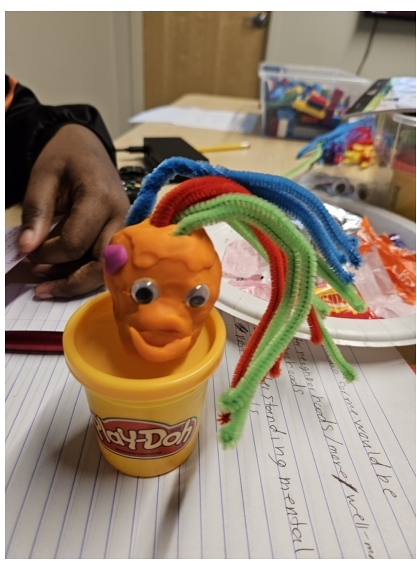
Classroom support. Students envisioned technology solutions addressing daily classroom challenges. One group in Workshop 1 proposed a “gender affirmation” robot where a student could “select what kind of affirmation that you want, whether it be masculine, feminine, or neither, and he spits them out of his mouth.” The students explained this support would be especially helpful for transgender students like them. Both had mentioned misgendering as a problem with their current school, even from teachers who were otherwise supportive. The students recognized this could be simply the limits of memory, but also, one pointed out, likely stemmed from educator assumptions based on students’ appearance or administrative gender designation. In the case of their future technology, students maintained control over their self-identification. The robot could provide perfect memory storage unbiased by faulty normative assumptions about students’ gender presentations. A student in Workshop 2 addressed a similar problem with "a smart implant under the skin in the left temple... beneficial for people with memory issues" (Figure 1). Another proposed robot from Workshop 1 was described as "like a mother... because [school] is personal sometimes... she's rooting for you." In these cases, students expressed their longing for deeply personal and affective connections within their schools through robotic means.
Curricular support. Many students shared their thoughts on how future educational technology could empower students’ curricular decisions. One group described a learning platform that provided “student authority so you can choose your own classes and implement them yourself.” That same group advocated for more flexible engagement with virtual classrooms: “There should be a way to implement a recording of the discussion happening in class... for things like labs, it would be really nice to be able to do them in person or not just have a video of it, to watch it and explain it.” Another group noted the need for accommodating different learning styles and that hologram-based technology could be an opportunity to visualize information necessary for assignments. As the students contrasted with their current learning practices, “You don't have to YouTube anything or go on Google and try to get pictures, you'll get your own experience.”
Community support. Many students did not shy away from the idea that the educational experience is embedded in broader communities. Students from Workshop 2 proposed a community information board, a virtual touchscreen in every single school that would present community information in a multi-modal fashion. The board would share neighborhood events and would allow students to learn and be “taught about community more.” As one student said, “There's the info section. And then the sections that help people get help, get immersed in their community...and learn more because inherently by being involved in your community, you are learning about your community.”
Taken together, students sought flexibility, care, support, and a context-driven technological environment that responded to their particular desires. This customizability and support-centered environment often seemed at odds with other design futures that students articulated that centered efficiency and immediacy.
4.3.2 Efficient Design Futures. What we call “efficient design futures” were those designs envisioned by participants that best reflected the schooling described in 4.2. This includes self-pacing, on demand knowledge, curriculum aligned to specific milestones, and wanting more a transactional relationship with teachers. Students wanted technology-mediated teaching and correct information available at the blink of an eye. We see these design futures as frequently at odds with those presented in 4.3.1.
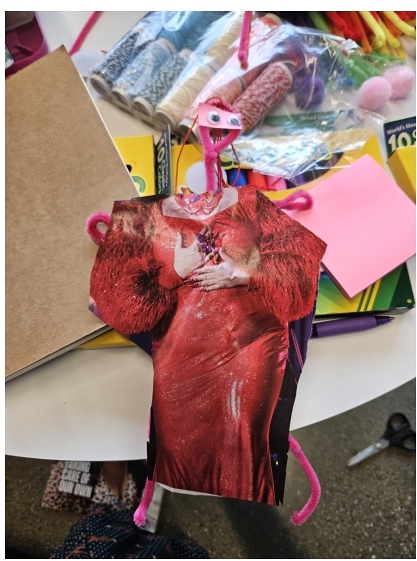
Replacement. Many designs focused on the often fraught relationship between students and teachers. There were multiple workshops where students proposed the complete replacement of a human teacher by a robot that had the correct knowledge at all times, knew exactly students’ needs and desires, and were often subservient to students. As one group from Workshop 1 described (see Figure 2): “These are our Fembot teachers. They're completely AI from their head down to their toes... instead of a teacher telling you to look it up or find the answer in a book, she'll help you look it up and get you the answer faster.” They went on to describe how she (the teacher robots were almost universally female-gendered) would, “not be overbearing...[or] get in your personal space. The Fembot will not be disrespectful and it would just be there for assistance.” As students in another workshop described their own teaching robot, “It knows like everything...[if] you have a question, it breaks it down for you and you learn from this robot...it'll do its lesson and then if you don't understand the lesson right away, raise your hand and she'll be there. Or he.” One can clearly see students’ aforementioned frustrations with teachers’ limited knowledge and intrusiveness serve as inspiration for these designs.
Immediate. Related to pace, speed, and on-demand knowledge, many of the design futures embodied the desire for immediacy in educational relationships. We heard repeated variations of “she knows everything,” referring to the robots that would deliver all information students needed. One student group proposed a hologram-based technology that embedded in a remote that could be carried around to present lessons or respond to questions whenever students wanted: “[It] gives you good sources. So you're not getting stuff from like...a bad source.” This student contrasted the robot with the ways students often felt like teachers ignored them or did not appropriately answer their questions. The students who proposed the Fembot also talked about how she would be faster at grading and would not question what type of classes they needed to take. This was in reference to issues students had with administrators requiring classes that they believed they already completed.
Many characteristics of future technology were motivated by a particular grievance with their current or recent educational environment. Students want to replace teachers because they are not seen as providing the right type of knowledge. Students want information immediately because many of them have been pushed, often for structural reasons, to view education as a process of checking boxes off so they can graduate.
4.3.3 Tensions in Design Futures. Students often envisioned design futures that embodied BOTH a desire for a holistic, responsive and caring education and key elements of efficiency. While these are often antithetical to each other, here we want to present ideas that reflected both desires in a way we found illuminating. These designs were often presented as a way to augment student-teacher relationships, rather than to replace them; to address teacher capacity; and to provide care and immediate knowledge.
Above, we highlighted a mobile, hand-held hologram-based technology that would provide on-demand information. The students described this design as having the ability to “give you some type of feedback without needing to call for a teacher who is busy.” They went on to describe cases where there might be a lot of students in a hybrid school situation, “Teachers are busy...I feel like this would be like another stand in just for that, just in case somebody needs a little more time with something.” Rather than fully replacing a teacher, students sought to augment the capabilities of a teacher while also facilitating immediate responsiveness.

In 4.3.1, we described a robot students proposed would care for them “like a mother," imbuing a personal sense into the classroom. These same students went on to describe that support was not only for emotional care, but also answering students’ questions. As they describe, “Because Google don't really explain to you where they get the answer from or how they get it...a teacher is more explanatory...it helps you understand more." In bringing together the care that a student would typically receive from a perceived female figure with the explanatory, knowledge-based power of a teacher, the students in this case sought to bridge the tension highlighted above through technology that embodied support, care, and a less transactional approach to knowledge and learning.
In another example, after discussing repeated problems with misgendering, students proposed an administrative system that would display chosen names and pronouns appropriately to staff while preserving a technical back-end that mapped these to legal names. This solution acknowledged both the need for affirming student identities and the bureaucratic realities of school record systems. Such designs reveal how students use imagined technologies to navigate tensions between personal needs and institutional constraints.
The designs that embodied the tensions central to our findings were less commonplace in our workshops than those designs that fell solidly in one camp or the other. We do not see this as a limitation of this finding, but rather an opportunity for future research and engagement.
Our findings confirm the tension from the literature between how education is delivered via digital platforms that promote surveillance and data-driven relationships, and the care and personal connection that are perceived as more common in traditional classroom settings, which teachers and students must navigate [29, 41, 46], providing a more in-depth understanding of the roles students understand schools to fulfill. This included, in 4.1, a desire for a more holistic, loving, and caring relationship with school. Yet in 4.2 we highlight desires for efficiency through self-pacing, on demand knowledge, and a more transactional nature of school to get students out the door with their credentials as quickly as possible. Section 4.3 identifies how different desires for schooling are embodied in the design futures of the students, providing more complexity as to how the purpose of school is situated within a hybrid classroom environment. These designs signal opportunity for future technologies that respect students’ desires for diverse care and support mechanisms.
5 Discussion
Is daydreaming anathema to current forms of schooling, as one educator participant suggested? As described in the Introduction, public schooling in the U.S. has faced conflicting demands as long as it has existed. Education is simultaneously asked to develop students into people with the capacity to be engaged citizens in democracy, to train students for differentiated roles in the workforce, to provide all students an opportunity to improve their social standing and thus decrease social inequality and eliminate poverty, and to facilitate human development and support all children in their human right of learning and pursuing meaningful lives and relationships [38, 42, 81, 82]. Hybrid schools inherit these tensions. While the underlying curricula within schools may seek to support multiple goals in response to policy imperatives, the emphasis within the platform architecture that most students in this study experienced boils down to an "efficiency orientation" [2, 4] reflecting acquisition of individual credentials. Conversations such as that described in 4.2.4 about colonialism, in which Kira attempted to enact her vision to "learn about the world around me," are ultimately squeezed out of a school structure that cannot effectively recognize moves towards democratic equality that occur outside of the online platform structure.
In hybrid schools, teachers sometimes work to fill these gaps in offline practices, for example by providing students the embodied care to help them thrive through food, transportation, and expressions of affirmation that contribute to both holistic human development and social welfare. Students often recognize the importance of that role and rebel when educators fail to live up to it, complaining when teachers "treat us like we have no rights," or fail to intervene around "disrespectful" conduct. Having identified the supremacy of their technology in organizing their schooling experience and its usefulness in meeting efficiency goals, students imagine expanding technical solutions to also help fulfill nurturing roles.
In what follows, we first turn to a continued discussion of the design tensions that arose in our workshops as a source of inspiration for future work. We then discuss how hybrid schools are a key place to understand what the future of school might look like and why they matter for CSCW and related fields.
5.1 Design Tensions as Inspiration for Future Schools
In the Findings, we articulate the tension between personal care and affirmation desired by students in hybrid educational settings with the structure of an educational experience that is seamless, self-paced, and on-demand. We see this tension as inherent to the nature of educational technologies and digital platforms as they currently exist. Virtual and hybrid schools are promoted as allowing for increased freedom [18, 51], so it should be no surprise that students internalize this value and that it comes out so vividly in their design futures. The platforms that enable this type of education are simultaneously critiqued as tools of surveillance and standardization [41, 88] that threaten to remove creativity and care from the educational process [2, 57]. In response, many scholars in HCI have advocated for intentionally foregrounding caring relationships and teacher agency in the design of education technology [4, 29, 34, 46] - which is also what we initially intended for this project. Yet sometimes, what students want from technology is mostly to get away from the more negative aspects of relationships.
The tension that we identify between care and efficiency may appear contradictory, as students’ desire for self-pacing, on-demand knowledge, and seamless experiences could themselves be understood as a form of care-seeking. However, what distinguishes these efficiency-oriented desires from the more relational care that we describe in 4.1 is their fundamentally transactional nature. When students envision robot teachers who provide immediate answers without judgment, or design systems that eliminate the need for human interaction entirely, they are seeking support that removes the complexities, inconsistencies, and emotions that are so foundational to human relationships. This is very different than the type of care that is affirming, understanding, and deeply human - what sociologist Pugh names “connective labor” [60, 61]. Students’ simultaneous desire for both reflects their embeddedness in educational systems that promise individual advancement through credentials while also seeking to provide community and personal development. The hybrid school environment intensifies these contradictions by making the transactional nature of education more visible through digital platforms while still positioning teachers as figures of care.
Students are wise to the “efficiency orientation” described by Chang et al. [4] that permeates their entire educational infrastructure. Those who turn to hybrid education have generally already chosen to use technology to pursue a more transactional road to completion. While they may crave emotional support, structures that facilitate their well-being, and in-depth learning experiences, they also are looking for strategies that will help them succeed within the world as it exists. As Harrington et al. [26] have found, “students have a difficult time imagining a future without the existing social issues they face today.” While futures workshops and other speculative and participatory methods attempt to circumvent the limitations of systemic power structures to encourage broader agency and imagination [4], students’ navigation of these tensions in their designs can be instructive. The hologram-based educational technology envisioned by students would provide immediate information while acknowledging teacher limitations, allowing teachers to focus on students who needed more personalized attention. This design recognized both the desire for on-demand knowledge and the reality of limited human resources.
We see opportunity here to explore what the future of technologies might look like that bring together multiple purposes of schooling. Students frequently recognized the complex context and resource constraints their teachers operated under. They used their imagination of future technologies to reconcile the human limitations of teachers — their need for bathroom breaks, their inability to be multiple places at once, the extended time they need to grade homework, their fallible memories — with their desire for a more rapid-paced learning environment. Having faced bias and hostility from teachers, students envisioned robotic forms that could surpass individual flaws.
Thus, robots served the function of displacing tensions around power and control in the classroom. Designs like the Fembot “mother" sought to combine the emotional support students craved with the knowledge-based capabilities they needed for academic success. In other cases, as exemplified by those designs that were intended as largely a mechanism for replacing human teachers, robots took up a role of deferential service that provided a comforting contrast to the surveillance and control exerted by some teachers. By placing a robot in this submissive posture, students could express longing without objectifying their actual teachers, using imagined technologies to sidestep conflict.
We see great opportunity for future work that can explore these tensions in a more intentional way. Jonas [29] and Lu et al. [46] have explored the ways that teachers attempt to imbue care into seemingly care-less, data-driven learning platforms. Future work should more directly introduce these tensions to students and ask them how digital technology and educational platforms can be better designed to respond to competing priorities. For now, we propose two high-level design principles, rather than specific interventions, as our Findings present many different design possibilities. First, educational technologies should aim to acknowledge structural constraints. Designs should make visible and work within the real limitations of educational structures rather than assuming limitless capacity. This addresses the tensions of teacher and student bandwidth vs. student need for support, and interest in learning and personalization of system vs. scale. Second, platforms can serve to mediate power dynamics. Technology can be designed as a buffer against structural inequalities that allows student agency without requiring direct confrontation. As Crooks [9] and Star and Strauss [73] illustrate, digitization can preserve student and educator autonomy within regimes of institutional control by placing some power to determine what “counts” with distributed users rather than centralized administrators. In practice, this could look like creating intermediary spaces for negotiation between students and teachers, allowing customization of interaction styles, and building in privacy preserving feedback mechanisms. These principles push us to design for the coexistence of competing needs rather than necessitating the resolution of contradictions that might otherwise help us better understand both schooling and technology.
5.2 Hybrid Schools as a Key Site of Learning about the Future of Schools
Virtual schooling has been sharply critiqued in both its pre-pandemic and emergency remote forms, particularly for the tendency to use online platforms to provide sub-par educational pathways for groups of students subjected to systemic oppression [32, 33, 53, 57, 64, 67]. Scholars also describe how the broad uptake of digital technologies in traditional schools results in both opportunities and concerning trends towards surveillance, automation, and privatization [2, 21, 40, 41, 88]. Less recognized has been the trend towards combining virtual school platforms with in-person attendance supervised by teachers, a “hybrid” school format. These hybrid schools exist to provide alternative educational venues for students who are marginalized out of traditional brick-and-mortar settings and do not want to, are not allowed to, or cannot attend fully virtual school. Although students may have limited educational options, these sites are notable in that students have actively chosen this hybrid setting in contrast to their default public schools and in that these schools are largely under the governance of public school districts. Students like Maryanne, from the introduction of the paper, arrive at hybrid alternative schools in order to salvage their hopes of graduating and maintaining a trajectory of social mobility and professional possibility. Thus, these settings foreground negotiation of student needs and desires, state mandates, and severe resource limitations under conditions of relative austerity.
In the context of alternative schooling endeavors, technology may blend into the background as a mundane aspect of daily life, but digital platforms have here already become a - if not *the* - primary tool for managing tensions around educational purpose. Teachers in these environments play dual roles of caring for their students as whole people primarily through in-person, material practices like affirming conversations or providing meals and rides, and shepherding them towards efficient completion of their online responsibilities. To some extent, students adopt this differentiation, imagining technologies that can better help them achieve their goal of graduation efficiently. Yet students also imagine a future in which this dichotomy is complicated, where technology also plays a role in meeting their human needs in ways human teachers have not always done for them.
Participants in these settings are thus uniquely positioned to consider the role of digital technologies in future schools. There are elements of hybrid schools that are becoming increasingly common in all schools (i.e., platform-based learning, variances in pace/speed of learning, digital monitoring and documentation) [2, 9, 21, 41, 57]. Students in hybrid schools have empirical experience with the realities of relying on digital technologies, and can thus speak from a grounded and realistic position about how digital technologies might function, even in their fantasies of utopian and dystopian schooling.
Further, we see the triangulation of love and affirmation with customizability, convenience, and freedom as particularly foregrounded in hybrid settings. Students desire a caring environment that responds to their well-being, provides emotional support, and helps facilitate in-depth learning. Yet, they also desire an environment that empowers them individually in their own capacity, is centered around their desired pace, allows for more transparency, and provides the knowledge and information they need when they need it without interference. For many of those in this study, the best way for them to access these goals was through hybrid schools. There is an argument to be made about each of these elements, and whether they are net-negatives or net-positives for the future of schooling. For example, many educators would argue that on-demand answers to any and all questions without going through a process of discovery and understanding is antithetical to the purpose of schooling, whether to develop citizens or prepare workers. Yet, these desired technologically-enabled educational futures need to be negotiated and understood given existing social pressures in order for us to envision and develop alternatives.
We see hybrid schools as a key site of understanding what an increasingly digitally-mediated learning experience looks like, what it's outcomes are, what this means for the design of digital schooling platforms, and how we imbue the future of learning with care while also making it useful for students’ administrative goals.
6 Conclusion
In this paper, we have presented findings from an ethnographic and design research study that uses participatory future workshops alongside in-depth interviews and classroom observations to understand the core elements, (inter)personal motivations, and structural mechanisms that shape the design futures created by students attending hybrid schools. We found that these students imagine an ideal hybrid learning environment as one which addresses multiple purposes of schooling at once. A focus on efficiency stood out as the most important element for students in creating an ideal hybrid learning environment and as the primary source of inspiration for their educational technology designs. We outline the tensions their designs illuminate between desires to complete high-school requirements and a need for other kinds of support and learning. We encourage leaning into the tensions by building recognition of structural constraints and mediation of power dynamics into educational platforms, arguing that hybrid schools are a key site of examining knowledge production and technological innovation for the future of school systems.
The students involved in these workshops were largely pragmatic. They were skeptical of major change coming to their educational system and of the potential of technology to be used to their benefit. Many were initially more interested in venting their current frustrations than in considering what it might look like to use technologies to make their schooling dreams come true. To play on the common phrase, ‘I do not dream of labor,’ [7] these students by and large do not dream of school - it is simply an immovable requirement of their lives. Yet as they began to experiment with designing, they allowed some of their cynicism to loosen. In these moments, we can begin to see them grappling with the crucial things we might hope school could provide, like community and learning, and those things they have been taught that schools value, like efficiency. Designers and researchers of educational technologies should follow suit.
