Demonstration of MorphoChrome: Real-time, Handheld Fabrication of Programmable Structural Color
DOI: https://doi.org/10.1145/3774746.3779256
SCF Adjunct '25: ACM Symposium on Computational Fabrication, Cambridge, MA, USA, November 2025
Structural color–color produced by light reflecting nanostructures rather than pigment–is nature's iridescent color palette. In this demo, we present MorphoChrome, a handheld optical device for programmable, real-time, structural color fabrication. Analogous to painting with light, MorphoChrome creates multicolor designs and color-mixing by exposing a commercially available holographic photopolymer film to user-controlled RGB wavelengths, thereby producing reflective nanostructures. We also introduce a resin-based process to integrate the structurally colored film with flexible and rigid objects.
ACM Reference Format:
Paris G Myers, Yunyi Zhu, Ben Miller, and Stefanie Mueller. 2025. Demonstration of MorphoChrome: Real-time, Handheld Fabrication of Programmable Structural Color. In ACM Symposium on Computational Fabrication (SCF Adjunct '25), November 20--21, 2025, Cambridge, MA, USA. ACM, New York, NY, USA 3 Pages. https://doi.org/10.1145/3774746.3779256
1 Introduction

In nature, structural color is created through visible light's interaction with nanostructures, materializing radiant iridescent or diffuse color. Pigments fade, but structural color remains stable, iridescent, and bright over time, displaying different colors depending on one's angle of vision. Recent advances in programmable color fabrication processes demonstrate the value and possibility of dynamic, color-changing displays [Zhu et al. 2024], animations [Sethapakdi et al. 2024], and physical object appearance [Jin et al. 2019; Miller et al. 2022]. However, due to its physical complexity, creative fabrication with structural color has historically been limited to using existing natural materials, such as select shells, feathers, or gemstones. Interdisciplinary scientists have created structurally colored pigments and metamaterials, but these methods require advanced chemical and material complexity, limiting access to select individuals and laboratories. [Kolle and Steiner 2012; McDougal et al. 2019]
Within HCI, handheld color-changing systems have largely relied on programmable pigments and dyes activated by light, heat, or magnetic fields to create adaptive interfaces for artistic and functional applications [Hashimoto et al. 2013; Jin et al. 2019; Sethapakdi et al. 2024; Zhu et al. 2024]. However, these pigment-based methods produce only diffuse color, can fade over time, and often require long exposure periods. True structural color fabrication remains largely underexplored within the programmable color space. In M and M: Molding and Melting Method Using a Replica Diffraction Grating Film and a Laser for Decorating Chocolate with Structural Color [Yamada 2022], they achieved structural color through diffraction gratings, while in Scalable Optical Manufacture of Dynamic Structural Color in Stretchable Materials [Miller et al. 2022] they applied the physics of Lippmann photography [Lippmann 1891] to holographic film with an RGB projector to form photonic nanostructures for flexible use-cases. However, both manufacturing-based fabrication approaches do not allow the user to real-time, hand-construct their own design on the film–they are limited to pre-formulated images.
In this demo, we present MorphoChrome, a real-time, handheld fabrication process for iridescent structural color, allowing real-time creative, personal fabrication with iridescent structural color. There are fabrication benefits to our system: 1) There is no pre-loading or programming of the image eliminating the need for digital interference and allowing direct making, 2) the process is multicolor (red, green, blue), allowing the user to control it based on color selection, 3) we use commercially available materials, thereby eliminating the need for any special chemical or material synthesis, 4) we developed a resin-based process for adhering the film to create iridescent objects.
MorphoChrome is an optical device and resin adhering process for creative fabrication of structural color for both flexible and rigid object applications. MorphoChrome provides a hand-controlled process that allows for real-time creative designs, color-selection, and switching out of aperture tips for different marks. Additionally, MorphoChrome requires no laboratory equipment or advanced chemical synthesis.
In summary, MorphoChrome contributes:
- An optical device design and fabrication pipeline that uses compact laser diodes instead of a LED projector, allowing for real-time color control and saturation of the film.
- A GUI for RGB color selection and iridescent preview.
- Resin-based curing methods with handheld UV light for rapid adherence and curing of the film to diverse objects.
2 MorphoChrome
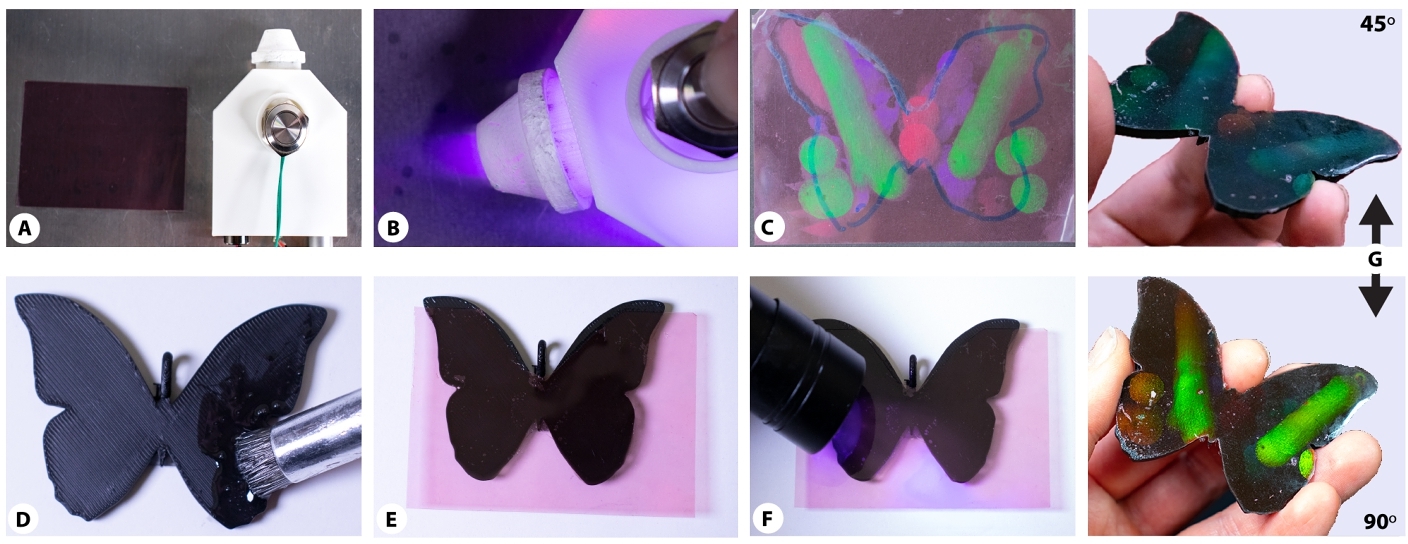
MorphoChrome is a handheld, multicolor optical device for real-time fabrication of programmable structural color. To create designs with MorphoChrome, the user freely draws with its emitted light beam, exposing the holographic photopolymer film canvas underneath, and switching colors as needed using the provided python UI. In Figure 1, MorphoChrome is utilized by a user to draw a color-changing butterfly design, and transferred to a 3D-printed necklace pendant using our simple resin process 1. When in use, MorphoChrome exposes the photopolymer film to controlled, calibrated combinations of red (635 nm), green (532 nm), and blue (450 nm) laser diode light, forming reflective nanostructures that produce iridescent structural color. Fabricating with MorphoChrome results in dynamic, angle-dependent iridescent structurally colored designs with vibrant hue and easy transferability to rigid or flexible objects and surfaces.
MorphoChrome consists of three integrated components: a handheld optical device that mixes RGB laser light real-time; a Python-based user interface for color selection and preview; and a holographic photopolymer film adhered to a reflective backing that serves as the color-recording “canvas.” By adjusting color intensities in real time, users can create and modulate structurally colored brushstrokes directly by hand, enabling fabrication workflows that integrate with other 2D and 3D objects.
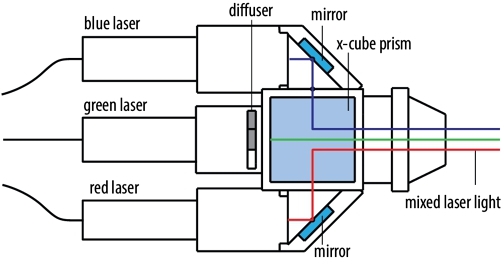
The handheld optical device combines three low-power laser diodes—red (635 nm), green (532 nm), and blue (450 nm)—within a compact housing that merges their beams through an X-cube prism. Unlike LED projection or pigment-based systems, MorphoChrome uses coherent light to achieve precise, wavelength-specific exposure of the photopolymer film, eliminating the need for optical filters. The coherent mixing of these lasers enables the creation of a full RGB color gamut through direct optical interference, generating structural rather than chemical color. Each laser's intensity is digitally controlled through pulse-width modulation (PWM), allowing fine-grained adjustment of power and color balance. The user interface translates on-screen RGB selections into real-time modulation of the three diodes to produce the desired hue. For instance, selecting magenta increases the red and blue laser output while reducing green. This digital–optical feedback loop enables continuous, brush-like color variation without interrupting the drawing process.
MorphoChrome's device body is 3D-printed in lightweight PLA, and houses all optics, electronics, and power within its single compact shell, minimizing weight and complexity, as seen in image a of Figure 1. Color mixing occurs within the X-cube prism, as the cube's dichroic coatings selectively reflect and transmit each primary color, combining three laser inputs into a single mixed beam, as shown in Figure 3. A single USB-C cable supplies both data and power, allowing operation directly from a laptop. The laser diodes operate at low power, no ventilation or active cooling is required. MorphoChrome's output tip aperture is modular, with easy customization of 3D-printed tips that diversely shape and focus the emitted light.
MorphoChrome encodes color directly into a holographic photopolymer film by forming nanoscale refractive layers with visible light, as shown in Figure 2. The film is adhered to a reflective metal backing, creating a standing wave of incident and reflected light that induces periodic refractive index variations within the polymer matrix. These layered structures act as Bragg reflectors, selectively reflecting specific wavelengths to produce visible color. After exposure, the film exhibits iridescence: its color shifts predictably with viewing angle due to angular-dependent Bragg diffraction. Red light shifts toward green, green to blue, and blue toward ultraviolet as the observation angle increases. Overall, with MorphoChrome, we introduce a new handheld fabrication process for the vibrant, unfading color space of programmable structural color.
References
- Sunao Hashimoto, Ryohei Suzuki, Youichi Kamiyama, Masahiko Inami, and Takeo Igarashi. 2013. LightCloth: senseable illuminating optical fiber cloth for creating interactive surfaces. In Proceedings of the SIGCHI Conference on Human Factors in Computing Systems (Paris, France) (CHI ’13). Association for Computing Machinery, New York, NY, USA, 603–606. https://doi.org/10.1145/2470654.2470739
- Yuhua Jin, Isabel Qamar, Michael Wessely, Aradhana Adhikari, Katarina Bulovic, Parinya Punpongsanon, and Stefanie Mueller. 2019. Photo-Chromeleon: Re-Programmable Multi-Color Textures Using Photochromic Dyes. In Proceedings of the 32nd Annual ACM Symposium on User Interface Software and Technology (New Orleans, LA, USA) (UIST ’19). Association for Computing Machinery, New York, NY, USA, 701–712. https://doi.org/10.1145/3332165.3347905
- Mathias Kolle and Ullrich Steiner. 2012. Structural Color in Animals. Springer Netherlands, Dordrecht, 2514–2527. https://doi.org/10.1007/978-90-481-9751-4384
- Gabriel Lippmann. 1891. La photographie des couleurs. Comptes Rendus de l'Académie des Sciences 112 (1891), 274–275. https://gallica.bnf.fr/ark:/12148/bpt6k3063w/f350.item
- Anthony McDougal, Benjamin Miller, Meera Singh, and Mathias Kolle. 2019. Biological growth and synthetic fabrication of structurally colored materials. Journal of Optics 21, 7 (jun 2019), 073001. https://doi.org/10.1088/2040-8986/aaff39
- Benjamin Harvey Miller, Helen Liu, and Mathias Kolle. 2022. Scalable optical manufacture of dynamic structural colour in stretchable materials. Nature Materials 21, 9 (2022), 1014–1018. https://doi.org/10.1038/s41563-022-01318-x
- Ticha Sethapakdi, Paris Myers, Tianyu Yu, Juliana Covarrubias, Mackenzie Leake, and Stefanie Mueller. 2024. Thermochromorph: Dynamic Relief Printing with Thermochromic Inks. In SIGGRAPH Asia 2024 Art Papers(SA ’24). Association for Computing Machinery, New York, NY, USA, Article 11, 7 pages. https://doi.org/10.1145/3680530.3695445
- Wataru Yamada. 2022. M&M: Molding and Melting Method Using a Replica Diffraction Grating Film and a Laser for Decorating Chocolate with Structural Color. In Adjunct Proceedings of the 35th Annual ACM Symposium on User Interface Software and Technology (Bend, OR, USA) (UIST ’22 Adjunct). Association for Computing Machinery, New York, NY, USA, Article 67, 3 pages. https://doi.org/10.1145/3526114.3558642
- Yunyi Zhu, Cedric Honnet, Yixiao Kang, Junyi Zhu, Angelina J. Zheng, Kyle Heinz, Grace Tang, Luca Musk, Michael Wessely, and Stefanie Mueller. 2024. PortaChrome: A Portable Contact Light Source for Integrated Re-Programmable Multi-Color Textures. In Proceedings of the 37th Annual ACM Symposium on User Interface Software and Technology (UIST ’24). https://hcie.csail.mit.edu/research/portachrome/portachrome.html
Permission to make digital or hard copies of part or all of this work for personal or classroom use is granted without fee provided that copies are not made or distributed for profit or commercial advantage and that copies bear this notice and the full citation on the first page. Copyrights for third-party components of this work must be honored. For all other uses, contact the owner/author(s).
SCF Adjunct '25, Cambridge, MA, USA
© 2025 Copyright held by the owner/author(s).
ACM ISBN 979-8-4007-2295-0/25/11.
DOI: https://doi.org/10.1145/3774746.3779256