ZibraGDS: Cinematic-Quality Animated Geometry Compression and Real-Time Playback
DOI: https://doi.org/10.1145/3799821.3820910
SIGGRAPH Real-Time Live! '26: Special Interest Group on Computer Graphics and Interactive Techniques Conference Real-Time Live!, Los Angeles, CA, USA, July 2026
ZibraGDS (Geometry Data Structure) is a high-performance, GPU-friendly, multi-attribute geometry data compression, decompression, and rendering technology, designed to bring cinematic-quality FX and animations to real time. It delivers up to 92% reduction in data size and at least 5–10x faster rendering than existing solutions. It can handle millions of polygons at a real-time frame rate, and up to thousands of frames per sequence. As offline and real-time industries continue to converge, more and more artists adopt real-time platforms for their creative process, yet many of the most popular FX elements, such as fluids and destruction, require extremely high geometry resolution to be visually convincing. Long iteration times and pipeline fragility are common frustrations. The core idea of ZibraGDS is to provide a simple, reliable solution by alleviating GPU streaming bottlenecks and enhancing GPU utilization to deliver efficient, fully parallel rendering of animated FX mesh sequences at levels of fidelity previously not possible.
ACM Reference Format:
Oleksandr Petrenko, Oleksandr Puchka, Oleksandr Klimenko, Mykhailo Moroz, Dmytro Bulatov, Mai Ao, Denys Maletkyi, and Oleksandr Havrylenko. 2026. ZibraGDS: Cinematic-Quality Animated Geometry Compression and Real-Time Playback. In Special Interest Group on Computer Graphics and Interactive Techniques Conference Real-Time Live! (SIGGRAPH Real-Time Live! '26), July 19--23, 2026, Los Angeles, CA, USA. ACM, New York, NY, USA 2 Pages. https://doi.org/10.1145/3799821.3820910
1 High-Resolution Animated Geometry Compression
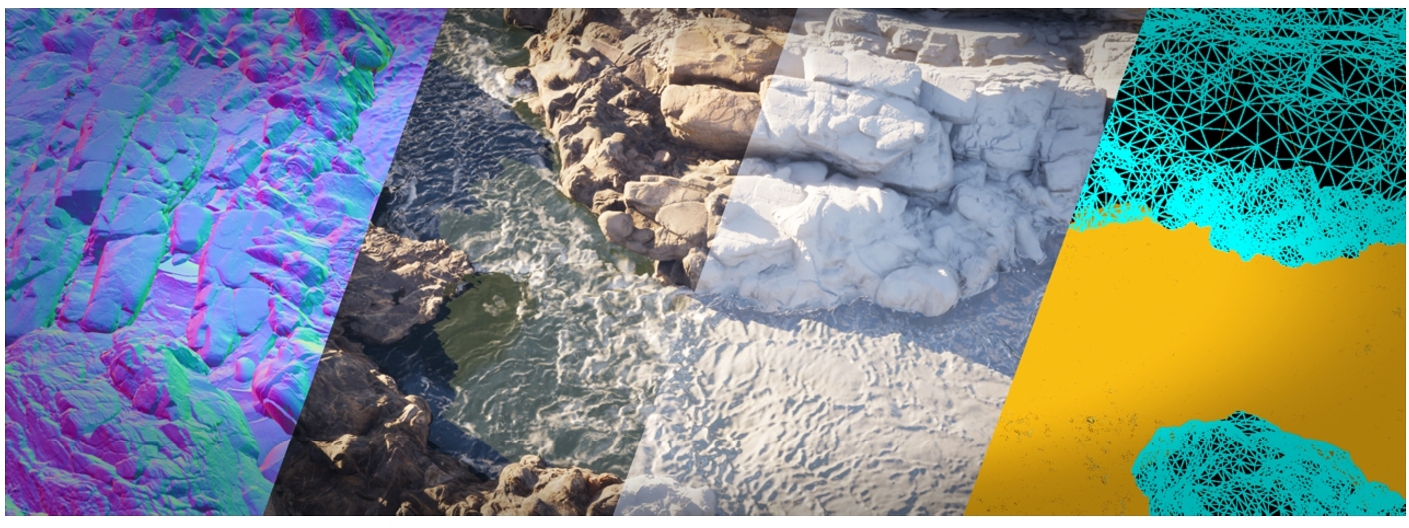
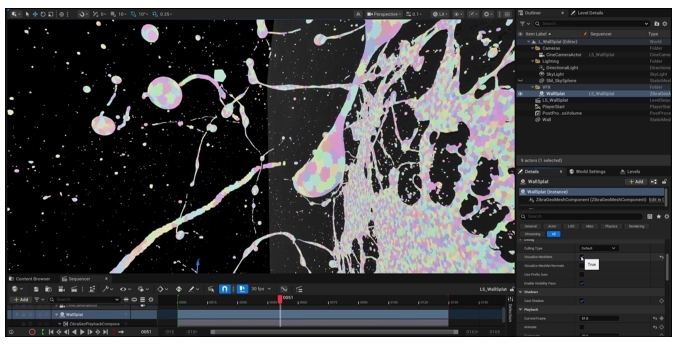
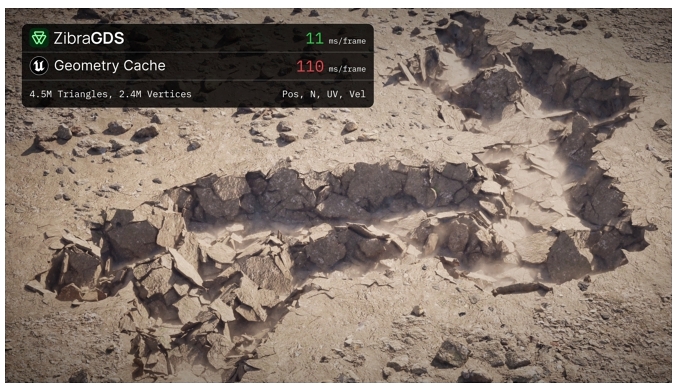
Efficient representation and storage of high-resolution geometry are an increasingly relevant concern for real-time computer graphics. In high-end productions, FX sequences can well exceed 100 GB in their source formats. Unreal Engine's Nanite Virtualized Geometry [Karis et al. 2021] has been a celebrated advancement of real-time geometry rendering, which largely removes the traditional limits on mesh resolutions feasible in a game engine. While Nanite and similar technologies provide answers to static meshes and animated skeletal meshes, there remain unsolved challenges in the real-time VFX space. In 2024, Zibra AI presented ZibraVDB, a solution to drastically compress volumetric data and efficiently decompress and render them at runtime [Petrenko et al. 2024]. ZibraGDS is a continuation of this idea but applied to animated mesh sequences, such as fluids (Figs. 1 and 2), destruction (Fig. 3), and even 3D motion graphics. However, mesh compression is in many ways more challenging than volume compression. Our solution delivers lossless compression of topology, combined with efficient lossy compression of other attributes: positions, normals, UVs, vertex colors, velocities, etc. We developed a new approach that heavily relies on mesh shaders. ZibraGDS subdivides mesh into meshlets (Fig. 2) during compression, and later at runtime, performs decompression in both the amplification and mesh shader stages, allowing fully parallel rendering of animated sequences with millions of polygons per frame. To ensure compatibility with platforms that do not support mesh shaders, we also created an alternative approach that relies only on compute shaders. Overall, our compression can achieve 80–92% reduction in data size depending on the characteristics of the input mesh sequence. It is also at least 3–4x faster to import the same assets compared to existing techniques.
2 High-Performance Runtime Decompression and Rendering
In real-time rendering, meshes often require more render passes than volumes. Consequently, if a high-resolution mesh sequence is impacting performance, such an impact will be compounded multiple times per frame. With ZibraGDS, we tackle this problem by meaningfully improving both streaming efficiency and rendering efficiency. For streaming, depending on the asset size, memory budget, and the FPS target, artists can choose to keep the entire compressed sequence on the GPU, stream compressed frames from RAM, or stream compressed frames from disk. In every scenario, compression plays a critical role in alleviating CPU-to-GPU data bottlenecks and allowing artists to use higher-quality assets. For rendering, the sequence is decompressed one frame at a time. For each frame, the meshlets generated during compression (Fig. 2) allow us to efficiently cull parts of the mesh not visible from the main view during the visibility pass. Overall, our rendering, including decompression, can be at least 5–10x faster than existing techniques. The output data from our decompression can be easily integrated into any target engine's native lighting, rendering, and material pipelines. Currently in Unreal Engine, we already support Lumen, ray tracing, path tracing, ray traced shadows, virtual shadow maps, Substrate materials, and more.
3 Cinematic and Real-Time Production Impacts
Apart from reducing storage and time costs, ZibraGDS's unprecedented resolution ceiling gives artists more freedom to create and bring to life stunning real-time VFX previously restricted to offline rendering. Its capability to handle a robust range of asset resolutions, from low to extremely high, means artists can have a painless, unified workflow. ZibraGDS can also work seamlessly with ZibraVDB (Fig. 3), allowing artists to author complex, two-way coupled physical simulations involving volumes and meshes, and combine the effects effortlessly in a real-time scene. As a next step, we will continue to advance our geometry compression to solve other issues artists are facing, such as working with large point clouds, hair grooms, and potentially Gaussian splats.
References
- Brian Karis, Rune Stubbe, and Graham Wihlidal. 2021. A Deep Dive into Nanite Virtualized Geometry. In ACM SIGGRAPH 2021 Courses(SIGGRAPH ’21). Association for Computing Machinery, New York, NY, USA. https://advances.realtimerendering.com/s2021/Karis_Nanite_SIGGRAPH_Advances_2021_final.pdf
- Oleksandr Petrenko, Oleksandr Puchka, and Oleksandr Klimenko. 2024. Revolutionizing VFX Production with Real-Time Volumetric Effects. In ACM SIGGRAPH 2024 Real-Time Live!(SIGGRAPH ’24). Association for Computing Machinery, New York, NY, USA. https://doi.org/10.1145/3641520.3665311

This work is licensed under a Creative Commons Attribution 4.0 International License.
SIGGRAPH Real-Time Live! '26, Los Angeles, CA, USA
© 2026 Copyright held by the owner/author(s).
ACM ISBN 979-8-4007-2544-9/26/07.
DOI: https://doi.org/10.1145/3799821.3820910